World Heritage Identification Number: 1447
World Heritage since: 2014
Category: Cultural Heritage
WHE Type: Religious Sites & Sacred Architecture
Transboundary Heritage: No
Endangered Heritage: No
Country: 🇩🇪 Germany
Continent: Europe
UNESCO World Region: Europe and North America
Map
The Carolingian Westwork and Civitas Corvey: A Unique Expression of Power and Faith
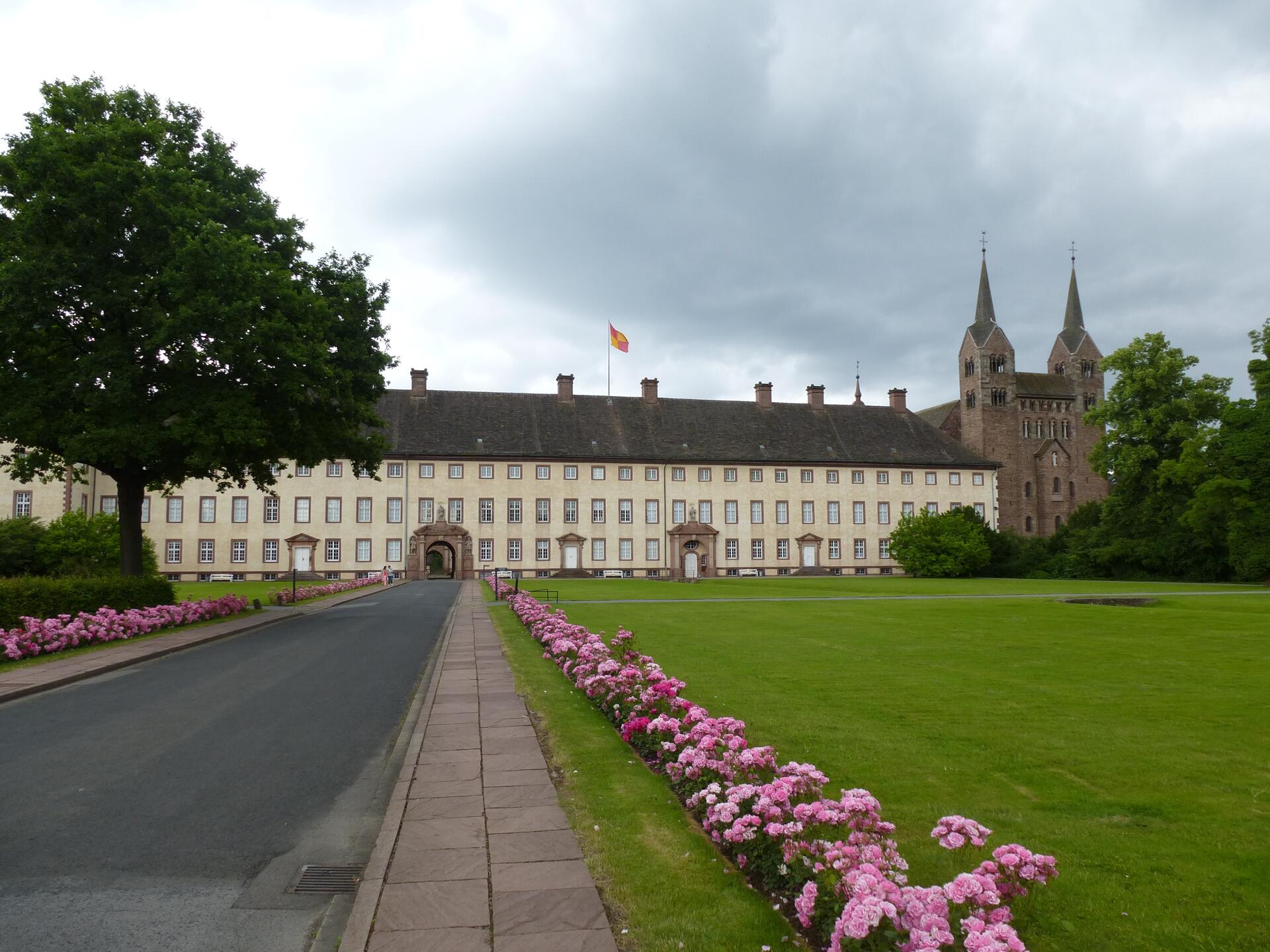
The Carolingian Westwork and Civitas Corvey, inscribed as a UNESCO World Heritage Site in 2014, stand as a testament to the power, faith, and architectural prowess of the Carolingian dynasty. Located along the Weser River on the outskirts of Höxter, Germany, these structures offer a glimpse into the political, religious, and cultural landscape of the Early Middle Ages.
More to come…UNESCO Description of the World Heritage Site
The site is located along the Weser River on the outskirts of Höxter where the Carolingian Westwork and Civitas Corvey were erected between AD 822 and 885 in a largely preserved rural setting. The Westwork is the only standing structure that dates back to the Carolingian era, while the original imperial abbey complex is preserved as archaeological remains that are only partially excavated. The Westwork of Corvey uniquely illustrates one of the most important Carolingian architectural expressions. It is a genuine creation of this period, and its architectural articulation and decoration clearly illustrate the role played within the Frankish empire by imperial monasteries in securing territorial control and administration, as well as the propagation of Christianity and the Carolingian cultural and political order throughout Europe.
UNESCO Justification of the World Heritage Site
Criterion (ii): Corvey possesses the only almost completely preserved Carolingian Westwork. The central main room on the upper floor which is encircled on three sides by galleries is based on ancient styles in its form and its original artistic decoration for secular rooms of representation; the arch in the entrance hall also uses ancient construction techniques. All in all, the Westwork formed the basis for further technical and morphological developments in ecclesiastical architecture in the Romanesque and Gothic periods, further reinterpreted in the Baroque narrative.
Criterion (iii): The main room on the upper floor served liturgical purposes and high-status uses. The wider monastic area around the monastery itself, which was fortified in 940 at the latest, with its school and library and which served as a religious, cultural and economic centre, was already established during Carolingian times and included a pilgrims hospice, dwellings for guests and servants, working quarters and workshops. The political and cultural revival under the Carolingians on the edge of the Frankish Empire manifested itself in this complex.
Criterion (iv): The Westwork of Corvey abbey is an outstanding testimony to Carolingian building and monastic culture, which was not solely an expression of religious content and clerical goals but also an instrument to secure sovereignty and to develop the country. As archaeological monuments, the former fortified monastic compound and the medieval town which grew from the Carolingian centres of settlement around it, are outstanding documents of political, cultural and economic life in the Middle Ages.
Encyclopedia Record: Princely Abbey of Corvey
The Princely Abbey of Corvey is a former Benedictine abbey and ecclesiastical principality now in North Rhine-Westphalia, Germany. It was one of the half-dozen self-ruling princely abbeys of the Holy Roman Empire from the Late Middle Ages until 1792 when Corvey was elevated to a prince-bishopric. Corvey, whose territory extended over a vast area, was in turn secularized in 1803 in the course of the German mediatisation and absorbed into the newly created Principality of Nassau-Orange-Fulda. Originally built in 822 and 885 and remodeled in the Baroque period, the abbey is an exceptional example of Carolingian architecture, the oldest surviving example of a westwork, and the oldest standing medieval structure in Westphalia. The original architecture of the abbey, with its vaulted hall and galleries encircling the main room, heavily influenced later western Romanesque and Gothic architecture. The inside of the westwork contains the only known wall paintings of ancient mythology with Christian interpretation in Carolingian times. The former abbey church was listed as a UNESCO World Heritage Site in 2014.Additional Site Details
Area: 12 hectares
Number of Components: 1
(iii) — Unique or exceptional testimony to a cultural tradition
(iv) — Outstanding example of a type of building or landscape
Coordinates: 51.7782777778 , 9.41025
World Heritage Research
Discover scientific research and academic studies that deepen our understanding of Carolingian Westwork and Civitas Corvey from its history and significance to its conservation, management, and contemporary challenges.
-
Zwischen Corvey und Arolsen
Historical library conditions and developments can be successfully reconstructed through research, library holding indexing, notifications, and digitalization. This study examines the divergent fates of two libraries: the Princely Abbey of Corvey, which faced dispersion, destruction, and reconstruction, and the Court Library of Arolsen Castle, which retains an ensemble of holdings but has experienced significant losses during the Reformation, binder’s waste, or the Thirty Years War. The research approach involves leveraging historical records, inventory analysis, and digitalization to trace the evolution of these collections over time.
Wolf, J. (2025). Zwischen Corvey und Arolsen. Beiträge Zur Geschichte Der Deutschen Sprache Und Literatur, 147(4), 467–486. https://doi.org/10.1515/bgsl-2025-0035
View Publication Record | Read Publication -
Carolingian Westwork and Civitas Corvey
The Carolingian Westwork and Civitas Corvey, recognized as UNESCO World Heritage Sites since 2014, represent the preserved remnants of a medieval monastery complex. The central element is the Carolingian church, constructed in two phases between 822 and 885, which was later demolished during the Thirty Years' War. A Baroque hall church now stands in its place, following the original outline. Recent restoration efforts have focused on stabilizing the structure, including tilted towers, while also uncovering and conserving historical wall paintings, plasters, Sinopias of stucco figures, and architectural color ornamentation. These interventions aim to preserve both the physical integrity of the Westwork and the cultural heritage embedded within its layers.
Lepper, J. (2021). Carolingian Westwork and Civitas Corvey. Natural Stone and World Heritage, 15–19. https://doi.org/10.1201/9780367823061-4
View Publication Record | Read Publication