World Heritage Identification Number: 187
World Heritage since: 1985
Category: Cultural Heritage
WHE Type: Religious Sites & Sacred Architecture
Transboundary Heritage: No
Endangered Heritage: No
Country: 🇩🇪 Germany
Continent: Europe
UNESCO World Region: Europe and North America
Map
St Mary's Cathedral and St Michael's Church: A Symphony of Romanesque Art in Hildesheim, Germany
The twin architectural marvels of St Mary's Cathedral and St Michael's Church, nestled in the heart of Hildesheim, Lower Saxony, Germany, stand as a testament to the rich cultural heritage of the region. Inscribed as a UNESCO World Heritage Site in 1985, these two structures exemplify the pinnacle of Ottonian Romanesque art in Old Saxony.
More to come…UNESCO Description of the World Heritage Site
St Michael's Church was built between 1010 and 1020 on a symmetrical plan with two apses that was characteristic of Ottonian Romanesque art in Old Saxony. Its interior, in particular the wooden ceiling and painted stucco-work, its famous bronze doors and the Bernward bronze column, are – together with the treasures of St Mary's Cathedral – of exceptional interest as examples of the Romanesque churches of the Holy Roman Empire.
UNESCO Justification of the World Heritage Site
Criterion (i): The Bernward bronzes and the ceiling at St Michael's Church represent a unique artistic achievement.
Criterion (ii): St Michael's Church has exerted great influence on developments in medieval architecture.
Criterion (iii): St Mary's Cathedral and St Michael's Church of Hildesheim and their artistic treasures afford better and more immediate overall understanding than any other decoration in Romanesque churches in the Christian West.
Encyclopedia Record: Hildesheim Cathedral
Hildesheim Cathedral, officially the Cathedral of the Assumption of Mary or simply St. Mary's Cathedral, is a medieval Roman Catholic cathedral in the city centre of Hildesheim in Lower Saxony, Germany, that serves as the seat of the Diocese of Hildesheim. The cathedral has been on the UNESCO World Cultural Heritage list since 1985, together with the nearby St. Michael's Church because of its unique art and outstanding Romanesque architecture.Additional Site Details
Area: 0.58 hectares
Number of Components: 2
(ii) — Significant interchange of human values
(iii) — Unique or exceptional testimony to a cultural tradition
Coordinates: 52.15278 , 9.94389
Image
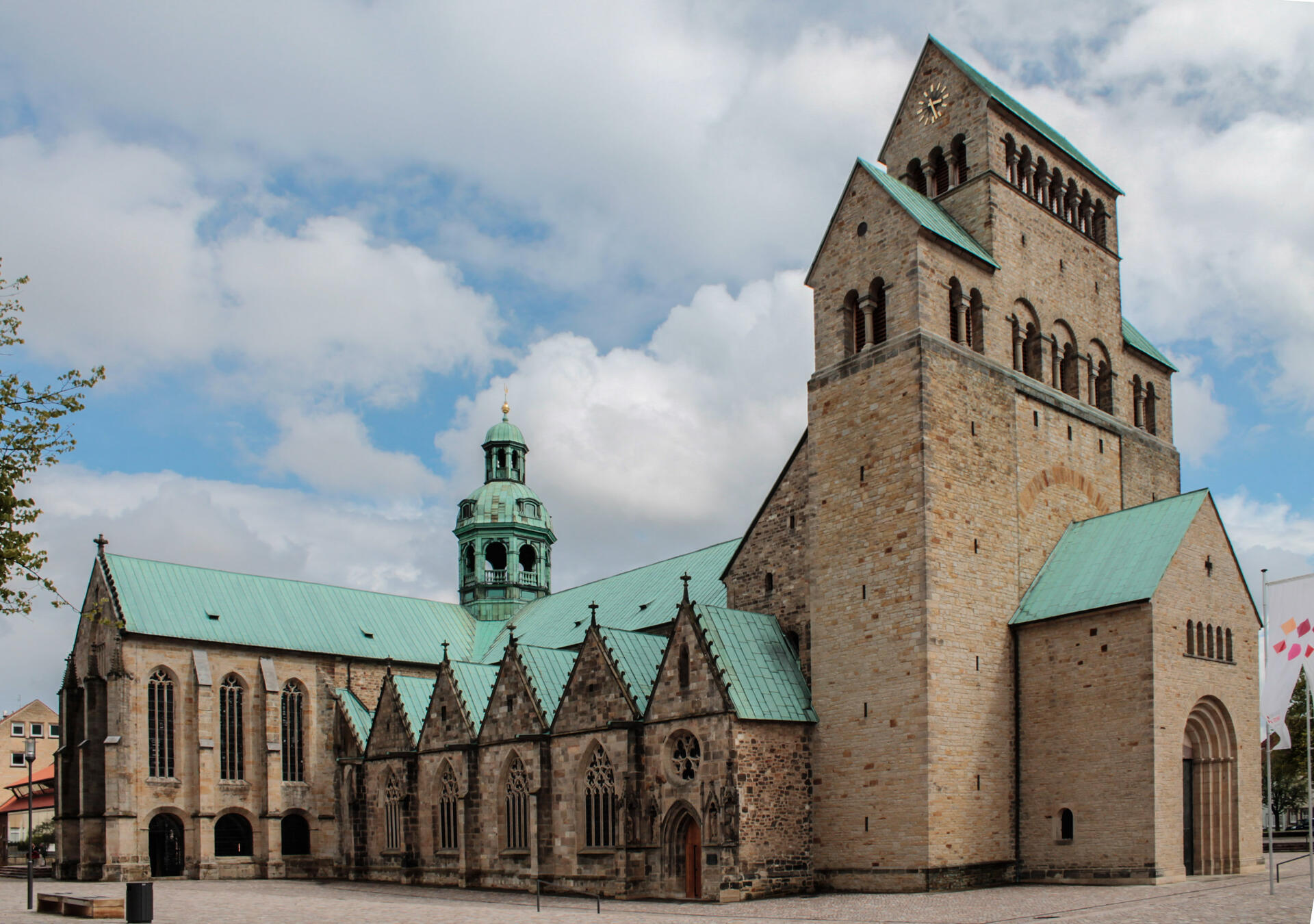
© Roland Struwe, CC BY-SA 4.0 Resized from original. (This derivative is under the same CC BY-SA license.)
World Heritage Research
Discover scientific research and academic studies that deepen our understanding of St Mary's Cathedral and St Michael's Church at Hildesheim from its history and significance to its conservation, management, and contemporary challenges.
-
St Laurence's at Bradford-on-Avon, St Michael's at Hildesheim and the Use of Squares in their Planning
Two early 11th-century churches, St Laurence's at Bradford-on-Avon and St Michael's at Hildesheim, employ squares in their architectural planning but with distinct approaches. St Laurence's dimensions are uniformly tied to two key lengths, while St Michael's west transept comprises three equal squares. The study proposes a novel explanation for the nave's unequal sections, challenging prior interpretations. This analysis underscores St Michael's potential as an early Romanesque prototype, bridging geometric precision and stylistic evolution.
Fernie, E. (2025). St Laurence’s at Bradford-on-Avon, St Michael’s at Hildesheim and the Use of Squares in their Planning. Romanesque and the Year 1000, 271–277. https://doi.org/10.4324/9781003571476-19
View Publication Record | Read Publication -
St Michael's Church in Hildesheim – a Magic Machine
St. Michael's Church in Hildesheim, founded by Bishop Bernward in the early 11th century, represents an extraordinary 'magic machine' designed to secure his eternal redemption through a meticulously arranged system of sacred objects and relics, including his own body post-mortem. This study reveals how Bernward's ambitious vision, though initially faltering after his death, persisted due to its inherent power, as evidenced by ongoing restorations and reconstructions. Declared a UNESCO World Heritage Site in recent times, the church now embodies global cultural significance, transitioning from religious to broader symbolic importance. The research explores the historical context, architectural innovations, and the enduring legacy of Bernward's design, highlighting its unique blend of spiritual intent and material craftsmanship.
Klein, B. (2025). St Michael’s Church in Hildesheim – a Magic Machine. Romanesque and the Year 1000, 199–211. https://doi.org/10.4324/9781003571476-14
View Publication Record | Read Publication