World Heritage Identification Number: 1240
World Heritage since: 2008
Category: Cultural Heritage
WHE Type: Agriculture Landscapes, Parks & Gardens
Transboundary Heritage: No
Endangered Heritage: No
Country: 🇭🇷 Croatia
Continent: Europe
UNESCO World Region: Europe and North America
Map
Stari Grad Plain: A Remarkable Cultural Landscape in Croatia
The Stari Grad Plain, located on the Adriatic island of Hvar, Croatia, is a unique cultural landscape that has remained largely unchanged for over two millennia. Inscribed as a UNESCO World Heritage Site in 2008, this fertile plain is a testament to the enduring legacy of the ancient Greek civilization.
More to come…UNESCO Description of the World Heritage Site
Stari Grad Plain on the Adriatic island of Hvar is a cultural landscape that has remained practically intact since it was first colonized by Ionian Greeks from Paros in the 4th century BC. The original agricultural activity of this fertile plain, mainly centring on grapes and olives, has been maintained since Greek times to the present. The site is also a natural reserve. The landscape features ancient stone walls and trims, or small stone shelters, and bears testimony to the ancient geometrical system of land division used by the ancient Greeks, the chora which has remained virtually intact over 24 centuries.
UNESCO Justification of the World Heritage Site
Criterion (ii): The land parcel system, dating from the 4th century BC, of Stari Grad Plain bears witness to the dissemination of the Greek geometrical model for the dividing up of agricultural land in the Mediterranean world.
Criterion (iii): The agricultural plain of Stari Grad has remained in continuous use, with the same initial crops being produced, for 2400 years. This bears witness to its permanency and sustainability down the centuries.
Criterion (v): The agricultural plain of Stari Grad and its environment are an example of very ancient traditional human settlement, which is today under threat from modern economic development, particularly from rural depopulation and the abandonment of traditional farming practices.
Encyclopedia Record: Stari Grad Plain
The Stari Grad Plain, near the town of Stari Grad on the island of Hvar, Croatia, is an agricultural landscape that was set up by the ancient Greek colonists in the 4th century BC, and remains in use. The plain is the largest agricultural area on any of the Adriatic islands, and is remarkably fertile due to Ice Age loess deposition.Additional Site Details
Area: 1,376.53 hectares
Number of Components: 1
(iii) — Unique or exceptional testimony to a cultural tradition
(v) — Outstanding example of traditional human settlement
Coordinates: 43.1816666667 , 16.6386111111
Image
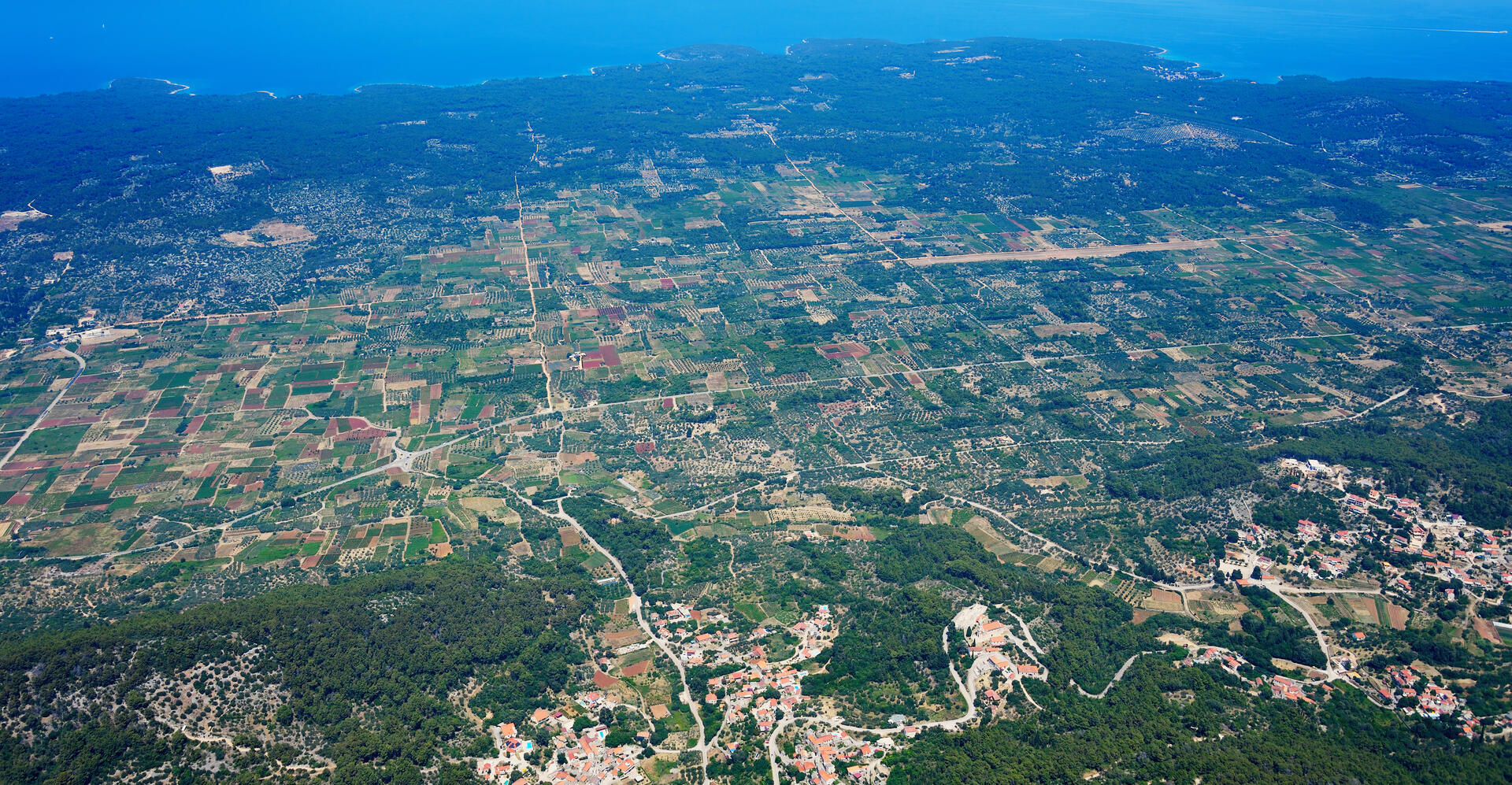
© Carsten Steger, CC BY-SA 4.0 Resized from original. (This derivative is under the same CC BY-SA license.)
World Heritage Research
Discover scientific research and academic studies that deepen our understanding of Stari Grad Plain from its history and significance to its conservation, management, and contemporary challenges.
-
‘A gift from God’: autochthonous grapes and wine heritage on the island of Hvar, Croatia
Autochthonous grape varieties, particularly bogdanuša, are identified as key elements for the future success of Hvar's wine industry. These grapes hold multiple registers of value, including uniqueness, perceived quality, heritage significance, and cultural patrimony, allowing them to navigate both local and globalized discourses of authenticity and quality. The study explores how grape and wine producers on the Stari Grad Plain, a UNESCO World Heritage-listed cultural landscape, leverage these attributes to enhance their product's value amidst economic challenges and shifting agricultural practices.
Skinner, W. (2019). ‘A gift from God’: autochthonous grapes and wine heritage on the island of Hvar, Croatia. Journal of Wine Research, 30(4), 294–311. https://doi.org/10.1080/09571264.2019.1678016
View Publication Record | Read Publication -
Izbrani primeri upravljanja območij s kulturno dediščino
Cultural heritage management can significantly contribute to regional development when implemented thoughtfully, as demonstrated by selected case studies from Southeast Europe and beyond. The study highlights the multifaceted role of cultural heritage, including its potential for sustainable growth, while also addressing the adverse impacts of military conflicts on such sites over the past two decades. It examines diverse protection systems and intergovernmental efforts in the region, focusing on UNESCO-listed sites like Kotor, Gamzigrad, and the Stari Grad Plain, as well as notable examples from outside Southeast Europe, such as Bilbao and the Rhaetian Railway. The research underscores the importance of strategic management in preserving and leveraging cultural heritage for economic and social benefits.
Nared, J., & Razpotnik Visković, N. (2014). Izbrani primeri upravljanja območij s kulturno dediščino. CAPAcities. https://doi.org/10.3986/9789610503453
View Publication Record | Read Publication