World Heritage Identification Number: 810
World Heritage since: 1997
Category: Cultural Heritage
WHE Type: Historic Cities & Urban Areas
Transboundary Heritage: No
Endangered Heritage: No
Country: 🇭🇷 Croatia
Continent: Europe
UNESCO World Region: Europe and North America
Map
The Historic City of Trogir: A Remarkable Example of Urban Continuity
The Historic City of Trogir, located on a small island off the Dalmatian coast in Croatia, is a testament to the enduring legacy of human civilization. Inscribed as a UNESCO World Heritage Site in 1997, Trogir stands as a remarkable example of urban continuity, boasting an uninterrupted history that spans over two millennia.
More to come…UNESCO Description of the World Heritage Site
Trogir is a remarkable example of urban continuity. The orthogonal street plan of this island settlement dates back to the Hellenistic period and it was embellished by successive rulers with many fine public and domestic buildings and fortifications. Its beautiful Romanesque churches are complemented by the outstanding Renaissance and Baroque buildings from the Venetian period.
UNESCO Justification of the World Heritage Site
Criterion (ii): Trogir demonstrates the influence of the various cultures in the Adriatic from its original settlement – Greek, Roman, Byzantine, Hungarian and Venetian, exemplified through its town planning from the Greek period onwards, and the architecture of its buildings, whether Romanesque, Gothic, Renaissance or Baroque. In terms of space and population Trogir is a miniature city, but its significance for the cultural and economic history of the Adriatic outweighs its restricted urban scale. Its institutions, its way of life, and its contribution to national and universal culture and science make it one of the most important Adriatic towns.
Criterion (iv): Trogir is an excellent example of a medieval town built on and conforming with the layout of a Hellenistic and Roman city that has conserved its urban fabric to an exceptional degree and with the minimum of modem interventions, in which the trajectory of social and cultural development is clearly visible in every aspect of the townscape.
Encyclopedia Record: Trogir
Trogir is a historic town and harbour on the Adriatic coast in Split-Dalmatia County, Croatia, with a population of 10,107 (2021) and a total municipal population of 12,393 (2021). The historic part of the city is situated on a small island between the Croatian mainland and the island of Čiovo. It lies 27 kilometres west of the city of Split.Additional Site Details
Area: 6.4 hectares
Number of Components: 1
(iv) — Outstanding example of a type of building or landscape
Coordinates: 43.5170833333 , 16.2513611111
Image
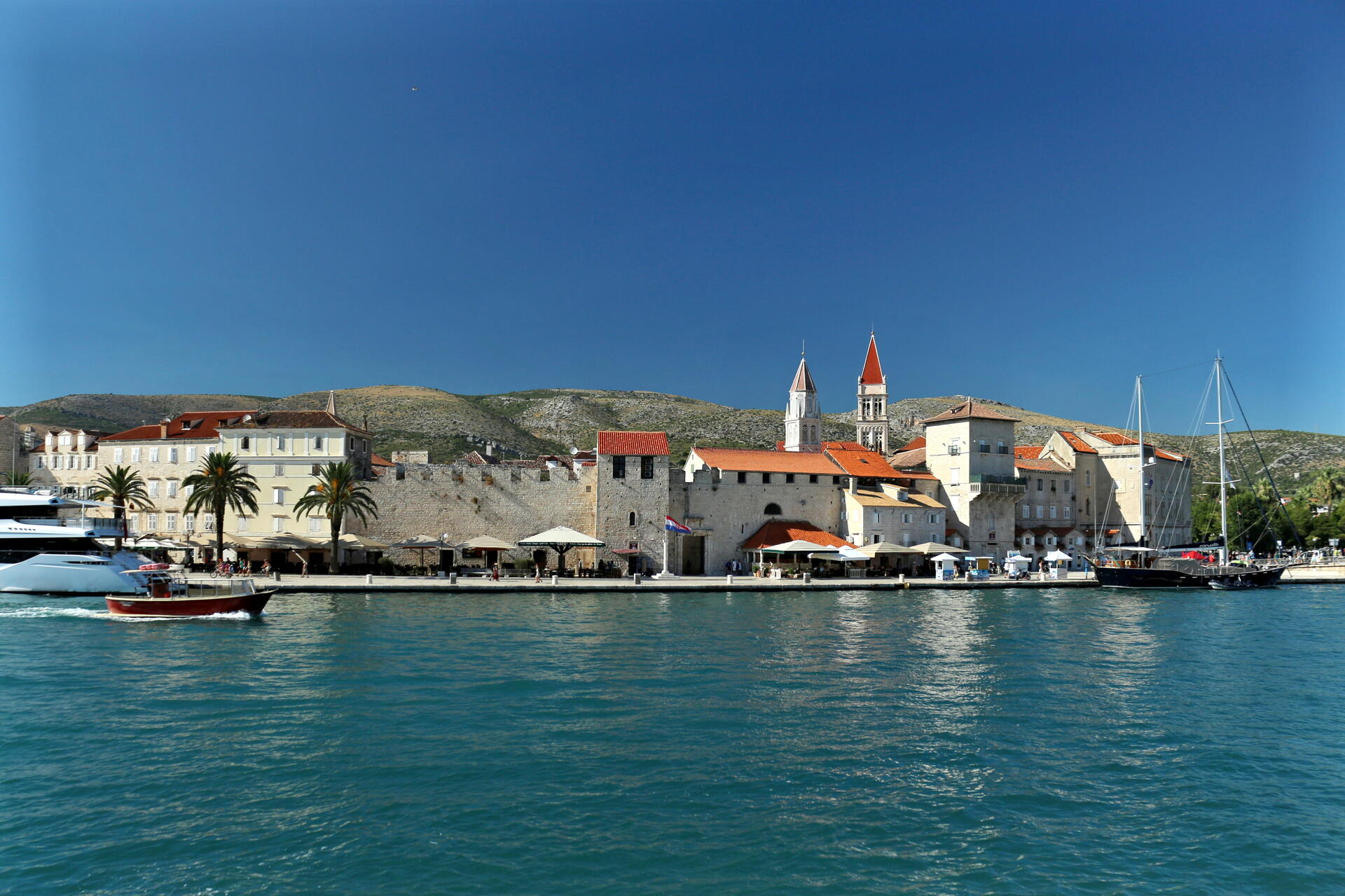
© VitVit, CC BY-SA 4.0 Resized from original. (This derivative is under the same CC BY-SA license.)
World Heritage Research
Discover scientific research and academic studies that deepen our understanding of Historic City of Trogir from its history and significance to its conservation, management, and contemporary challenges.
-
Law, Power, and Consensus
The Statute of Trogir, traditionally viewed as a legal code, reveals itself to be a dynamic instrument for articulating power, negotiating consensus, and legitimizing authority across shifting regimes. This study demonstrates how the statute evolved from a practical tool of governance in late medieval Dalmatia into a symbolic monument of civic identity, preserving the illusion of continuity and collective self-representation. By applying interpretive frameworks from Hagen Keller and Didier Lett, the research situates the Statute within the broader Mediterranean context of pragmatic literacy and legal textualization, highlighting its performative role in maintaining political identity during the Venetian phase.
Popić, T. (2026). Law, Power, and Consensus. Specimina Nova Pars Prima Sectio Medaevalis, 14, 89–104. https://doi.org/10.15170/spmnnv.2025.14.05
View Publication Record | Read Publication -
A historical reconstruction of the legend of Miljenko and Dobrila (Kaštela, Croatia, 17th century)
A historical reconstruction of the legend of Miljenko and Dobrila, a 17th-century tale of tragic love between two noble families from Kaštela, Croatia, reveals both plausible historical elements and significant gaps. The study confirms the existence of key figures like Francesco Vitturi, his wife Elisabetta, and Dobrila's sister Klara, as well as the feud between the Vitturi and Rosani families. It also verifies the legend’s settings, including the Vitturi Castle in Kaštel Lukšić and the Monastery of St. Nicholas in Trogir. However, no evidence supports claims that Dobrila was forcibly kept in the monastery or that Miljenko and Dobrila were married or buried together. The research relied on archival materials, literary sources, and historical records but found insufficient proof to definitively confirm or refute the legend’s historicity due to limited available data.
Klišmanić, V., & Domazet, M. (2025). A historical reconstruction of the legend of Miljenko and Dobrila (Kaštela, Croatia, 17th century). St Open, 6, 1–22. https://doi.org/10.48188/so.6.2
View Publication Record | Read Publication -
Execution of Repair Works on the Trogir –Čiovo Island Bridge
A comprehensive restoration of the Trogir–Čiovo Island Bridge, a UNESCO-listed movable bridge connecting Croatia's historic city of Trogir to Čiovo Island, was successfully executed. The 63-year-old structure, featuring steel and reinforced concrete elements with stone cladding, underwent systematic repairs divided into three key phases: restoration of the central steel arch span and expansion joints; rehabilitation of reinforced concrete components including roadway slabs, pedestrian walkways, arches, and caissons; and renewal of the stone facade. Conducted by Spegra in collaboration with Trogir's Conservation Department, the project ensured structural integrity while preserving aesthetic heritage. This case study highlights effective methodologies for restoring complex, mixed-material bridges in culturally significant coastal environments.
Kelava, A., Mlinar, A., Pavić, L., & Buzov, A. (2025). Execution of Repair Works on the Trogir –Čiovo Island Bridge. Innovations in Bridge Engineering, 164, 3–14. https://doi.org/10.4028/p-77v3fo
View Publication Record | Read Publication -
Uncovering Lithic Artefacts in the Dinaric Karst: Challenges of Field Survey in Bristivica near Trogir
A novel artefact-based field survey approach successfully identified lithic artefacts and chert raw materials in the fragmented Dinaric karst landscape near Bristivica, Trogir. This method adapted to challenging conditions—such as drystone walls, cairns, dense vegetation, and limited soil visibility—demonstrated potential for detecting lithic scatters despite difficulties in determining their spatial context or precise chronological frame. The study highlights the impact of historical agricultural practices and deruralization on surface archaeology while offering a practical solution for surveying such landscapes.
Bažoka, M., Bodružić, M., Sirovica, F., & Paraman, L. (2025). Uncovering Lithic Artefacts in the Dinaric Karst: Challenges of Field Survey in Bristivica near Trogir. Proceedings from the 11th and 12th Scientific Conference Methodology and Archaeometry, 9–28. https://doi.org/10.17234/metarh.2025.2
View Publication Record | Read Publication -
Operational plan for responding to and rescuing works of art in the event of a fire
A specialized operational plan for rescuing works of art during fires, tailored to the UNESCO World Heritage Site of Trogir, Croatia, has been developed. This plan uniquely integrates the material and non-material values of artifacts, distinguishing it from conventional emergency response measures. The approach involved assessing the Sacred Art Collection's conditions, evaluating existing safety protocols, estimating artifact values, prioritizing based on value, measuring each piece, and creating detailed grab sheets for efficient evacuation. The resulting plan includes critical components such as facility information, contact lists, evacuation procedures, risk assessments, floor plans, priority artifact listings, management structures, triage room locations, temporary storage areas, and grab sheets. This study underscores the need for site-specific emergency response strategies that account for the unique cultural significance of heritage artifacts.
Buble, M., & Popović, J. (2023). Operational plan for responding to and rescuing works of art in the event of a fire. St Open, 4, 1–18. https://doi.org/10.48188/so.4.16
View Publication Record | Read Publication -
Political Expressions of Pragmatic Literacy in Thirteenth-Century Trogir
Thirteenth-century Trogir saw the emergence of pragmatic literacy as a pivotal factor in reshaping its political and social landscape, marking a significant shift from episcopal dominance to municipal governance. This transformation was characterized by the consolidation of power among urban families, necessitating the redefinition of communal institutions' roles in both internal and external power dynamics. The study reveals that the increasing reliance on written documentation by the local elite facilitated the establishment of new government structures, including the first city statute and the professionalization of the chancery. This shift from charters to notarial, court, and council registers underscores the critical role of pragmatic literacy in configuring power relations during this period.
Popić, T. (2022). Politički aspekti pragmatične pismenosti u trinaestostoljetnom Trogiru. Povijesni Prilozi, 41(62), 47–82. https://doi.org/10.22586/pp.v41i62.20100
View Publication Record | Read Publication -
Domišljanje Kontinuiteta. Problem Najstarijega Trogirskog Memorijalnog Teksta
A re-evaluation of the earliest preserved memorial text linked to Trogir’s 6th-century octagonal church, St. Mary de Platea, challenges its long-held belief as a genuine early medieval document. Through rigorous analysis of textual transmission, historiographic interpretations, and archaeological context, this study concludes that the text was artificially constructed in the 15th century by Trogir’s communal elite, later formalized in writing during the 16th century. The research redefines the church as a 9th-century structure, later repurposed into a communal church (ecclesia communis) during the High Middle Ages. The study highlights how this fabricated narrative served to create an illusion of continuous communal patronage over the centuries.
Basić, I. (2021). DOMIŠLJANJE KONTINUITETA. PROBLEM NAJSTARIJEGA TROGIRSKOG MEMORIJALNOG TEKSTA. Miscellanea Hadriatica et Mediterranea, 7. https://doi.org/10.15291/misc.3172
View Publication Record | Read Publication