World Heritage Identification Number: 379
World Heritage since: 1986
Category: Cultural Heritage
WHE Type: Historic Cities & Urban Areas
Transboundary Heritage: No
Endangered Heritage: No
Country: 🇪🇸 Spain
Continent: Europe
UNESCO World Region: Europe and North America
Map
The Historic City of Toledo: A Testimony to Civilizational Harmony and Cultural Richness
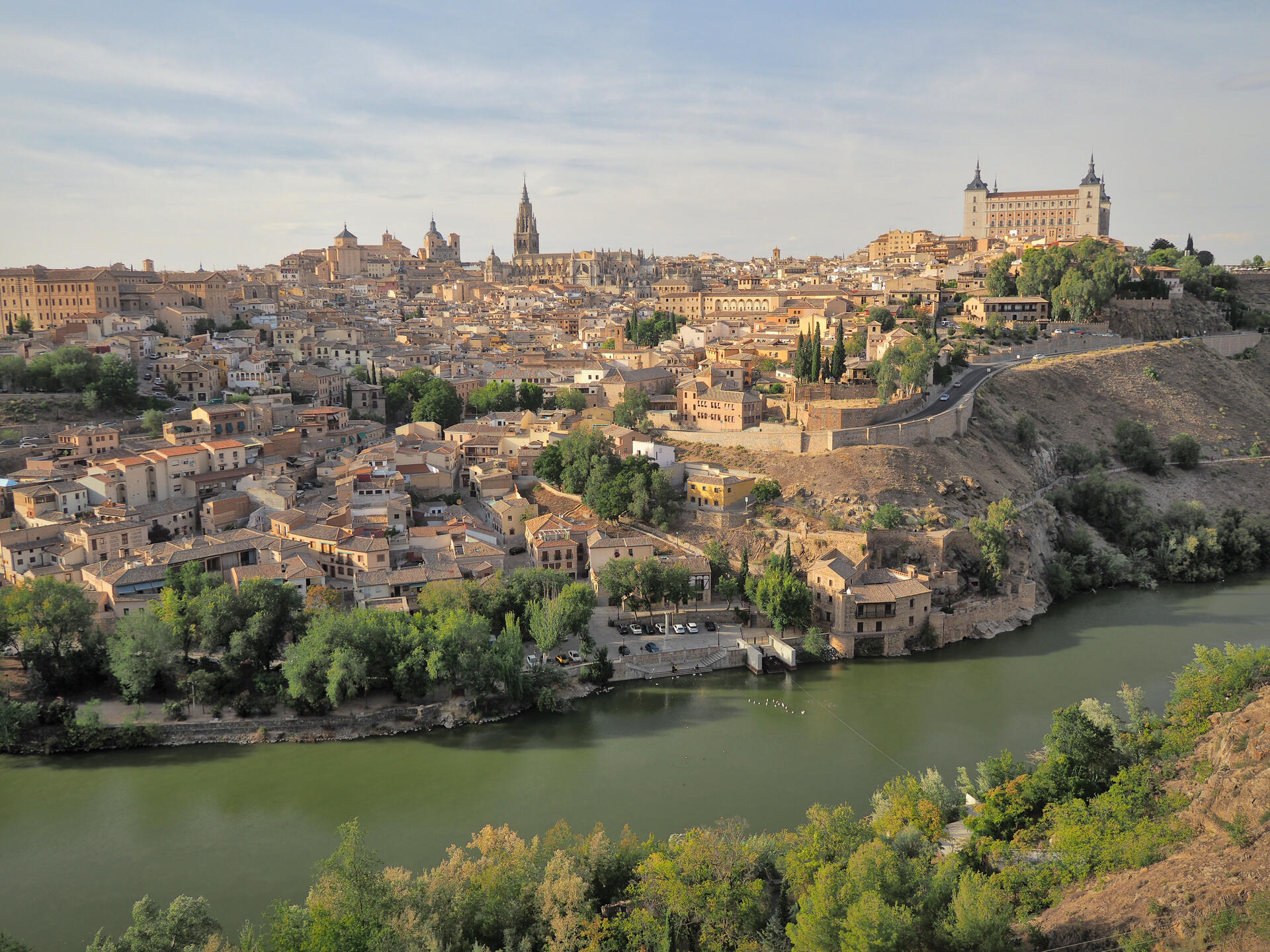
The Historic City of Toledo, located in central Spain, stands as a remarkable testament to the harmonious coexistence of diverse cultures and civilizations over the course of more than two millennia. Inscribed as a UNESCO World Heritage Site in 1986, this ancient city offers a unique blend of architectural styles, religious traditions, and historical events that have shaped its rich cultural identity.
More to come…UNESCO Description of the World Heritage Site
Successively a Roman municipium, the capital of the Visigothic Kingdom, a fortress of the Emirate of Cordoba, an outpost of the Christian kingdoms fighting the Moors and, in the 16th century, the temporary seat of supreme power under Charles V, Toledo is the repository of more than 2,000 years of history. Its masterpieces are the product of heterogeneous civilizations in an environment where the existence of three major religions – Judaism, Christianity and Islam – was a major factor.
UNESCO Justification of the World Heritage Site
Criterion (i): The city of Toledo in its entirety represents a unique artistic achievement and an uninterrupted succession of remarkable achievements, from the Visigothic churches to the Baroque ensembles of the early 18th century.
Criterion (ii): Toledo exerted considerable influence, both during the Visigoth period, when it was the capital of a kingdom which stretched all the way to the Narbonnese region, and during the Renaissance, when it became one of the most important artistic centres in Spain.
Criterion (iii): Toledo bears exceptional testimony of several past civilisations and maintains remarkable architectural features from the Roman, the Visigoths, the Andalusian and Jewish occupation as well as a broad spectrum of structures from the medieval period.
Criterion (iv): Toledo retains a series of outstanding examples of 15th- and 16th-century constructions: the church of San Juan de los Reyes and the Cathedral, San Juan Bautista and Santa Cruz hospitals, the Puerta Nueva de Bisagra, etc. Each of these monuments is a perfect example of a particular type of architecture of the Spanish golden age, whether religious, hospital or military. Moreover, Toledo witnessed the emergence, starting in the Middle Ages, of a Mudejar style which combined the structural and decorative elements of Visigoth and Islamic art, adapting them thereafter into successive styles, represented in buildings such as Santiago del Arrabal (13th century), the Moorish Workshop and Puerta del Sol gate (14th century), the wainscot of Santa Cruz Hospital and the chapter house of the Cathedral (15th and 16th centuries), etc.
Encyclopedia Record: Toledo, Spain
Toledo is a city and municipality in Spain. It is the capital of the province of Toledo and the de jure seat of the government and parliament of the autonomous community of Castilla–La Mancha.Additional Site Details
Area: 259.85 hectares
Number of Components: 1
(ii) — Significant interchange of human values
(iii) — Unique or exceptional testimony to a cultural tradition
(iv) — Outstanding example of a type of building or landscape
Coordinates: 39.8569444444 , -4.0244444444
World Heritage Research
Discover scientific research and academic studies that deepen our understanding of Historic City of Toledo from its history and significance to its conservation, management, and contemporary challenges.
-
Understanding active commuting to school: a participatory Photovoice project at a Secondary School in Toledo, Spain
Adolescents' school commuting experiences in Toledo, Spain, reveal that while geographical distance is the primary barrier to active commuting, students also value social interactions, route autonomy, and environmental appreciation as key facilitators. This study used a participatory Photovoice methodology to capture 12 students' perspectives on their commute, identifying five main categories of transport-related themes: school bus, urban bus, private car, walking, and sunrises. The findings highlight the importance of integrating adolescent voices into mobility policy design to create context-sensitive interventions that promote health and wellbeing.
Cruz, E. C., Espejo, P. C., Martín-Moraleda, E., García Coll, V., Suarez, A. D., Marín, A. J., Blanco, C. R., & Laín, S. A. (2026). Understanding active commuting to school: a participatory Photovoice project at a Secondary School in Toledo, Spain. Wellbeing, Space and Society, 11, 100452. https://doi.org/10.1016/j.wss.2026.100452
View Publication Record | Read Publication -
Unpacking World Heritage cultural clusters through the interplay of urban tourism and gentrification
A study on UNESCO World Heritage Sites reveals that urban landscape protection can inadvertently limit the diversity of cultural expressions, particularly when tied to declining local populations and aging infrastructure. Analyzing the interplay between touristification and gentrification in historic centers like Ávila, Cuenca, Salamanca, Segovia, and Toledo, researchers found significant discrepancies between urban policies and residents' socio-cultural realities. While touristification may mitigate gentrification, its effects vary, with some areas experiencing stagnation while others undergo rapid change. The findings, derived from surveys, public data, and in-depth interviews, underscore the need for adaptive cultural policies to address these dynamics in similar World Heritage cities.
Altaba Tena, P., Ginés Sánchez, X., Querol Vicente, V. A., & García-Esparza, J. A. (2025). Unpacking World Heritage cultural clusters through the interplay of urban tourism and gentrification. Cities, 158, 105634. https://doi.org/10.1016/j.cities.2024.105634
View Publication Record | Read Publication -
Perceptions and Opinions of the Host Community Regarding Overtourism in the Tourist-Historic City
Residents of Toledo, Spaindo not widely perceive overtourism as a severe issue despite its economic significance. However, they recognize specific negative impacts, such as the historic center becoming overly commercialized for tourists and traffic congestion from overcrowding. Notably, residents in the historic core express more negativity toward tourism development than those in other areas. The study used surveys to assess social carrying capacity perceptions, revealing nuanced local attitudes that could inform policy responses for sustainable tourism management.
Escudero Gómez, L. A. (2020). Perceptions and Opinions of the Host Community Regarding Overtourism in the Tourist-Historic City. Handbook of Research on the Impacts, Challenges, and Policy Responses to Overtourism, 325–345. https://doi.org/10.4018/978-1-7998-2224-0.ch017
View Publication Record | Read Publication -
Using Flickr Geotagged Photos to Estimate Visitor Trajectories in World Heritage Cities
Research reveals that tourist spatial behavior in World Heritage Cities, such as Toledo (Spain), is significantly influenced by the location of attractions and mixed-use areas. Using thousands of geotagged Flickr photos, advanced GIS techniques reconstructed visitor trajectories, identifying overcrowded streets and underexplored 'shadow areas.' Findings underscore how urban environments shape tourist movement, offering new insights for managing heritage assets and mitigating overcrowding effects in touristified cities.
Domènech, A., Mohino, I., & Moya-Gómez, B. (2020). Using Flickr Geotagged Photos to Estimate Visitor Trajectories in World Heritage Cities. ISPRS International Journal of Geo-Information, 9(11), 646. https://doi.org/10.3390/ijgi9110646
View Publication Record | Read Publication -
Sustainability and Visitor Management in Tourist Historic Cities
A Special Issue on ‘Sustainability and Visitor Management in Tourist Historic Cities’ presents innovative methods to assess tourism impacts, focusing on environmental, physical, cultural, and social effects. It highlights the use of big data technology for measuring these impacts and examines resident perceptions and conflicts arising from tourism activities. The collection includes case studies from historic cities such as Toledo (Spain), Venice (Italy), and Porto (Portugal), providing practical tools and policy recommendations for sustainable tourism management. By addressing emerging trends, this work offers actionable insights to mitigate negative social problems while promoting balanced visitor experiences.
(Ed.). (2020). Sustainability and Visitor Management in Tourist Historic Cities. https://doi.org/10.3390/books978-3-03936-245-5
View Publication Record | Read Publication -
The Toledo School – Early Center of Translation in Medieval Europe
The Toledo School, operating in the 12th and 13th centuries, emerges as a pivotal early center of translation in medieval Europe, bridging East and West cultures. This study establishes its role as a foundational institution for the Western Renaissance by analyzing historical, political, social, and cultural processes on the Iberian Peninsula. It identifies the Toledo School's unique translation methods—such as 'Arab→Castilian→Latin' and 'Arab→Hebrew→Latin'—and demonstrates how these processes facilitated the synthesis of Eastern scientific knowledge into Latin scholarship. The research employs historicism, comparative analysis, systematization, classification, and a problem-chronological approach to trace the school's development, the contributions of its translators, and the broader impact on medieval European intellectual history.
(Ed.). (2020). The Toledo School – Early Center of Translation in Medieval Europe. European Researcher, 11(3). https://doi.org/10.13187/er.2020.3.150
View Publication Record | Read Publication -
Land Squandering in the Spanish Medium Sized Cities: The Case of Toledo
Spanish medium-sized cities, including the historic UNESCO World Heritage Site of Toledo, experienced significant urban sprawl and land squandering from the mid-1990s to 2008. This process, driven by speculation and profit, transformed compact urban forms into disjointed spaces, particularly in peripheral districts. The study highlights how Toledo's urban expansion extended into its hinterland while also noting internal dispersion through the 'Ensanche' (widening) process in the late 20th century. Using urban estate cadaster data alongside fieldwork and bibliographic research, the authors demonstrate that such growth patterns resulted in fragmented urban landscapes. This research underscores the consequences of unchecked land development on historic cities.
Sánchez Ondoño, I., & Escudero Gómez, L. A. (2019). Land Squandering in the Spanish Medium Sized Cities: The Case of Toledo. Urban Science, 3(1), 16. https://doi.org/10.3390/urbansci3010016
View Publication Record | Read Publication