World Heritage Identification Number: 946
World Heritage since: 2005
Category: Cultural Heritage
WHE Type: Historic Cities & Urban Areas
Transboundary Heritage: No
Endangered Heritage: No
Country: 🇧🇦 Bosnia and Herzegovina
Continent: Europe
UNESCO World Region: Europe and North America
Map
The Old Bridge Area of the Old City of Mostar: A Symbol of Reconciliation and Multicultural Urban Settlement
The Old Bridge Area of the Old City of Mostar, located in Bosnia and Herzegovina, stands as a testament to the rich history, cultural diversity, and resilience of this Balkan region. This UNESCO World Heritage Site, inscribed in 2005, offers a unique blend of architectural styles that reflect the multicultural influences that shaped the city over time. The site is recognized not only for its architectural value but also for its powerful symbolic role in reconciliation, international cooperation, and the coexistence of diverse cultural and religious communities.
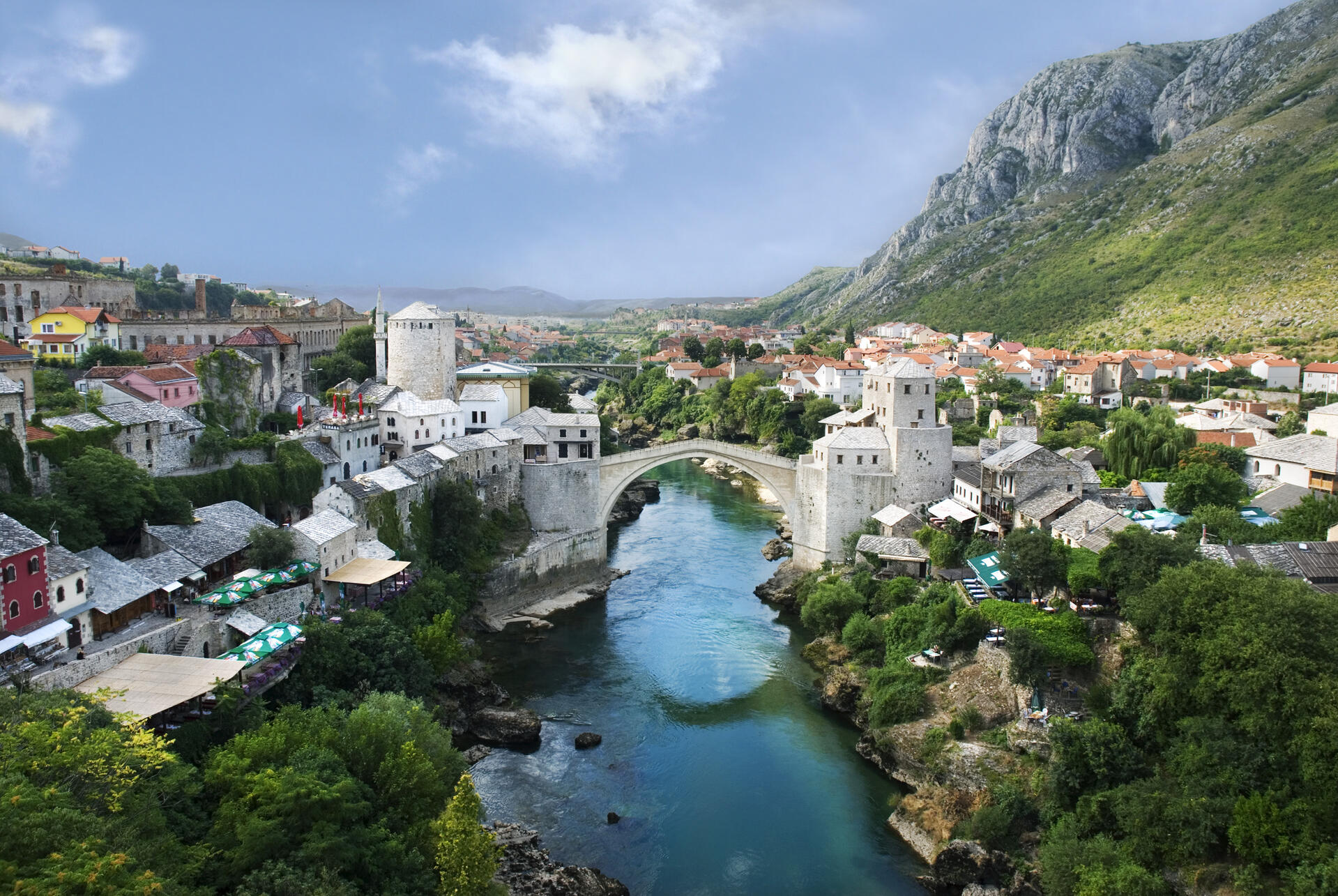
At the heart of Mostar lies the Old Bridge (Stari Most), the city’s defining landmark and an outstanding example of Ottoman architecture. Commissioned in the mid-16th century during the reign of Sultan Suleiman the Magnificent, the bridge was designed by the architect Mimar Hayruddin, a student of the renowned Mimar Sinan. Spanning the deep valley of the Neretva River, it physically and symbolically connects the two sides of the city. The name “Mostar” itself derives from the mostari, the bridge keepers who once guarded the structure and inhabited its fortified towers.
The Old Bridge is an exemplary piece of Balkan Islamic architecture and a remarkable feat of engineering, consisting of a single stone arch of approximately 29 meters in span, flanked by fortified towers (the Tara and Halebija towers) at either end, and rising roughly 24 meters above the Neretva River at its highest point. Its elegant proportions and innovative construction techniques exemplify the sophistication of Ottoman architecture in the Balkans, making it one of the region’s most significant monuments.
Beyond the bridge, the Old City of Mostar reveals a rich architectural tapestry shaped by successive historical periods. Elements of pre-Ottoman, Ottoman, Mediterranean, and western European traditions coexist, reflecting the city’s development under Ottoman rule, Austro-Hungarian administration, and within the former Yugoslavia. The narrow, winding streets are lined with traditional stone houses, often featuring courtyards, wooden upper structures, and overhanging balconies characteristic of the region.
The urban fabric of Mostar preserves the essential features of a traditional Ottoman town, offering insight into its historical organization and daily life. At its core lies the čaršija, or market district, where narrow streets are lined with small shops and workshops that once formed the commercial heart of the city. This area is complemented by religious buildings, particularly mosques, which served not only as places of worship but also as social and cultural anchors for the community. Public structures such as hammams (bathhouses), fountains, and bridges further reflect the integrated urban planning characteristic of the Ottoman period.
During the 1990s conflict, much of the Old City and the Old Bridge were destroyed, with the bridge itself collapsing in 1993 during the Bosnian War. It was meticulously reconstructed and reopened in 2004, using traditional materials and techniques alongside modern engineering methods. The reconstruction was carried out with the support of UNESCO and an international coalition of experts and institutions, and it has come to symbolize reconciliation, international cooperation, and the restoration of cultural heritage, as well ase the coexistence of diverse cultural, ethnic, and religious communities.
The site also preserves an important “living” heritage: a centuries-old tradition of bridge diving, in which local divers leap from the arch of the Old Bridge into the Neretva River. Documented since at least the 17th century, this practice has become a defining ritual of Mostar’s cultural identity and continues to be celebrated today, most prominently during annual diving competitions.
Today, the Old Bridge Area of the Old City of Mostar continues to embody the spirit of resilience and coexistence that defines this historic city. As a UNESCO World Heritage Site, it invites visitors from around the world to engage with its layered history and architectural richness, fostering a deeper understanding of shared cultural heritage across diverse communities. The bridge, both as a physical structure and as a symbol, remains a powerful reminder of connection—between places, cultures, and histories.
UNESCO Description of the World Heritage Site
The historic town of Mostar, spanning a deep valley of the Neretva River, developed in the 15th and 16th centuries as an Ottoman frontier town and during the Austro-Hungarian period in the 19th and 20th centuries. Mostar has long been known for its old Turkish houses and Old Bridge, Stari Most, after which it is named. In the 1990s conflict, however, most of the historic town and the Old Bridge, designed by the renowned architect Sinan, was destroyed. The Old Bridge was recently rebuilt and many of the edifices in the Old Town have been restored or rebuilt with the contribution of an international scientific committee established by UNESCO. The Old Bridge area, with its pre-Ottoman, eastern Ottoman, Mediterranean and western European architectural features, is an outstanding example of a multicultural urban settlement. The reconstructed Old Bridge and Old City of Mostar is a symbol of reconciliation, international co-operation and of the coexistence of diverse cultural, ethnic and religious communities.
UNESCO Justification of the World Heritage Site
Criterion (vi): With the “renaissance” of the Old Bridge and its surroundings, the symbolic power and meaning of the City of Mostar - as an exceptional and universal symbol of coexistence of communities from diverse cultural, ethnic and religious backgrounds - has been reinforced and strengthened, underlining the unlimited efforts of human solidarity for peace and powerful cooperation in the face of overwhelming catastrophes.
Encyclopedia Record: Stari Most
The Old Bridge, also known as the Mostar Bridge, is a rebuilt 16th-century Ottoman bridge in the city of Mostar in Bosnia and Herzegovina. It crosses the river Neretva and connects the two parts of the city, which is named after the bridge keepers who guarded the Old Bridge during the Ottoman era. Commissioned by Suleiman the Magnificent in 1557 and designed by Mimar Hayruddin, a student and apprentice of the architect Mimar Sinan, the Old Bridge is an exemplary piece of Balkan Islamic architecture.Additional Site Details
Area: 7.6 hectares
Number of Components: 1
Coordinates: 43.3373055556 , 17.815