World Heritage Identification Number: 1042
World Heritage since: 2001
Category: Cultural Heritage
WHE Type: Historic Cities & Urban Areas
Transboundary Heritage: No
Endangered Heritage: No
Country: 🇮🇱 Israel
Continent: Asia
UNESCO World Region: Europe and North America
Map
The Old City of Acre: A Testament to History and Cultural Diversity
The Old City of Acre, officially recognized as a UNESCO World Heritage Site since 2001, stands as a remarkable testament to history and cultural diversity. Situated in the coastal plain region of the Northern District of Israel, this ancient port-city has witnessed continuous settlement since the Phoenician period, making it a significant historical site that offers an extraordinary glimpse into various civilizations that have shaped its development over millennia.
More to come…UNESCO Description of the World Heritage Site
Acre is a historic walled port-city with continuous settlement from the Phoenician period. The present city is characteristic of a fortified town dating from the Ottoman 18th and 19th centuries, with typical urban components such as the citadel, mosques, khans and baths. The remains of the Crusader town, dating from 1104 to 1291, lie almost intact, both above and below today's street level, providing an exceptional picture of the layout and structures of the capital of the medieval Crusader kingdom of Jerusalem.
UNESCO Justification of the World Heritage Site
Criterion (ii): Acre is an exceptional historic port-town in that it preserves the substantial remains of its medieval Crusader buildings beneath the existing Moslem fortified town dating from the 18th and 19th centuries.
Criterion (iii): The remains of the Crusader town of Acre, both above and below the present-day street level, provide an exceptional picture of the layout and structures of the capital of the medieval Crusader Kingdom of Jerusalem.
Criterion (v): Present-day Acre is an important example of an Ottoman walled town, with typical urban components such as the citadel, mosques, khans, and baths well preserved, partly built on top of the underlying Crusader structures.
Encyclopedia Record: Acre, Israel
Acre, known in Hebrew as Akko and in Arabic as Akka, is a city in the coastal plain region of the Northern District of Israel.Additional Site Details
Area: 63.3 hectares
Number of Components: 1
(iii) — Unique or exceptional testimony to a cultural tradition
(v) — Outstanding example of traditional human settlement
Coordinates: 32.9216666667 , 35.0688888889
Image
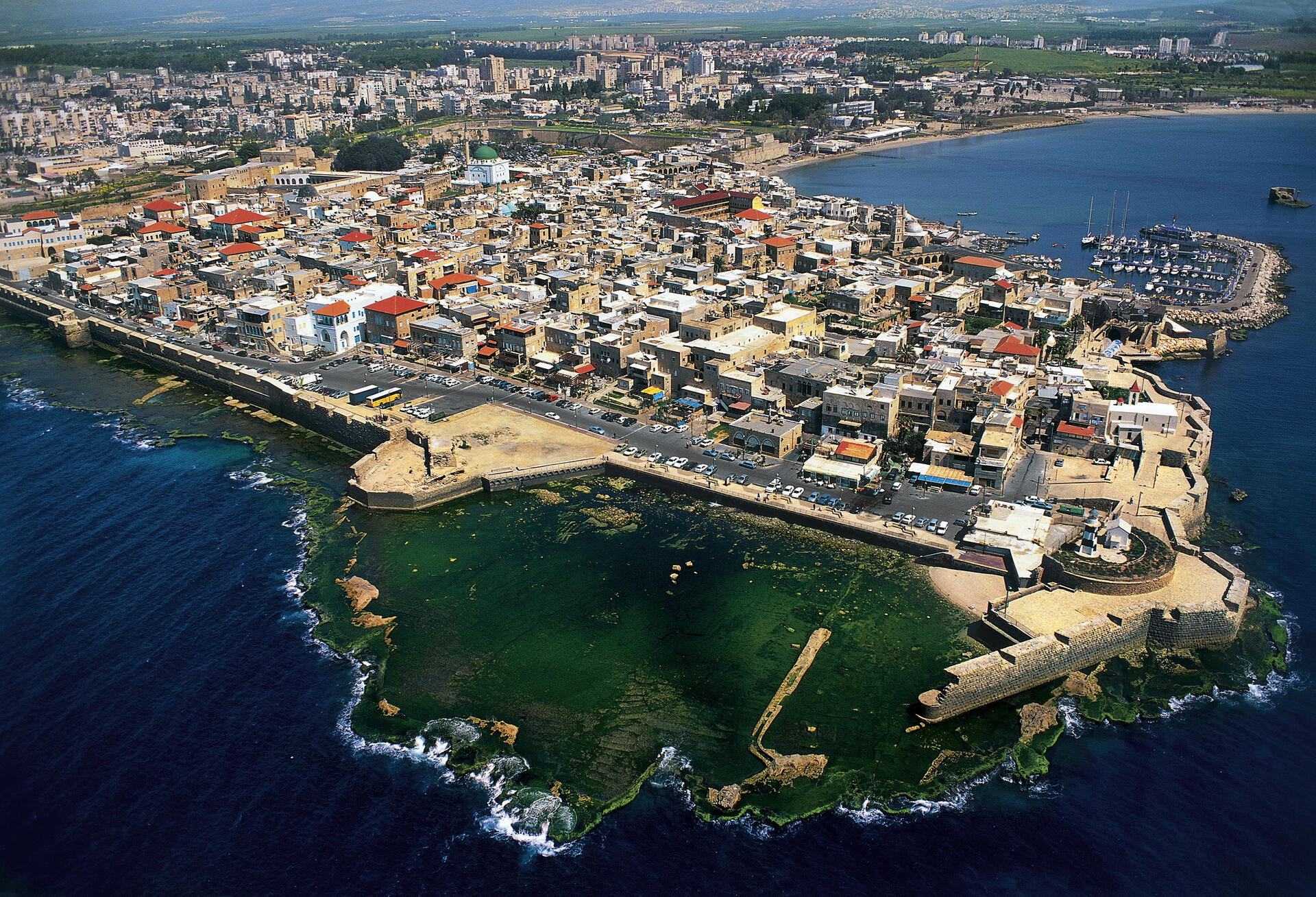
© israeltourism from Israel, CC BY-SA 2.0 Resized from original. (This derivative is under the same CC BY-SA license.)
World Heritage Research
Discover scientific research and academic studies that deepen our understanding of Old City of Acre from its history and significance to its conservation, management, and contemporary challenges.
-
Resisting and Remaking Heritage Work: An Archaeology of the Surface in Acre's Old City
Acre's Old City, a UNESCO World Heritage Site since 2001, reveals how Palestinian residents selectively appropriate heritage narratives to challenge state-led tourism development. Through photographic surface surveys, researchers document local practices—such as bread offerings for animals and fishermen—that reflect aesthetic values while subverting dominant heritage discourses. This study highlights an alternative theorization of heritage that balances historical significance with livability, offering a counter-narrative to Israel's international tourist promotion efforts.
Taylor, E. (2022). 9 Resisting and Remaking Heritage Work: An Archaeology of the Surface in Acre’s Old City. Archaeological Papers of the American Anthropological Association, 33(1), 135–151. Portico. https://doi.org/10.1111/apaa.12162
View Publication Record | Read Publication -
Deterioration of Sandstone in the Historical and Contemporary Sea Walls upon the Impact of the Natural and Man-Made Hazards
A rapid deterioration of porous calcarenite sandstone, known as 'kurkar,' was observed in contemporary sea walls along the pedestrian seashore zone of Acre, Israel, within a few years. The study identified that adhering kurkar siding with cement mortar and subsequent exposure to a humid, salt-enriched offshore environment with high air pollution were the primary causes of this deterioration. In contrast, historic walls built from dimensional kurkar stone remain structurally sound, suggesting that the construction method plays a significant role in the material's longevity.
Wasserman, R. (. (2021). Deterioration of Sandstone in the Historical and Contemporary Sea Walls upon the Impact of the Natural and Man-Made Hazards. Applied Sciences, 11(15), 6892. https://doi.org/10.3390/app11156892
View Publication Record | Read Publication -
Street‐naming, tourism development and cultural conflict: the case of the Old City of Acre/Akko/Akka
Place-naming in the Old City of Acre, Israel, serves as both a tool for tourism development and a catalyst for cultural conflict. The study reveals that official street names, often chosen by development agencies like the Acre Development Company, clash with the oral naming systems used by local Arab residents, leading to symbolic struggles over the city's identity. While prior research focused on prestige or profit motivations in place-naming, this work uniquely examines tourism-driven naming and its societal implications, including resident reactions and contested identities. The analysis combines historical context with qualitative methods to uncover how naming processes reflect broader tensions between heritage preservation, commercialization, and local agency.
Shoval, N. (2013). Street‐naming, tourism development and cultural conflict: the case of the Old City of Acre/Akko/Akka. Transactions of the Institute of British Geographers, 38(4), 612–626. Portico. https://doi.org/10.1111/tran.12003
View Publication Record | Read Publication