World Heritage Identification Number: 1108
World Heritage since: 2005
Category: Cultural Heritage
WHE Type: Archaeological Sites
Transboundary Heritage: No
Endangered Heritage: No
Country: 🇮🇱 Israel
Continent: Asia
UNESCO World Region: Europe and North America
Map
Ancient Urban Centers: A Journey Through the Biblical Tels of Megiddo, Hazor, and Beer Sheba
The Biblical Tels - Megiddo, Hazor, and Beer Sheba - are significant archaeological sites in Israel, each offering a unique glimpse into the rich history of the region. These tels, or prehistoric settlement mounds, are characteristic of the eastern Mediterranean and have been instrumental in understanding the cultural, political, and economic developments of the Levant over millennia.
More to come…UNESCO Description of the World Heritage Site
Tels (prehistoric settlement mounds), are characteristic of the flatter lands of the eastern Mediterranean, particularly Lebanon, Syria, Israel and eastern Turkey. Of more than 200 tels in Israel, Megiddo, Hazor and Beer Sheba are representative of those that contain substantial remains of cities with biblical connections. The three tels also present some of the best examples in the Levant of elaborate Iron Age, underground water-collecting systems, created to serve dense urban communities. Their traces of construction over the millennia reflect the existence of centralized authority, prosperous agricultural activity and the control of important trade routes.
UNESCO Justification of the World Heritage Site
Criterion (ii): The three tels represent an interchange of human values throughout the ancient near-east, forged through extensive trade routes and alliances with other states and manifest in building styles which merged Egyptian, Syrian and Aegean influences to create a distinctive local style.
Criterion (iii): The three tels are a testimony to a civilization that has disappeared - that of the Cananean cities of the Bronze Age and the biblical cities of the Iron Age - manifests in their expressions of creativity: town planning, fortifications, palaces, and water collection technologies.
Criterion (iv): The Biblical cities reflect the key stages of urban development in the Levant, which exerted a powerful influence on later history of the region.
Criterion (vi): The three tels, through their mentions in the Bible, constitute a religious and spiritual testimony of Outstanding Universal Value.
Encyclopedia Record: Tel Megiddo
Tel Megiddo is the site of the ancient city of Megiddo, the remains of which form a tell or archaeological mound, situated in northern Israel at the western edge of the Jezreel Valley. During the Bronze Age, Megiddo was an important Canaanite city-state, and in the Iron Age, it became a royal city in the Kingdom of Israel. The site is renowned for its historical, geographical, and theological significance, especially under its Greek name Armageddon (Ἁρμαγεδών), which appears once in the Koine Greek New Testament in Revelation 16:16.Additional Site Details
Area: 96.04 hectares
Number of Components: 3
(iii) — Unique or exceptional testimony to a cultural tradition
(iv) — Outstanding example of a type of building or landscape
(vi) — Directly associated with events or living traditions
Coordinates: 32.59722 , 35.18222
Image
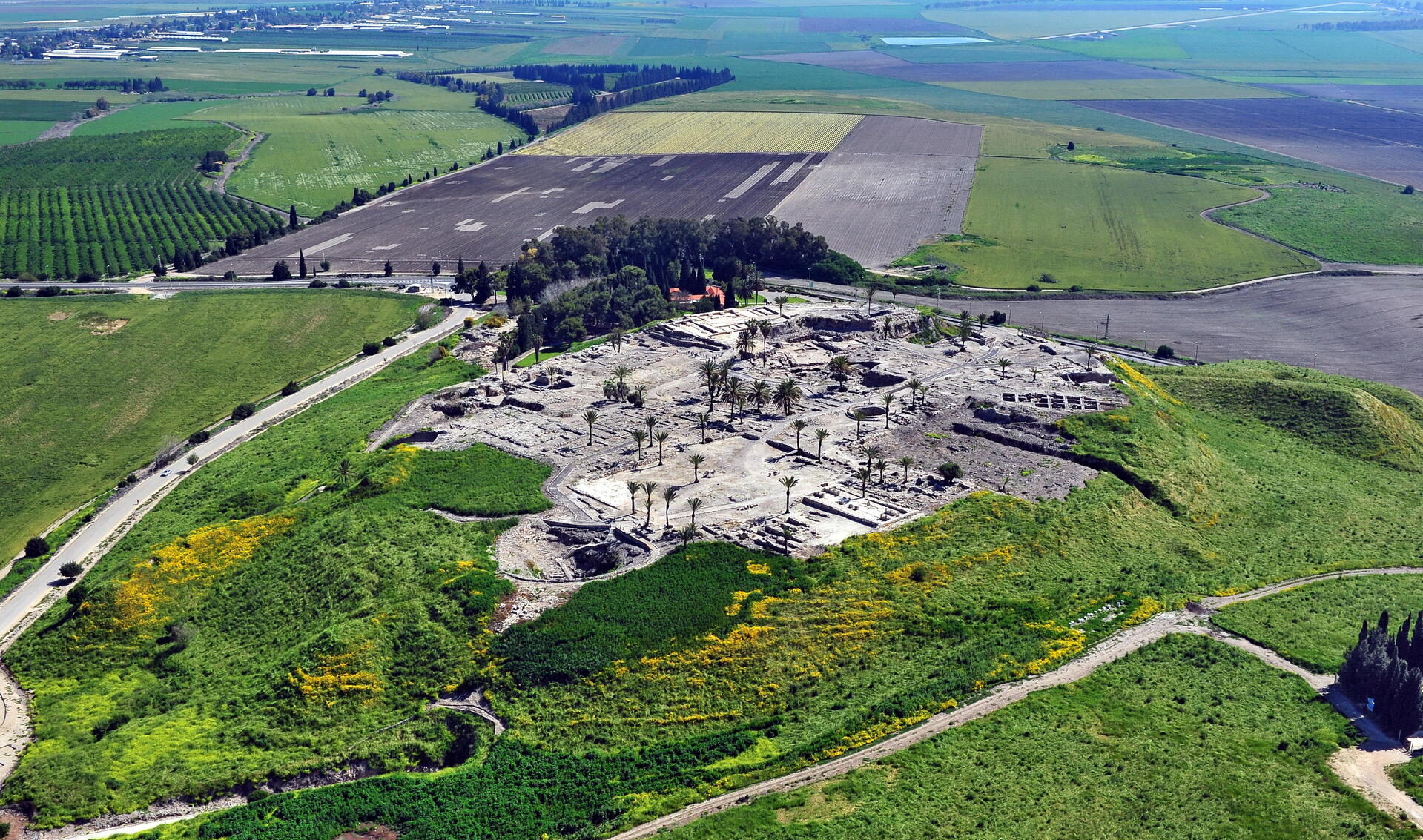
© AVRAM GRAICER, CC BY-SA 3.0 Resized from original. (This derivative is under the same CC BY-SA license.)
World Heritage Research
Discover scientific research and academic studies that deepen our understanding of Biblical Tels - Megiddo, Hazor, Beer Sheba from its history and significance to its conservation, management, and contemporary challenges.
-
Serial properties and heritage interpretation. Lessons from the Israeli Biblical Tels inscription
Serial World Heritage properties, which group multiple sites sharing common themes and values, are influenced by an 'interpretive dynamic' that affects both their nomination justifications and on-site interpretation. This study analyzes the Israeli Biblical Tels—Megiddo, Hazor, Beer-Sheba (2005)—to demonstrate how this dynamic emerges during the inscription process, highlighting a gap between the catalytic use of serial inscriptions and their core value-oriented purpose. The research traces revisions in the nomination to show that interpretive dynamics inevitably shape heritage significance, leading the authors to critique the overuse of serial inscriptions and advocate for redefining them to prioritize interpretation. The findings underscore the need for a more nuanced approach to serial properties to align with their intended role as value-driven constructs.
Wolfling-Assa, O., Alon-Mozes, T., & Liberty-Shalev, R. (2024). Serial properties and heritage interpretation. Lessons from the Israeli Biblical Tels inscription. International Journal of Heritage Studies, 30(5), 519–539. https://doi.org/10.1080/13527258.2024.2320332
View Publication Record | Read Publication -
The Early Kingdom of Judah in Light of Radiometric Dating
New radiometric dating evidence challenges the 'low chronology' model of the Iron Age, revealing that Judah's early kingdom flourished by the 10th century BCE with fortified urban centers like Khirbet Qeiyafa and Gezer. Contrary to minimalist claims, these sites—characterized by casemate walls and strategic positioning—demonstrate sophisticated urban planning aligned with biblical traditions. The study, led by Y. Garfinkel (2024), analyzed samples from Judahite sites, including a six-chambered gate at Gezer, dated to Solomon's reign. This contradicts earlier assumptions that such structures belonged to Israel or were post-Solomonic, instead supporting the historical reliability of biblical accounts of Judah's territorial expansion and monumental construction.
Garfinkel, Y. (2024). The Early Kingdom of Judah in Light of Radiometric Dating. Journal of Eastern Mediterranean Archaeology and Heritage Studies, 12(4), 443–448. https://doi.org/10.5325/jeasmedarcherstu.12.4.0443
View Publication Record | Read Publication -
Figments of Chronological Debates
A groundbreaking radiocarbon dating study of Gezer, one of the Biblical Tels (Megiddo, Hazor, Beer Sheva), challenges long-standing assumptions about the chronology of monumental architecture in the region. Using high-precision radiocarbon dating and Bayesian analysis, researchers dated Gezer's Stratum 8 to the first half of the tenth century BCE, suggesting that its six-chambered gate and administrative center were constructed during this period. This finding complicates the 'high vs. low chronology' debate, which hinges on whether such structures align with biblical accounts of King Solomon's reign. The study also highlights the need for a more nuanced approach to understanding ancient Israelite society, moving beyond simplistic neo-evolutionary models and considering its polymorphous nature—blending settled and nomadic elements. While the new dating provides valuable insights into the gradual emergence of monumental architecture during this transformative period, it underscores the limitations of radiocarbon dating in resolving year-specific events, advocating for the integration of archaeomagnetic dating to achieve more precise chronological reconstructions.
Ben-Yosef, E. (2024). Figments of Chronological Debates. Journal of Eastern Mediterranean Archaeology and Heritage Studies, 12(4), 428–434. https://doi.org/10.5325/jeasmedarcherstu.12.4.0428
View Publication Record | Read Publication -
Solomon, Scripture, and Science at Gezer
New carbon-14 dates from Gezer Field IV provide conclusive evidence for the existence of an early Judahite state by the late eleventh to tenth century BCE, effectively dismantling the 'low chronology' paradigm proposed by Israel Finkelstein. This paradigm, which sought to down-date monumental archaeological evidence and eliminate the historical validity of the united monarchy described in biblical narratives, has been widely discredited due to its reliance on selective data and propaganda tactics. The study employs a rigorous comparison of carbon-14 dates from multiple sites, including Megiddo, Tel Rehov, Khirbet Qeiyafa, and others, demonstrating that the conventional chronology is supported by a preponderance of evidence. Unlike Finkelstein's approach, which often ignored opposing data, this research adheres to patient, well-documented scholarship, advocating for a shift from arbitrary phasing (e.g., 'Iron IIA') to absolute, high-precision dating methods. The findings underscore the importance of scientific rigor over ideological agendas in reconstructing ancient history.
Dever, W. G. (2024). Solomon, Scripture, and Science at Gezer. Journal of Eastern Mediterranean Archaeology and Heritage Studies, 12(4), 434–437. https://doi.org/10.5325/jeasmedarcherstu.12.4.0434
View Publication Record | Read Publication -
To what extent did foreign aspects influence the religion of the Judahites? Sanctuaries, altars and terracotta figurines
Recent archaeological discoveries from Israel reveal significant foreign influences on the religion of the Judahites during the Iron Age. The Judahite temple at Tel Moẓa exhibits North Syrian architectural elements, while horned altars found in Beer-sheba and Dan or Megiddo are linked to Philistine traditions originating in the Aegean region and Egypt. Additionally, terracotta figurines, such as the 'horse and rider' from Moẓa, suggest a shift in symbolic representation, possibly indicating elite status rather than divine imagery. The study analyzes these artifacts by comparing them with parallels from other sites, providing insight into how Judahite cult practices were shaped by interactions with neighboring cultures, including Egypt, the Aegean, Syria, and Mesopotamia.
Moulis, D. R. (2021). To what extent did foreign aspects influence the religion of the Judahites? Sanctuaries, altars and terracotta figurines. Acta Fakulty Filozofické, 13(1). https://doi.org/10.24132/actaff.2021.13.1.2
View Publication Record | Read Publication -
Israel at the time of the united monarchy
Archaeological and biblical evidence from the 10th century BCE suggests that non-biblical testimony, including findings at Megiddo, Hazor, Gezer, tenth-century Jerusalem, Khirbet Qeiyafa, and the Tel Dan Inscription, aligns with the broad narrative of Israel's united monarchy under Kings David and Solomon. While this evidence is incomplete and contested, it provides a coherent framework that supports the biblical accounts found in 1–2 Samuel and 1 Kings. The study integrates multi-disciplinary approaches to reconstruct historical contexts, offering insights into the political and cultural landscape of ancient Israel.
Johnson, B. J. M. (2021). Israel at the time of the united monarchy. The Biblical World, 498–518. https://doi.org/10.4324/9781315678894-32
View Publication Record | Read Publication -
Archaeology, Epigraphy, Philology
A reevaluation of the term 'tōr' in biblical texts, traditionally translated as 'turtledove,' challenges its conventional interpretation. Scholars propose alternative renderings based on zooarchaeological data from the Southern Levant, suggesting that sacrificial birds in ancient Israel may not have been exclusively domesticated. This finding has implications for understanding Israelite cult practices and the relationship between household boundaries and ritual spaces. The study combines archaeological bird remains with biblical indications to refine interpretations of sacrificial rituals.
Begg, C. T., Urbrock, W. J., Matthews, V. H., Spencer, J. R., Payne, R. C., & Guyette, F. W. (2021). Archaeology, Epigraphy, Philology. Old Testament Abstracts, 44(1), 40–68. https://doi.org/10.1353/ota.2021.0004
View Publication Record | Read Publication