World Heritage Identification Number: 1096
World Heritage since: 2003
Category: Cultural Heritage
WHE Type: Historic Cities & Urban Areas
Transboundary Heritage: No
Endangered Heritage: No
Country: 🇮🇱 Israel
Continent: Asia
UNESCO World Region: Europe and North America
Map
The White City of Tel-Aviv - A Unique Blend of Modern Architecture and Middle Eastern Culture
The White City of Tel-Aviv, officially recognized as a UNESCO World Heritage Site since 2003, stands as a remarkable testament to the fusion of modern architecture and Middle Eastern culture. This architectural ensemble, primarily consisting of over 4,000 buildings from the 1930s, represents a unique interpretation of the International Style, more commonly known as Bauhaus, in a new cultural context.
More to come…UNESCO Description of the World Heritage Site
Tel Aviv was founded in 1909 and developed as a metropolitan city under the British Mandate in Palestine. The White City was constructed from the early 1930s until the 1950s, based on the urban plan by Sir Patrick Geddes, reflecting modern organic planning principles. The buildings were designed by architects who were trained in Europe where they practised their profession before immigrating. They created an outstanding architectural ensemble of the Modern Movement in a new cultural context.
UNESCO Justification of the World Heritage Site
Criterion (ii): The White City of Tel Aviv is a synthesis of outstanding significance of the various trends of the Modern Movement in architecture and town planning in the early part of the 20th century. Such influences were adapted to the cultural and climatic conditions of the place, as well as being integrated with local traditions.
Criterion (iv): The White City of Tel Aviv is an outstanding example of new town planning and architecture in the early 20th century, adapted to the requirements of a particular cultural and geographic context.
Encyclopedia Record: White City, Tel Aviv
The White City is a collection of over 4,000 buildings in Tel Aviv from the 1930s built in a unique form of the International Style, commonly known as Bauhaus, by German Jewish architects who fled to the British Mandate of Palestine from Germany after the rise to power of the Nazis. Tel Aviv has the largest number of buildings in the Bauhaus/International Style of any city in the world. Preservation, documentation, and exhibitions have brought attention to Tel Aviv's collection of 1930s architecture. In 2003, the United Nations Educational, Scientific and Cultural Organization (UNESCO) proclaimed Tel Aviv's White City a World Cultural Heritage site, as "an outstanding example of new town planning and architecture in the early 20th century." The citation recognized the unique adaptation of modern international architectural trends to the cultural, climatic, and local traditions of the city. Bauhaus Center Tel Aviv organizes regular architectural tours of the city.Additional Site Details
Area: 140.4 hectares
Number of Components: 1
(iv) — Outstanding example of a type of building or landscape
Coordinates: 32.0777777778 , 34.7741666667
Image
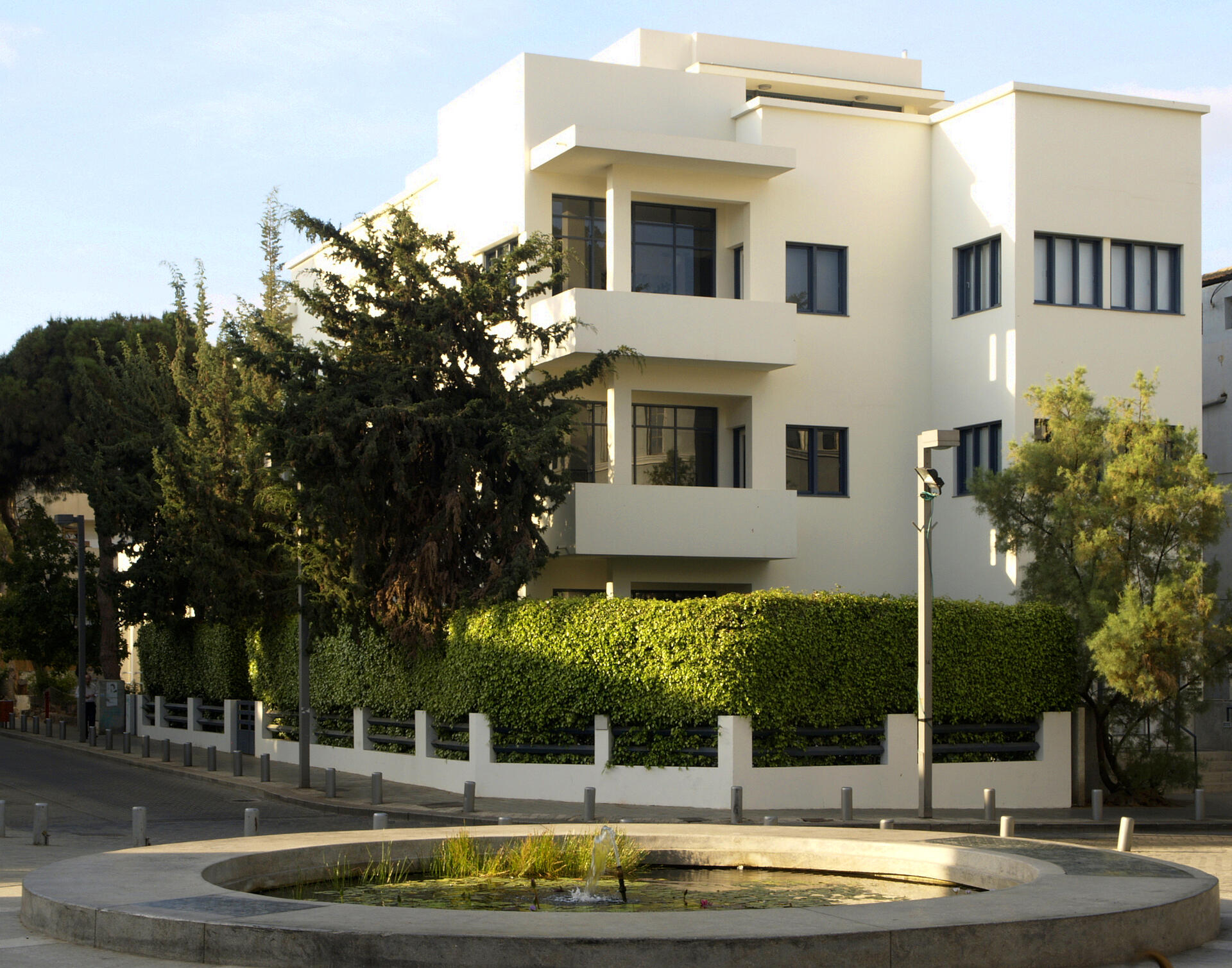
© BergA, CC BY-SA 3.0 Resized from original. (This derivative is under the same CC BY-SA license.)
World Heritage Research
Discover scientific research and academic studies that deepen our understanding of White City of Tel-Aviv – the Modern Movement from its history and significance to its conservation, management, and contemporary challenges.
-
Reinterpreting the Garden City: Green-Built Relations in Tel Aviv’s Metropolitan Planning
Green-built relations, a core principle of the Garden City concept adapted in Tel Aviv's 1925 plan by Patrick Geddes, extend beyond the UNESCO World Heritage inscribed White City area but are unevenly recognized across municipalities and planning documents. This study analyzed strategic plans, conservation frameworks, and master plans using a workshop involving 18 participants who evaluated six municipal planning documents against 31 predefined attributes. Findings reveal that these attributes, which underpin the Outstanding Universal Value of the site, persist in metropolitan planning but with significant variation. The research demonstrates green-built relations as a valuable framework for integrating heritage management with metropolitan planning and supporting Nature-Culture governance approaches.
Matar, A., Cannatella, D., & Pereira Roders, A. (2026). Reinterpreting the Garden City: Green-Built Relations in Tel Aviv’s Metropolitan Planning. Land, 15(3), 359. https://doi.org/10.3390/land15030359
View Publication Record | Read Publication -
From garden city planning to World Heritage property: the cultural significance of the nature–culture relations of Tel Aviv
Research reveals a progressive shift in the cultural significance attributed to nature-culture relations in Tel Aviv's White City, from Patrick Geddes' 1925 integrated vision—where built and natural attributes were equally prominent—to ICOMOS and UNESCO evaluations that prioritized architectural concepts while genericizing natural elements. This transition likely stems from the inclusion of International Style architecture and the evaluative scope of the inscription process. The study employs comparative content analysis, code counting, and co-occurrence analysis to systematically evaluate these shifts, offering a transferable framework for assessing cultural significance in planned urban landscapes and informing heritage management and urban planning policies.
Matar, A., Cannatella, D., & Pereira Roders, A. (2026). From garden city planning to World Heritage property: the cultural significance of the nature–culture relations of Tel Aviv. Built Heritage, 10(1). https://doi.org/10.1186/s43238-026-00290-8
View Publication Record | Read Publication -
Conclusion. White Supremacy, Settler Colonialism, Modernist Architecture, and Contemporary Preservation
This study reveals how the narratives of preservationists shape the historical understanding and political significance of modernist architecture, particularly within UNESCO World Heritage Sites. It demonstrates that knowledge about the modernist movement is not neutral but is deeply intertwined with power dynamics, influencing international politics and the global perception of modernist architecture. The research analyzes how preservationist practices in cities like Tel Aviv, Brasília, Rabat, Asmara, and Casablanca consolidate privileged positions for those trained in architectural history while framing modernist architecture as a universal project. By examining epistemic, institutional, and personal power structures, the study highlights the consequences of these narrative practices on global heritage recognition.
Flahive, R. (2025). Conclusion. White Supremacy, Settler Colonialism, Modernist Architecture, and Contemporary Preservation, 159–166. https://doi.org/10.4324/9781003566588-8
View Publication Record | Read Publication -
White Supremacy, Settler Colonialism, Modernist Architecture, and Contemporary Preservation
Contemporary architectural preservation efforts have inadvertently perpetuated the racialized legacy of early 20th-century settler colonialism, particularly in UNESCO World Heritage Sites like Tel Aviv. The study reveals how preservation narratives, including documentation and inscription on the World Heritage List, often reinforce the notion of 'white cities'—originally designed to exclude Indigenous zones. Through ethnographic research with local preservationists and analysis of primary sources such as World Heritage Committee notes and nomination files, the book exposes the geopolitical and spatial politics embedded in modernist architecture. This work challenges scholars and policymakers to reconsider the ethics and consequences of preserving built environments that carry colonial histories.
Flahive, R. (2025). White Supremacy, Settler Colonialism, Modernist Architecture, and Contemporary Preservation. https://doi.org/10.4324/9781003566588
View Publication Record | Read Publication -
Silencing Palestinians
This study reveals how the preservation of Tel-Aviv's White City obscures its settler colonial origins and racialized history. By analyzing nomination documents, committee materials, and ethnographic data from preservationists, it demonstrates that narratives surrounding the site's significance erase the relationship between Israelis and Palestinians, reinforcing ontological boundaries through epistemological silences. The research exposes how Zionist national historiographies, modernist architectural discourse (e.g., DOCOMOMO), and UNESCO's technopolitical frameworks collectively edit out histories of colonialism and racial difference, thereby reshaping Israeli national history and the legacy of modernist architecture.
Flahive, R. (2025). Silencing Palestinians. White Supremacy, Settler Colonialism, Modernist Architecture, and Contemporary Preservation, 83–111. https://doi.org/10.4324/9781003566588-4
View Publication Record | Read Publication -
Ideal construction and adaptation: experiences and implications of idyllic urban planning in Tel Aviv
Tel Aviv's urban planning, influenced by Zionism and the modern movement, exemplifies the adaptability of the idyllic city concept—a design approach rooted in concentric circles and parks that transcends its formal expression to embrace social significance. This study reveals how Tel Aviv's idyllic city development has evolved over time, synthesizing early Jewish urban theories with contemporary sustainable planning practices. By analyzing adaptive characteristics such as 'survival and retention,' the research provides a framework for applying this concept in modern urban regeneration, aiming to balance human, societal, and environmental sustainability. The findings offer valuable insights for global urban planning, demonstrating how historical idyllic models can be reimagined for 21st-century challenges.
Tian, H., Li, M., Ding, Y., & Dou, Y. (2024). Ideal construction and adaptation: experiences and implications of idyllic urban planning in Tel Aviv. Journal of Asian Architecture and Building Engineering, 24(5), 4589–4605. https://doi.org/10.1080/13467581.2024.2399733
View Publication Record | Read Publication -
Concluding remarks
Murals and public art significantly impact urban environments, influencing community values, politics, inclusion, and social debates. This study highlights their role in shaping cities, provoking discussions on creative freedom, property rights, policy-making, and the right to the city. Through qualitative analysis of murals in Tel Aviv, Littleton, and Detroit, the research demonstrates how these artworks serve as powerful reminders of cultural significance and community identity. The findings underscore the need for further exploration into the perception, regulation, maintenance, and financing of public art to better understand its broader societal implications.
Mendelson-Shwartz, E., & Mualam, N. (2024). Concluding remarks. Murals and the City, 335–339. https://doi.org/10.4324/9781003370956-19
View Publication Record | Read Publication