World Heritage Identification Number: 1368
World Heritage since: 2011
Category: Cultural Heritage
WHE Type: Infrastructure & Industry
Transboundary Heritage: No
Endangered Heritage: No
Country: 🇩🇪 Germany
Continent: Europe
UNESCO World Region: Europe and North America
Map
Pioneering Modern Architecture: The Fagus Factory in Alfeld
The Fagus Factory in Alfeld, located in Lower Saxony, Germany, stands as a testament to the revolutionary spirit that characterized the dawn of modern architecture. Inscribed as a UNESCO World Heritage Site in 2011, this ten-building complex, designed by Walter Gropius and Adolf Meyer, serves as a significant milestone in the evolution of architectural design and industrial construction.
More to come…UNESCO Description of the World Heritage Site
Fagus Factory in Alfeld is a 10-building complex - began around 1910 to the design of Walter Gropius, which is a landmark in the development of modern architecture and industrial design. Serving all stages of manufacture, storage and dispatch of lasts used by the shoe industry, the complex, which is still operational today, is situated in Alfeld an der Leine in Lower Saxony. With its groundbreaking vast expanses of glass panels and functionalist aesthetics, the complex foreshadowed the work of the Bauhaus school and is a landmark in the development of architecture in Europe and North America.
UNESCO Justification of the World Heritage Site
Criterion (ii): The Fagus factory in Alfeld illustrates a moment of considerable interchange between different generations of German, European and North American architects, which gave rise to a rational and modernist architecture. It was a site of synthesis of these influences, which were technical, artistic and humanistic; it went on to influence many other architectural works; it was the starting point of the Bauhaus movement.
Criterion (iv): A manifesto of modernity in architecture, the Fagus factory won its designer, Walter Gropius, an international reputation. It exemplifies the innovation of the curtain wall, which optimises both luminosity and lightness. It is a concrete expression of the functionality of the industrial complex in the interest of productivity and the humanisation of the working environment. It incorporates into the scheme the concepts of industrial aesthetics and design.
Encyclopedia Record: Fagus Factory
The Fagus Factory, a shoe last factory in Alfeld on the Leine, Lower Saxony, Germany, is an important example of early modern architecture. Commissioned by owner Carl Benscheidt who wanted a radical structure to express the company's break from the past, the factory was designed by Walter Gropius and Adolf Meyer. It was constructed between 1911 and 1913, with additions and interiors completed in 1925. Because of its influence in the development of modern architecture and outstanding design, the factory has been listed as a UNESCO World Heritage Site since 2011.Additional Site Details
Area: 1.88 hectares
Number of Components: 1
(iv) — Outstanding example of a type of building or landscape
Coordinates: 51.9838888889 , 9.8122222222
Image
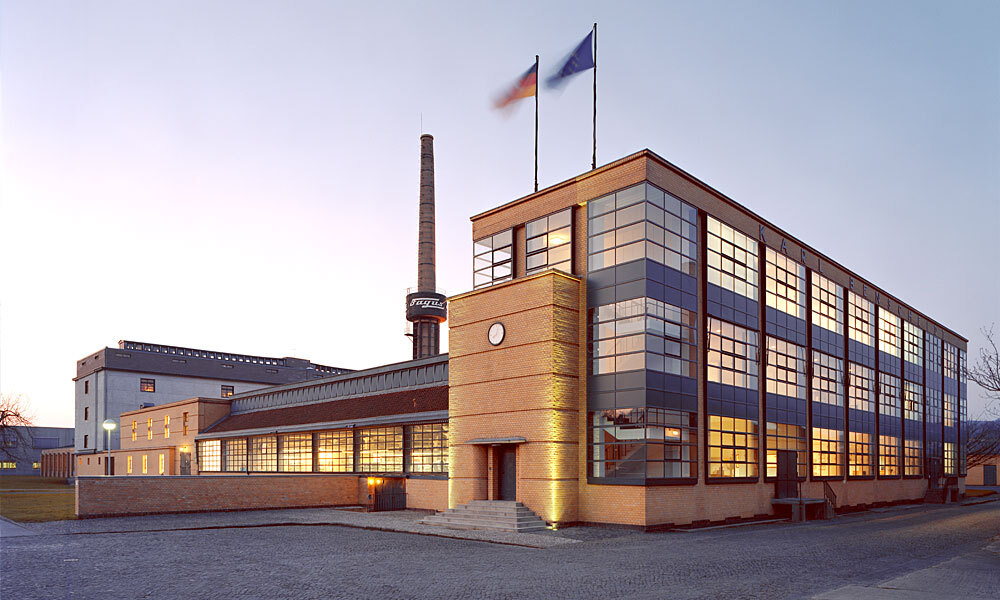
© Carsten Janssen, CC BY-SA 2.0 de Resized from original. (This derivative is under the same CC BY-SA license.)
World Heritage Research
Discover scientific research and academic studies that deepen our understanding of Fagus Factory in Alfeld from its history and significance to its conservation, management, and contemporary challenges.
-
People, Factories, and Making
Factories are not just physical spaces but dynamic arenas where architecture, social theories, and production processes intersect. This study reveals that the design of manufacturing environments—such as the Fagus Factory in Alfeld, AEG turbine plant, or Apple’s headquarters—shapes complex relationships between employers, employees, and products, leaving lasting impacts on both workers and urban landscapes. By analyzing diverse factory typologies, the research demonstrates how architectural innovation reflects broader social and economic forces, including employment terms and global competition. The findings highlight the evolving role of developers and architects in reimagining workspaces to adapt to changing industrial dynamics.
Hatuka, T., & Ben-Joseph, E. (2022). People, Factories, and Making. New Industrial Urbanism, 21–37. https://doi.org/10.4324/9780367855000-2
View Publication Record | Read Publication -
Artistic Component in Modern Industrial Architecture
Modern industrial architecture, exemplified by sites such as the Fagus Factory in Alfeld and the Nestle plant in Mexico, increasingly integrates aesthetic design to enhance productivity and social integration. Research highlights that incorporating artistic elements—such as aluminum facades or varied color schemes—not only improves worker efficiency but also fosters environmental sustainability through energy-efficient designs. The study emphasizes the dual role of industrial buildings, blending functional necessity with cultural significance while addressing resource depletion. By analyzing spatial composition and material innovation, this work underscores the evolving intersection of technology, aesthetics, and urban development in industrial landscapes.
Kharytonova, A. A., Kravchuk, Y. R.,. (2020). ARTISTIC COMPONENT IN MODERN INDUSTRIAL ARCHITECTURE. Regional Problems of Architecture and Urban Planning, (14), 123–128. https://doi.org/10.31650/2707-403x-2020-14-123-128
View Publication Record | Read Publication -
Parallels of German Avant-garde Architecture and Development in Kyiv
This comparative analysis reveals striking parallels between German and Kyiv architectural developments in the early 20th century, highlighting shared trends from Art Nouveau to avant-garde movements. The study examines key structures like Walter Gropius and Adolf Meyer's Fagus Factory (1910-1911), Max Berg's Centennial Hall (1911-1913), and Kyiv's Stalin district power plant (1926–1930) by Mikhailo Parusnikov, among others. It traces the evolution from eclecticism to modernism, noting influences such as Werkbund, Bauhaus, constructivism, and Soviet neoclassicism. The research underscores how Kyiv's architectural trajectory reflects broader international artistic transitions, including Stalinist empire and post-war modernism.
Markovskyi, A. (2020). PARALLELS OF GERMAN AVANT-GARDE ARCHITECTURE AND DEVELOPMENT IN KYIV. Current Problems of Architecture and Urban Planning, (58), 302–313. https://doi.org/10.32347/2077-3455.2020.58.302-313
View Publication Record | Read Publication -
Fagus-Werk
The Fagus Factory in Alfeld, Germany, stands as a seminal work of modern architecture, embodying the 'objective' (sachlich) principles of the 1920s Modern Movement. Built between 1911 and 1914 by Walter Gropius—with contributions from Adolf Meyer—it is recognized as a pioneer in architectural realism. This study reinterprets its historical significance by scrutinizing its planning stages, design process, and the influences shaping its development. It also addresses potential challenges arising from the assimilation of architectural history, offering a nuanced perspective on its enduring impact on modern architecture.
(Ed.). (2019). Fagus-Werk. Walter Gropius, 28–33. https://doi.org/10.1515/9783035617375-008
View Publication Record | Read Publication -
Reglazing Modernism
Modernist architecture, characterized by its extensive use of steel and glass building envelopes, faces significant preservation challenges due to defects in the building fabric. This study evaluates the current technological approaches to addressing these issues through three primary strategies: restoration, rehabilitation, and replacement. Focusing on 20 iconic buildings across Europe and the USA—including Fallingwater House by Frank Lloyd Wright and the Fagus Factory by Walter Gropius—the research provides a comprehensive overview of how architectural design, building physics, and historic preservation principles are applied to maintain these structures. The findings highlight the effectiveness and limitations of each strategy, offering practical insights for the conservation of modernist heritage sites.
Pottgiesser, U., & Ayón, A. (2019). Reglazing Modernism. https://doi.org/10.1515/9783035619348
View Publication Record | Read Publication -
Neue Fassaden im Bestand
A comprehensive analysis of the preservation challenges faced by iconic steel and glass buildings, including UNESCO-recognized sites like the Fagus Factory in Alfeld, reveals that restoration, rehabilitation, and replacement are the three most effective strategies for maintaining their structural integrity and historical authenticity. The study documents 20 European and American buildings, showcasing advanced technological solutions to address severe defects in building fabric while balancing architectural design, building physics, and heritage conservation principles. By examining landmark structures such as Fallingwater House by Frank Lloyd Wright and the Farnsworth House by Ludwig Mies van der Rohe, alongside the Fagus Factory and Bauhaus Building by Walter Gropius, this research provides a critical framework for preserving modernist architecture without compromising its original character.
Pottgiesser, U., & Ayón, A. (2019). Neue Fassaden im Bestand. https://doi.org/10.1515/9783035619324
View Publication Record | Read Publication -
Walter Gropius: The Fagus Factory
A groundbreaking architectural analysis reveals Walter Gropius' innovative design philosophy, exemplified by the Fagus Factory in Alfeld. This study dissects his classic works to uncover how structural and functional elements were harmonized to challenge traditional norms, emphasizing industrial aesthetics and spatial efficiency. Gropius' approach integrated modernist principles with practical engineering, setting a precedent for 20th-century architecture. The research employs comparative analysis of his projects, highlighting the Fagus Factory as a pivotal case study that bridges theoretical thought and built environment.
XUE, J. (2017). Walter Gropius: The Fagus Factory. Proceedings of the 2016 International Conference on Architectural Engineering and Civil Engineering. https://doi.org/10.2991/aece-16.2017.23
View Publication Record | Read Publication