World Heritage Identification Number: 398
World Heritage since: 1996
Category: Cultural Heritage
WHE Type: Buildings & Architectural Ensembles
Transboundary Heritage: No
Endangered Heritage: No
Country: 🇮🇹 Italy
Continent: Europe
UNESCO World Region: Europe and North America
Map
The Enigmatic Castle of Castel del Monte: A Medieval Masterpiece in Southern Italy
The enigmatic Castle of Castel del Monte, nestled on a hilltop in the Apulia region of southeastern Italy, stands as a testament to the architectural prowess and intellectual curiosity of its builder, King Frederick II (r. 1220-1250). This unique structure, inscribed as a UNESCO World Heritage Site in 1996, offers a fascinating blend of influences from classical antiquity, the Islamic Orient, and North European Cistercian Gothic.
More to come…UNESCO Description of the World Heritage Site
When the Emperor Frederick II built this castle near Bari in the 13th century, he imbued it with symbolic significance, as reflected in the location, the mathematical and astronomical precision of the layout and the perfectly regular shape. A unique piece of medieval military architecture, Castel del Monte is a successful blend of elements from classical antiquity, the Islamic Orient and north European Cistercian Gothic.
UNESCO Justification of the World Heritage Site
Criterion (i): Given its formal perfection and harmonious blending of cultural elements from northern Europe, the Muslim world and classical antiquity, Castel del Monte is a unique masterpiece of medieval military architecture which reflects the humanist ideas of its founder, Frederick II of Hohenstaufen.
Criterion (ii): Inseparably linked to Frederick II of Hohenstaufen, the building of Castel del Monte illustrates the cosmopolitan spirit of the Emperor who brought together Greek, Arab, Italian and Jewish scholars to his court in Palermo. This designates him as one of the precursors of the modern humanists.
Criterion (iii): Symbolic of the Mediterranean policy of a Germanic Emperor who was born at Iesî, brought up in Sicily and attracted at a very early age by the Oriental world, Castel del Monte combines intellectual and moral elements from the great Mediterranean civilizations in one creation.
Encyclopedia Record: Castel del Monte, Apulia
Castel del Monte is a 13th-century citadel and castle situated on a hill in Andria in the Apulia region of southeast Italy. It was built during the 1240s by King Frederick II, who had inherited the lands from his mother Constance of Sicily. In the 18th century, the castle's interior marbles and remaining furnishings were removed. It has neither a moat nor a drawbridge and some considered it never to have been intended as a defensive fortress. However, archaeological work has suggested that it originally had a curtain wall.Additional Site Details
Area: 3.1 hectares
Number of Components: 1
(ii) — Significant interchange of human values
(iii) — Unique or exceptional testimony to a cultural tradition
Coordinates: 41.08480556 , 16.27094444
Image
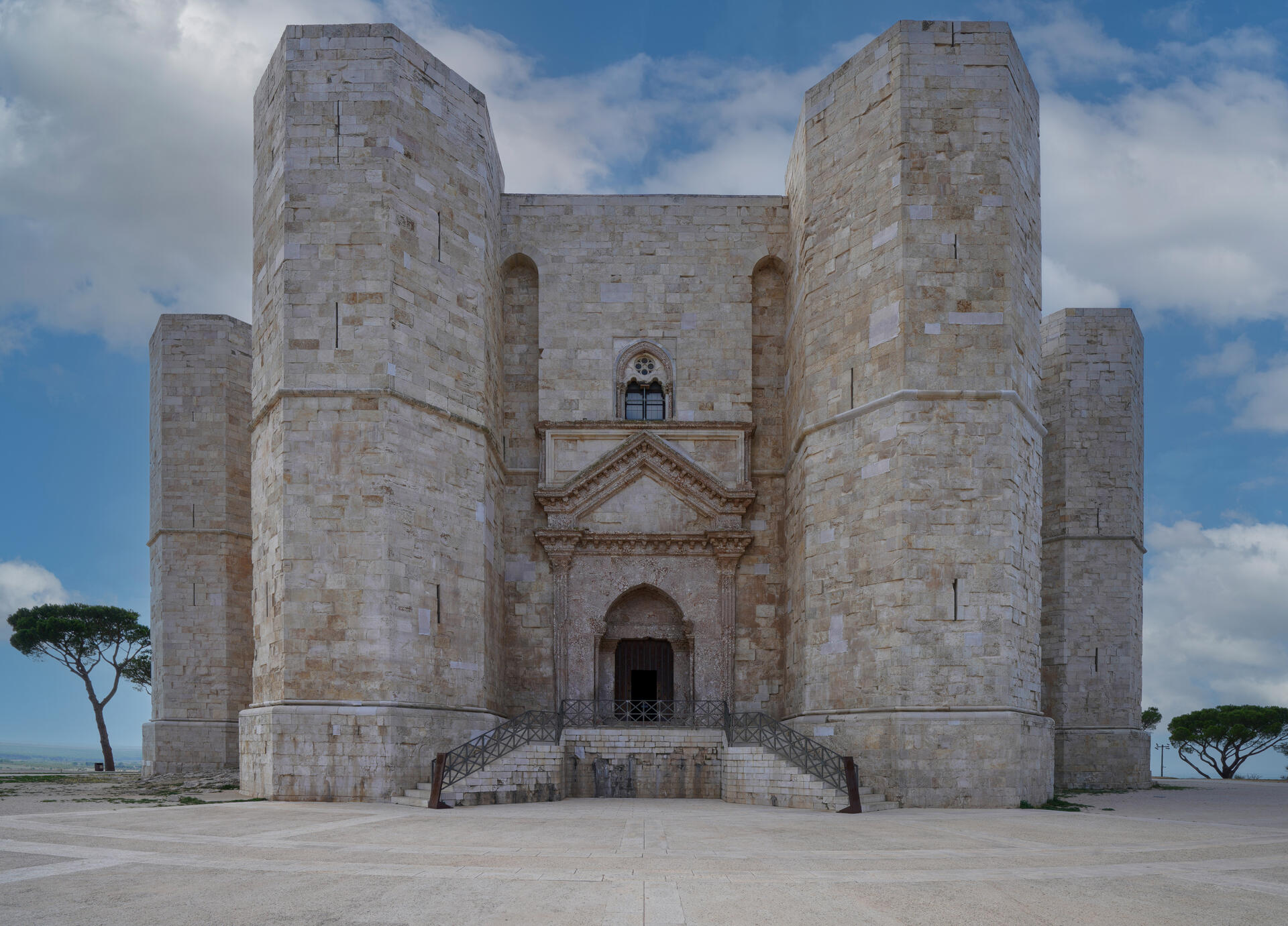
© ParisTaras, CC BY-SA 4.0 Resized from original. (This derivative is under the same CC BY-SA license.)
World Heritage Research
Discover scientific research and academic studies that deepen our understanding of Castel del Monte from its history and significance to its conservation, management, and contemporary challenges.
-
The role of the ‘silver ratio’ in the geometry of Castel del Monte
Research reveals that the geometry of Castel del Monte can be harmoniously constructed using solely the silver ratio, eliminating slight discrepancies observed when both the golden and silver ratios are applied. This study challenges traditional assumptions about the influence of historical octagonal plans on Frederick II's design choices by focusing on the silver ratio's role in creating balanced proportions within the castle's structure. The analysis employs geometric relationships to propose an idealized plan that maintains aesthetic harmony, offering new insights into the mathematical principles underlying medieval architectural innovation.
Castellano, A., & Demelio, G. P. (2022). The role of the ‘silver ratio’ in the geometry of Castel del Monte. Journal of Mathematics and the Arts, 16(4), 309–335. https://doi.org/10.1080/17513472.2022.2124475
View Publication Record | Read Publication -
Razionalità e mistero a Castel del Monte
Castel del Monte, the enigmatic fortress commissioned by Emperor Frederick II of Swabia, embodies rational beauty through its perfect forms and mathematical precision. The structure's design, rooted in concepts like the golden ratio, reflects a deliberate harmony of form, number, and naturalistic detail, symbolizing imperial perfection. While the building's myriad interpretations remain speculative, its aesthetic and symbolic significance stand as a testament to the intersection of art, mathematics, and political power. This study underscores Castel del Monte’s role as a masterful fusion of rationality and mystery, where every element serves both functional and symbolic purposes.
Colli Franzone Bonzanini, A. (2016). Razionalità e mistero a Castel del Monte. ----, Vol 7, No 3 (2016): Issue 3/2016. https://doi.org/10.13132/2038-5498/7.3.147-151
View Publication Record | Read Publication -
Wulf Schirmer: Castel del Monte
Castel del Monte has been the subject of significant architectural and historical research, as documented in Wulf Schirmer's study. The book presents groundbreaking findings from research conducted between 1990 and 1996, focusing on the site's archaeological and architectural history. Schirmer, along with a team of collaborators including Günter Hell, Dorothee Sack, Werner Schnuchel, Christoph Uricher, and Wolfgang Zick, employed a multidisciplinary approach to analyze Castel del Monte. The study incorporates photographs by Rafael Cardenas-Dopf, providing visual documentation that complements the textual analysis. Key insights include the reconstruction of the site's historical layers and an in-depth examination of its unique architectural features, contributing significantly to the understanding of its cultural significance.
Knaak, A. (2016). Wulf Schirmer: Castel del Monte. Journal Für Kunstgeschichte, Bd. 6 Nr. 4 (2002): Journal für Kunstgeschichte. https://doi.org/10.11588/JFK.2002.4.32248
View Publication Record | Read Publication