World Heritage Identification Number: 670
World Heritage since: 1993
Category: Cultural Heritage
WHE Type: Archaeological Sites
Transboundary Heritage: No
Endangered Heritage: No
Country: 🇮🇹 Italy
Continent: Europe
UNESCO World Region: Europe and North America
Map
The Sassi and the Park of the Rupestrian Churches of Matera: A Unique Troglodyte Settlement in Southern Italy
The Sassi and the Park of the Rupestrian Churches of Matera, located in the southern Italian region of Basilicata, is a remarkable UNESCO World Heritage Site that offers a unique glimpse into human history. This site is renowned for its troglodyte settlements, which are cave dwellings carved into the soft tufa rock, dating back to the Paleolithic era.
More to come…UNESCO Description of the World Heritage Site
This is the most outstanding, intact example of a troglodyte settlement in the Mediterranean region, perfectly adapted to its terrain and ecosystem. The first inhabited zone dates from the Palaeolithic, while later settlements illustrate a number of significant stages in human history. Matera is in the southern region of Basilicata.
UNESCO Justification of the World Heritage Site
Criterion (iii): The Sassi and the Park of the Rupestrian Churches of Matera represent an outstanding example of a rock-cut settlement, adapted perfectly to its geomorphological setting and ecosystem and exhibiting continuity over more than two millennia.
Criterion (iv): The town and park constitute an outstanding example of an architectural ensemble and landscape illustrating a number of significant stages in human history.
Criterion (v): The town and park represent an outstanding example of a traditional human settlement and land-use showing the evolution of a culture which has maintained a harmonious relationship with its natural environment over time.
Encyclopedia Record: Sassi di Matera
The Sassi di Matera are two districts of the Italian city of Matera, Basilicata, well-known for their ancient cave dwellings inhabited since the Paleolithic period.Additional Site Details
Area: 1,016 hectares
Number of Components: 1
(iv) — Outstanding example of a type of building or landscape
(v) — Outstanding example of traditional human settlement
Coordinates: 40.66638889 , 16.61027778
Image
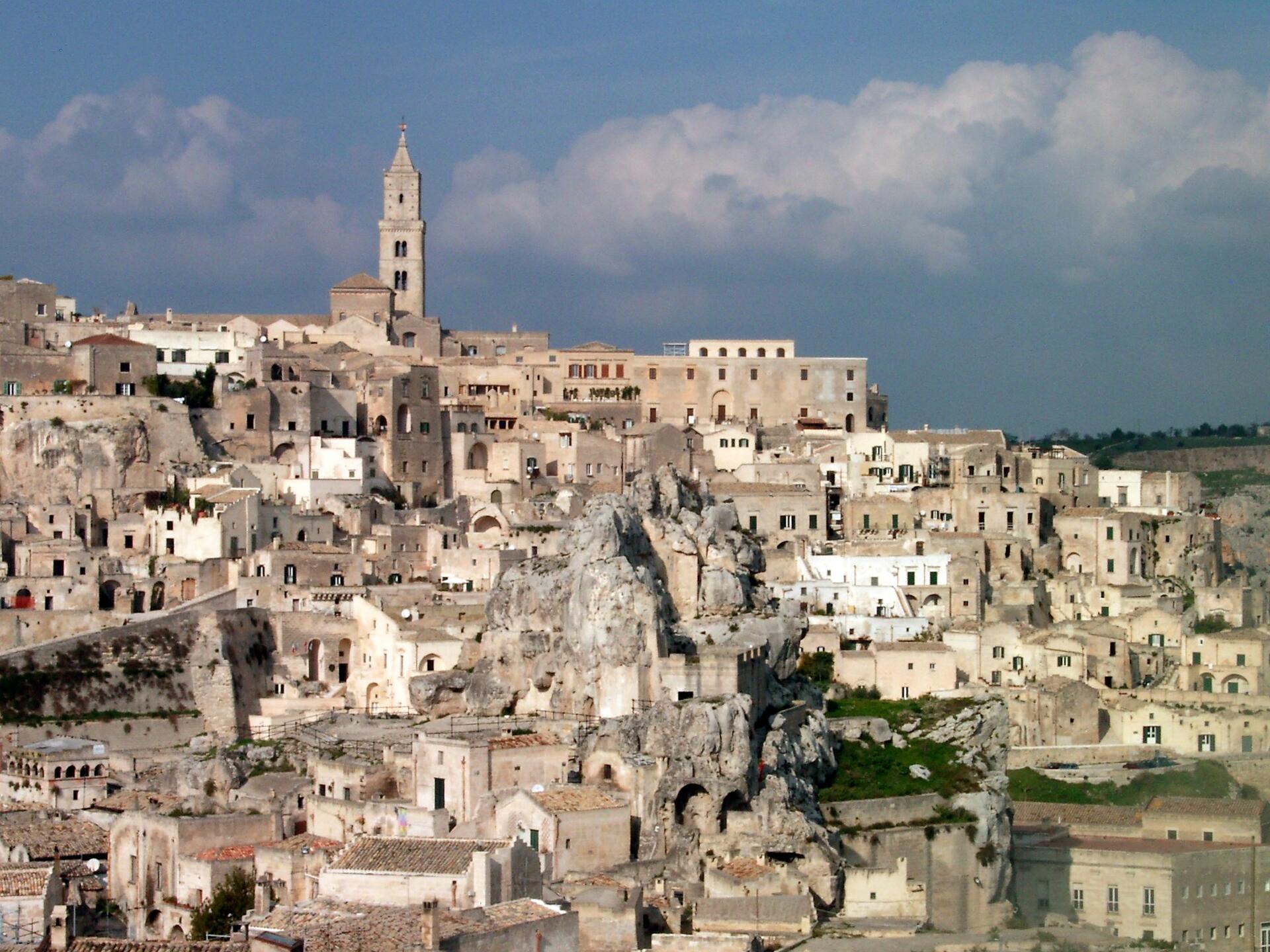
© Bönisch, CC BY-SA 2.0 de Resized from original. (This derivative is under the same CC BY-SA license.)
World Heritage Research
Discover scientific research and academic studies that deepen our understanding of The Sassi and the Park of the Rupestrian Churches of Matera from its history and significance to its conservation, management, and contemporary challenges.
-
Evaluation of Calcarenite Degradation by X-ray Photoelectron Spectroscopy Analysis inside the Rupestrian Church of San Pietro Barisano (Matera, Southern Italy)
X-ray photoelectron spectroscopy (XPS) analysis reveals distinct degradation products on the calcarenite surfaces of San Pietro Barisano, a rupestrian church within Matera's UNESCO-listed Sassi district. This study identifies biotic and abiotic degradation indicators, offering a diagnostic framework for preserving such heritage sites. By comparing degraded samples to reference calcarenite, researchers link findings to local environmental factors and historical context, enabling targeted conservation strategies under the National Smart Cities research project.
Cardellicchio, F., Acquavia, M. A., Curcio, M., & Salvi, A. M. (2024). Evaluation of Calcarenite Degradation by X-ray Photoelectron Spectroscopy Analysis inside the Rupestrian Church of San Pietro Barisano (Matera, Southern Italy). Sustainability, 16(11), 4634. https://doi.org/10.3390/su16114634
View Publication Record | Read Publication -
La conoscenza per il recupero dei ‘valori’ del passato: il caso della chiesa della Madonna delle Vergini a Matera
The Church of the Madonna delle Vergini, a 16th-century rupestrian church within Matera’s UNESCO-listed Park of the Rupestrian Churches, stands as a living testament to the region's historical and cultural evolution. This study highlights its role as a fragile yet invaluable repository of ancient traditions, now largely lost, which are critical for understanding the interplay between human settlement and natural landscapes in the Sassi district. By employing multidisciplinary analysis, researchers aim to recover these intangible and material values, offering new pathways for preserving and appreciating Matera’s religious and rupestrian heritage. The approach underscores the necessity of integrating historical, artistic, and archaeological perspectives to inform sustainable conservation strategies that balance past significance with contemporary enjoyment.
Pagliuca, A., & D’Angiulli, G. (2023). La conoscenza per il recupero dei ‘valori’ del passato: il caso della chiesa della Madonna delle Vergini a Matera. Restauro Archeologico, 30(1). https://doi.org/10.36253/rar-14333
View Publication Record | Read Publication -
Application and Monitoring of Oxidative Alginate–Biocide Hydrogels for Two Case Studies in “The Sassi and the Park of the Rupestrian Churches of Matera”
A novel biocide treatment using alginate–oxidizing hydrogels successfully removed biological colonization from the historic buildings of Matera, Italy, while preserving the original chromaticity of the surfaces. This approach, tested on two UNESCO World Heritage Site churches—San Pietro Barisano and Madonna dei Derelitti—demonstrated long-term efficacy, with no recolonization observed even after two years. The treatment minimized environmental impact by avoiding excessive biocide use and was followed by protective acrylic coatings to further prevent biological regrowth. Colorimetric and microscopic analyses confirmed the restoration of original surface characteristics without material grain loss.
Gabriele, F., Bruno, L., Casieri, C., Ranaldi, R., Rugnini, L., & Spreti, N. (2022). Application and Monitoring of Oxidative Alginate–Biocide Hydrogels for Two Case Studies in “The Sassi and the Park of the Rupestrian Churches of Matera”. Coatings, 12(4), 462. https://doi.org/10.3390/coatings12040462
View Publication Record | Read Publication -
The Bio-Patina on a Hypogeum Wall of the Matera-Sassi Rupestrian Church “San Pietro Barisano” before and after Treatment with Glycoalkaloids
A natural glycoalkaloid mixture derived from Solanum nigrum demonstrated significant biocidal efficacy against most bio-patina colonizers on the hypogeum wall of the UNESCO-listed Matera-Sassi rupestrian church 'San Pietro Barisano,' with visible and chemical changes detected within four weeks. However, fungal species capable of migrating into calcarenite porosities persisted, highlighting the need for integrated fungicidal treatments alongside surface consolidation to prevent recolonization. The study also identified biocalcogenic autochthonous microorganisms, suggesting potential for their isolation and reintroduction as bio-consolidants post-cleaning. This research underscores the promise of glycoalkaloids in cultural heritage conservation while emphasizing the complexity of achieving long-term bioremediation.
Cardellicchio, F., Bufo, S. A., Mang, S. M., Camele, I., Salvi, A. M., & Scrano, L. (2022). The Bio-Patina on a Hypogeum Wall of the Matera-Sassi Rupestrian Church “San Pietro Barisano” before and after Treatment with Glycoalkaloids. Molecules, 28(1), 330. https://doi.org/10.3390/molecules28010330
View Publication Record | Read Publication -
The Rupestrian Church of San Pietro Da Morrone (Matera, Italy): Insights and Photogrammetric-based Characterisation
Photogrammetry emerges as a powerful tool for characterizing the complex geometry of rupestrian churches, such as San Pietro da Morrone in Matera, Italy. This study demonstrates its effectiveness in overcoming the limitations of conventional surveying methods by generating accurate 3D models that capture both architectural structures and integrated artistic elements like paintings or sculptures. The approach provides valuable insights into the building's geometry, serving as a reference for conservation efforts and future research on similar heritage sites.
Ramírez Eudave, R., D’Amato, M., & Andrisani, G. (2021). The rupestrian church of San Pietro da Morrone (Matera, Italy) : insights and photogrammetric-based characterisation [JD]. Conservation Science in Cultural Heritage : 21, 2021, 21. https://doi.org/10.48255/1973-9494.JCSCH.21.2021.12
View Publication Record | Read Publication -
Multi-Scale Monitoring of Rupestrian Heritage: Methodological Approach and Application to a Case Study
A significant correlation between indoor and outdoor environmental parameters was identified, offering new opportunities for the systematic monitoring of rupestrian heritage. The study applied a multi-scale methodological approach to analyze data from three platforms: indoor, close-range outdoor, and meteorological stations, including weather forecasts from the COSMO 5 model. This approach allowed researchers to characterize the relationships between microclimatic conditions inside and outside rupestrian churches, such as those in Matera, which host vulnerable wall paintings. By leveraging data from readily available sources, this method provides a robust framework for assessing the impact of environmental factors on these precious cultural assets.
Sileo, M., Gizzi, F. T., Donvito, A., Lasaponara, R., Fiore, F., & Masini, N. (2020). Multi-Scale Monitoring of Rupestrian Heritage: Methodological Approach and Application to a Case Study. International Journal of Architectural Heritage, 16(3), 469–484. https://doi.org/10.1080/15583058.2020.1799261
View Publication Record | Read Publication -
Preliminary Studies on Fungal Contamination of Two Rupestrian Churches from Matera (Southern Italy)
A study of fungal contamination in two rupestrian churches within the UNESCO World Heritage Site, The Sassi and the Park of the Rupestrian Churches of Matera, identified six dominant fungal species: Parengyodontium album, Alternaria alternata, Cladosporium cladosporioides, Lecanicillium psalliotae, Meyerozyma guilliermondii, and Botryotrichum atrogriseum. These fungi, with a 99–100% similarity to known species, pose risks to the structural integrity and aesthetic value of the churches, as well as to the health of visitors and guardians due to spore diffusion. The research employed genomic DNA extraction from fungal cultures, followed by PCR amplification and sequencing of ribosomal DNA (ITS) and β-tubulin gene regions, with sequences deposited in the EMBL database. This detailed characterization aims to inform future environmentally friendly restoration efforts.
Mang, S. M., Scrano, L., & Camele, I. (2020). Preliminary Studies on Fungal Contamination of Two Rupestrian Churches from Matera (Southern Italy). Sustainability, 12(17), 6988. https://doi.org/10.3390/su12176988
View Publication Record | Read Publication