World Heritage Identification Number: 787
World Heritage since: 1996
Category: Cultural Heritage
WHE Type: Buildings & Architectural Ensembles
Transboundary Heritage: No
Endangered Heritage: No
Country: 🇮🇹 Italy
Continent: Europe
UNESCO World Region: Europe and North America
Map
The Trulli of Alberobello: A Unique Architectural Gem in Southern Italy
The Trulli of Alberobello, located in the heart of the Apulian region in southern Italy, stand as a testament to the ingenuity and resilience of traditional architecture. Inscribed as a UNESCO World Heritage Site in 1996, these unique limestone dwellings offer a glimpse into the rich cultural heritage of Italy.
Developed over several centuries, the trulli of Alberobello represent a traditional dry-stone building technique with origins stretching back thousands of years in the Mediterranean region, which has survived into the modern era. Constructed without mortar, these structures are built using roughly hewn limestone collected from nearby fields. This method of construction allows the trulli to blend harmoniously with the surrounding landscape while demonstrating a sophisticated understanding of local materials and environmental conditions.
Characteristic of the trulli are their distinctive pyramidal, domed, or conical roofs, constructed from corbelled limestone slabs. These intricate roof designs not only contribute to the trulli’s unique aesthetic appeal but also serve a practical purpose by shedding rainwater effectively. The absence of mortar in the construction process ensures that the trulli can be easily dismantled and reassembled, providing flexibility in case of need for relocation.
According to a long-standing local tradition, the absence of mortar was connected to efforts by local feudal lords to avoid taxation from the Kingdom of Naples, since the dwellings could supposedly be dismantled quickly whenever royal tax inspectors from the Kingdom of Naples approached. This remarkable flexibility ultimately contributed to their long-term survival in the region. Although historians continue to debate the extent of this practice, the narrative remains an important part of Alberobello’s cultural heritage.
Alberobello, a small town and comune within the Metropolitan City of Bari, contains more than 1,500 trulli, making it one of the most significant concentrations of these architectural structures in Italy. The origins of the settlement date back to the mid-14th century, around 1350, when peasant families began clearing the surrounding forests to establish agricultural communities.
Today, the town is divided into two principal districts: Monti and Aia Piccola. The Monti district, situated on a hillside, contains the largest concentration of trulli and has become the principal tourist area of the town. Aia Piccola, by contrast, retains a more residential character and offers visitors a quieter and more traditional atmosphere. Most of the surviving trulli in Alberobello date from the eighteenth and nineteenth centuries.
The trulli of Alberobello are not merely architectural curiosities; they also possess considerable cultural significance. Originally associated with rural life and agricultural communities, these dwellings evolved from simple shelters and storage spaces into permanent homes. Over time, the trulli became enduring symbols of local identity and craftsmanship. Today, many have been carefully preserved and adapted into shops, restaurants, museums, and hotels, allowing visitors to immerse themselves in the unique charm of this UNESCO World Heritage Site.
Altogether, the trulli of Alberobello represent a remarkable fusion of artistry, functionality, and history. Their distinctive design, rooted in centuries-old construction traditions, offers a captivating glimpse into the past while showcasing the enduring spirit of human innovation and adaptation. As a UNESCO World Heritage Site, these architectural landmarks serve as an important reminder of the value of preserving cultural heritage for future generations.
UNESCO Description of the World Heritage Site
The trulli , limestone dwellings found in the southern region of Puglia, are remarkable examples of drywall (mortarless) construction, a prehistoric building technique still in use in this region. The trulli are made of roughly worked limestone boulders collected from neighbouring fields. Characteristically, they feature pyramidal, domed or conical roofs built up of corbelled limestone slabs.
UNESCO Justification of the World Heritage Site
Criterion (iii): The Trulli of Alberobello illustrate the long-term use of dry-stone building, a technique which has a history of many thousands of years in the Mediterranean region.
Criterion (iv): The Trulli of Alberobello are an outstanding example of a vernacular architectural ensemble that survives within a Historic Urban Landscape context.
Criterion (v): The Trulli of Alberobello is an outstanding example of human settlement that retains its original form to a remarkable extent.
Encyclopedia Record: Alberobello
Alberobello is a small town and comune of the Metropolitan City of Bari, Apulia, southern Italy. It has 10,237 inhabitants (2022) and is famous for its unique trullo buildings. The trulli of Alberobello have been designated as a UNESCO World Heritage Site since 1996. Alberobello is one of I Borghi più belli d'Italia.Additional Site Details
Area: 10.52 hectares
Number of Components: 6
(iv) — Outstanding example of a type of building or landscape
(v) — Outstanding example of traditional human settlement
Coordinates: 40.7825 , 17.23694
Image
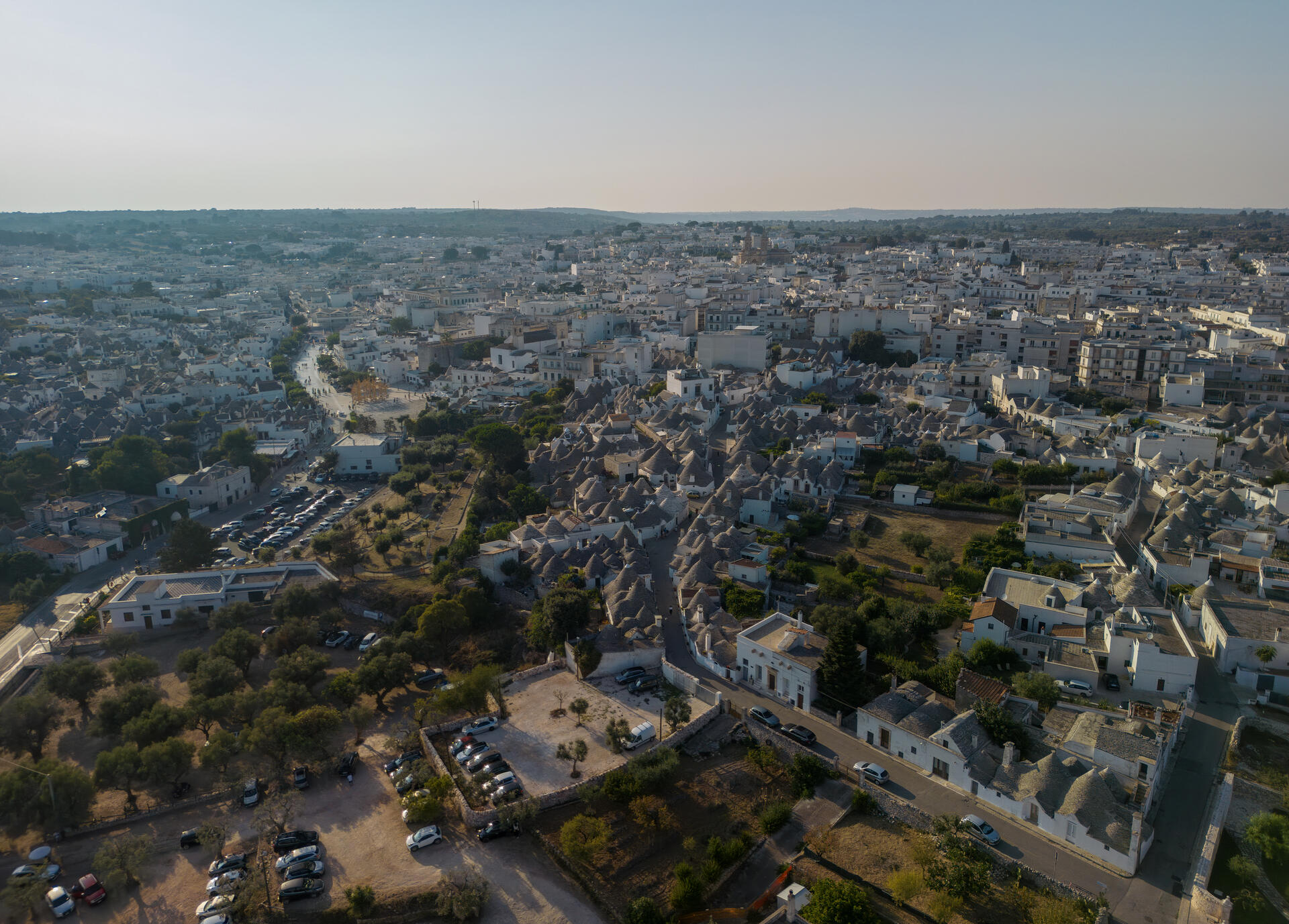
© TWE. Used with permission.
World Heritage Research
Discover scientific research and academic studies that deepen our understanding of The Trulli of Alberobello from its history and significance to its conservation, management, and contemporary challenges.
-
Così falso da sembrare vero: il fact checking nell'era della fake history. Un approccio etnografico ad Alberobello
Research reveals that the UNESCO World Heritage status of Alberobello's Trulli has paradoxically fueled the persistence and proliferation of historical myths, despite its intended role as a safeguard for accurate cultural narration. While the designation aimed to boost global tourism, it did not impose obligations on site managers to ensure historical fidelity, leading to widespread dissemination of inaccurate narratives in guided tours and non-authentic merchandise. The study employs an ethnographic approach to analyze two prominent myths—alleged tax evasion by early settlers and the magical influence of roof symbols—which continue to shape public perception despite lacking verifiable historical basis. This highlights a critical gap between UNESCO's conservation objectives and the commercialization of heritage sites, where economic incentives often overshadow scholarly rigor.
Rosato, G. C. (2025). Così falso da sembrare vero: il fact checking nell'era della fake history. Un approccio etnografico ad Alberobello. Duetredue Edizioni. https://doi.org/10.5281/ZENODO.18698207
View Publication Record | Read Publication -
Natural Stone and World Heritage
Apulian limestones, the foundation of UNESCO-listed trulli structures in Puglia's Itria Valley and Alberobello, represent a unique stone heritage. These drywall constructions, built from roughly quarried limestone blocks, exhibit distinct petrographic and mechanical properties that define their architectural significance. The study systematically analyzes these characteristics while addressing best practices for the evaluation, protection, and restoration of such stone heritage. It bridges geological, archaeological, and architectural disciplines, offering insights valuable to academics, industry professionals, and tourism stakeholders alike.
Bellopede, R., & Quartulli, A. (2024). Natural Stone and World Heritage. https://doi.org/10.1201/9780429294723
View Publication Record | Read Publication -
When Historical Untruths Enhance Popularity of a Tourist Destination: Fake, Real and Everything in between About the UNESCO Site 'Trulli of Alberobello'
Historical untruths and mythicized narratives significantly enhance the popularity of UNESCO World Heritage Sites, as demonstrated by the 'Trulli of Alberobello' in Southern Italy. Despite its recognition as a global tourist destination since 1996, the site's authenticity is compromised by exaggerated or false historical claims, which are perpetuated through inaccurate guided tours, merchandising, and media representations. This study highlights how such distortions, while boosting tourism, undermine faithful historical exposure. It argues that restoring accurate history requires collaboration across the entire tourist sector—including residents, souvenir sellers, guides, and media—to ensure authenticity without sacrificing appeal.
Rosato, G. C. (2023). When Historical Untruths Enhance Popularity of a Tourist Destination: Fake, Real and Everything in between About the UNESCO Site 'Trulli of Alberobello'. Zenodo. https://doi.org/10.5281/ZENODO.7758768
View Publication Record | Read Publication -
Family-owned Heritage Houses or Inhabited Monuments? A Peculiar Case of Living Heritage
Research introduces the term 'inhabited monument' to describe sites where housing functions coexist with cultural heritage status, addressing a gap in scientific terminology. The study proposes a model for buildings that maintain both permanent habitation and recognized heritage value, using Alberobello's Trullias a case study. Recognized nationally as monuments since the early 20th century and globally since 1996, these structures exemplify living heritage, blending preservation with contemporary use. The approach combines theoretical framing with empirical analysis of this unique Southern Italian site.
Rosato, G. C. (2022). Family-owned Heritage Houses or Inhabited Monuments? A Peculiar Case of Living Heritage. IJAHSSS. https://doi.org/10.5281/ZENODO.18697159
View Publication Record | Read Publication -
Il ruolo dei residenti nella valorizzazione del patrimonio culturale. I siti Unesco di Matera e di Alberobello a confronto
UNESCO World Heritage inscription can significantly boost economic growth for cultural sites, but its success hinges on the active engagement of local communities. A comparative study of Alberobello (Trulli) and Matera (Sassi), both inscribed in 1996 and 1993 respectively, reveals stark differences in their development trajectories despite similar tourist arrivals. While Alberobello, with its smaller population, has seen consistent positive representation, Matera faced historical perceptions of backwardness that shaped its tourism evolution. The research, based on surveys conducted between 2007 and 2012—targeting residents, tourists, and industry operators—and an analysis of newspaper archives from 'La Stampa,' underscores the critical role of local communities in leveraging cultural heritage as a resource for sustainable growth.
Battilani, P., Cerabona, A., & Sgobba, S. (2014). Il ruolo dei residenti nella valorizzazione del patrimonio culturale. I siti Unesco di Matera e di Alberobello a confronto. Rivista Di Scienze Del Turismo - Ambiente Cultura Diritto Economia, (1), 15–42. https://doi.org/10.7358/rst-2014-001-batt
View Publication Record | Read Publication