World Heritage Identification Number: 560
World Heritage since: 1998
Category: Cultural Heritage
WHE Type: Archaeological Sites
Transboundary Heritage: No
Endangered Heritage: No
Country: 🇲🇽 Mexico
Continent: Americas
UNESCO World Region: Latin America and the Caribbean
Map
The Archaeological Zone of Paquimé, Casas Grandes: A Key Cultural Crossroads in North America
The Archaeological Zone of Paquimé, Casas Grandes, located in the northwestern Mexican state of Chihuahua, stands as a testament to the rich cultural history that once thrived in this region. Inscribed as a UNESCO World Heritage Site in 1998, this ancient settlement played a pivotal role in facilitating trade and fostering cultural exchanges between various civilizations across North America and Mesoamerica during the 14th and 15th centuries.
More to come…UNESCO Description of the World Heritage Site
Paquimé, Casas Grandes, which reached its apogee in the 14th and 15th centuries, played a key role in trade and cultural contacts between the Pueblo culture of the south-western United States and northern Mexico and the more advanced civilizations of Mesoamerica. The extensive remains, only part of which have been excavated, are clear evidence of the vitality of a culture which was perfectly adapted to its physical and economic environment, but which suddenly vanished at the time of the Spanish Conquest.
UNESCO Justification of the World Heritage Site
Criterion (iii) : Paquimé, Casas Grandes, bears eloquent and abundant testimony to an important element in the cultural evolution of North America, and in particular to prehispanic commercial and cultural links.
Criterion (iv) : The extensive remains of the archaeological site of Paquimé, Casas Grandes, provide exceptional evidence of the development of adobe architecture in North America, and in particular of the blending of this with the more advanced techniques of Mesoamerica.
Encyclopedia Record: Casas Grandes
Casas Grandes is a prehistoric archaeological site in the northern Mexican state of Chihuahua. Construction of the site is attributed to the Mogollon culture. Casas Grandes has been designated a UNESCO World Heritage Site under the purview of INAH and a "Pueblo Mágico" since 2015.Additional Site Details
Area: 146.72 hectares
Number of Components: 1
(iv) — Outstanding example of a type of building or landscape
Coordinates: 30.367128 , -107.948122
Image
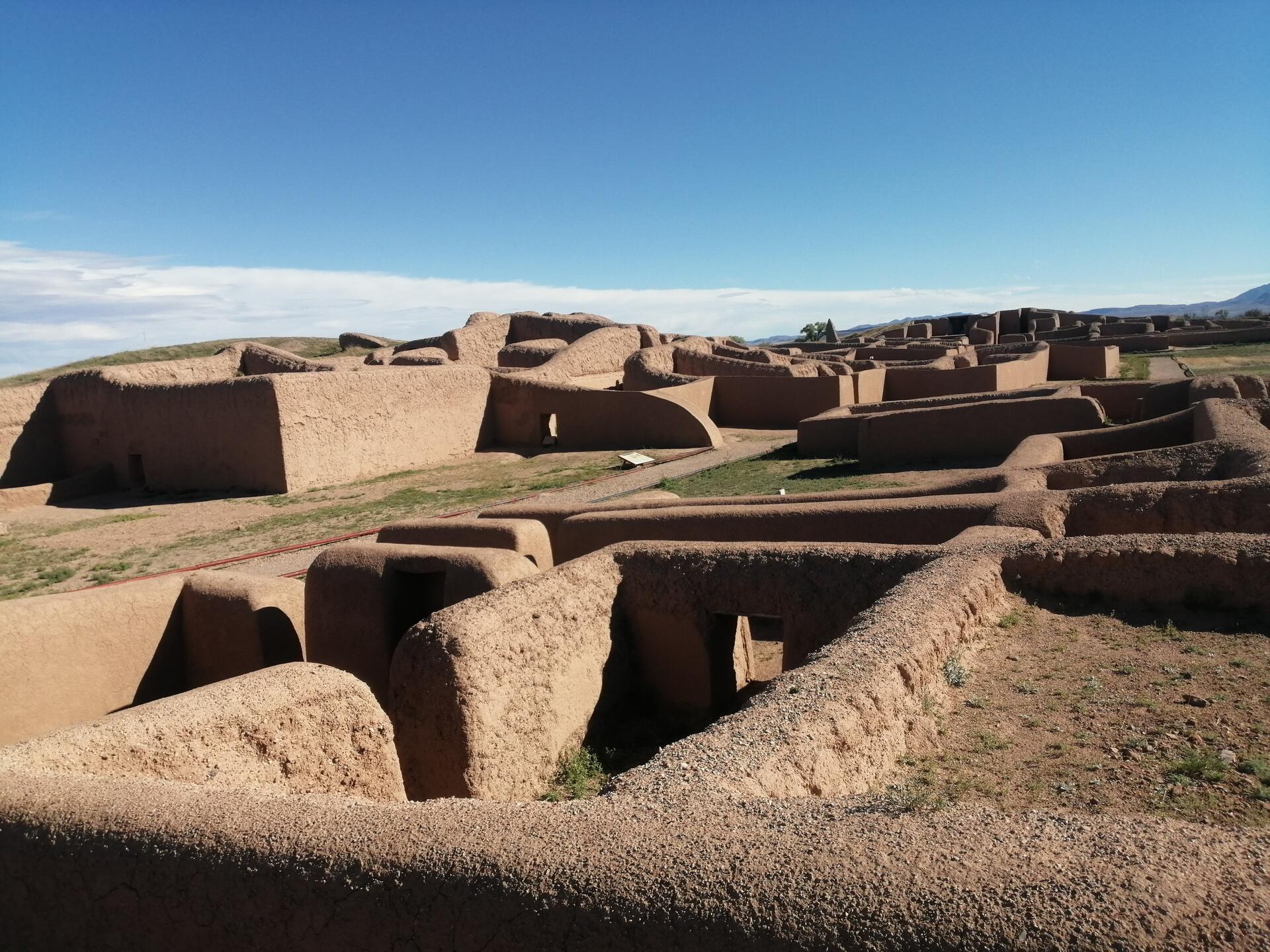
© Levi bernardo, CC BY-SA 3.0 Resized from original. (This derivative is under the same CC BY-SA license.)
World Heritage Research
Discover scientific research and academic studies that deepen our understanding of Archaeological Zone of Paquimé, Casas Grandes from its history and significance to its conservation, management, and contemporary challenges.
-
The Keepers of Tradition: Clown Societies in the Casas Grandes and Puebloan Worlds
Clown societies among the Casas Grandes culture, centered in Chihuahua, Mexico, played a significant role during the Medio Period (AD 1200–1450), with potential influence on the development of Puebloan clown societies. These clowns, often seen as avatars of Sun Youth, were integral to governance, katsina ritualism, medicine societies, and the agricultural cycle. The study combines archaeological, ethnohistorical, and ethnological data from the U.S. Southwest and northwest Mexico to uncover their complex roles and societal significance.
Mathiowetz, M. D. (2025). The Keepers of Tradition: Clown Societies in the Casas Grandes and Puebloan Worlds. Kiva, 91(2), 147–179. https://doi.org/10.1080/00231940.2025.2461803
View Publication Record | Read Publication -
A reanalysis of population dynamics in the Casas Grandes region of Northern Mexico using mitochondrial DNA
A reanalysis of mitochondrial DNA from 114 individuals interred at Casas Grandes sites reveals that low levels of migration occurred diachronically, challenging the long-standing assumption that large-scale population replacement drove the rise of Paquimé in the 13th century A.D. While these findings suggest limited widescale migration, they may still explain hybridized cultural practices observed in the region. The study compares full mitogenomes from earlier (A.D. 700-1200) and later (A.D. 1200-1450) time periods to test migration hypotheses, providing new insights into population dynamics in this UNESCO World Heritage Site.
Snow, M., Searcy, M. T., Summers, R., Blohm, T., Hazelwood, L., McDonald, H., Jensen, S. J., & Punzo-Díaz, J. L. (2025). A reanalysis of population dynamics in the Casas Grandes region of Northern Mexico using mitochondrial DNA. Proceedings of the National Academy of Sciences, 122(38). https://doi.org/10.1073/pnas.2506162122
View Publication Record | Read Publication -
Isotopic Evidence Linking the Southern Jornada Mogollon to Turquoise Mines in the Orogrande Mining District, Jarilla Mountains, Otero County, New Mexico
A groundbreaking isotopic analysis reveals that turquoise artifacts from the Southern Jornada Mogollon region, particularly those linked to Doña Ana and El Paso-phase sites near New Mexico's Jarilla Mountains, overwhelmingly originate from the Orogrande mining district. This finding confirms that precontact miners sourced turquoise exclusively from this region, the only significant source in the area. Modern geological samples from Orogrande exhibit isotope signatures that align with prehistoric materials, solidifying their provenance. Additionally, evidence suggests that turquoise from this region circulated beyond the Jornada Mogollon territory, notably reaching the Mimbres region. The study underscores the importance of future research to trace turquoise distribution and exchange across broader Mogollon regions, including the Casas Grandes area.
Thibodeau, A. M., Kurota, A., Kale, A., & Maxwell, T. D. (2025). Isotopic Evidence Linking the Southern Jornada Mogollon to Turquoise Mines in the Orogrande Mining District, Jarilla Mountains, Otero County, New Mexico. Kiva, 91(4), 482–501. https://doi.org/10.1080/00231940.2025.2594251
View Publication Record | Read Publication -
Bioarchaeology of the Casas Grandes Region, Chihuahua, Mexico
Research on the Archaeological Zone of Paquimé, Casas Grandes, reveals significant gene flow and political interactions between Paquimé and neighboring Mimbres and West Mexican populations. Analysis of paleodemographics, biodistance, isotopes, and genomics indicates that while Paquimé absorbed local groups, high-status individuals were predominantly born within the region, with immigrants rarely achieving elite status. The study also identifies ritual violence and human sacrifice as part of public ceremonies, likely performed by elites to assert political power. Inhabitants experienced physiological stress and were smaller than their Southwestern counterparts, with mortuary practices reflecting social stratification and health disparities.
Waller, K. D. (2025). Bioarchaeology of the Casas Grandes Region, Chihuahua, Mexico. Bioarchaeology of the Southwest, 178–202. https://doi.org/10.5744/florida/9781683405160.003.0007
View Publication Record | Read Publication -
High levels of consanguinity in a child from Paquimé, Chihuahua, Mexico
A child burial at Paquimé, Chihuahua, Mexico—a multicultural center from the 13th–14th centuries AD—reveals high levels of consanguinity between parents, suggesting elite social practices. Ancient DNA analysis of Burial 23-8, placed under a central post in an important room, indicates that this child's genetic relationship with its parents was likely due to close relatives, reinforcing the role of aggrandizement among Paquimé’s ruling class. The study sheds light on the social dynamics of this pivotal archaeological site, bridging Mesoamerican and Ancestral Puebloan influences.
Sedig, J., Snow, M., Searcy, M., Punzo Diaz, J. L., LeBlanc, S., Ramos, F., Eccles, L., & Reich, D. (2024). High levels of consanguinity in a child from Paquimé, Chihuahua, Mexico. Antiquity, 98(400), 1023–1039. https://doi.org/10.15184/aqy.2024.94
View Publication Record | Read Publication -
Reevaluating the Suma Occupation in the Casas Grandes Valley, Chihuahua, Mexico
A reevaluation of the Suma occupation in the Casas Grandes Valley challenges long-standing assumptions about their relationship to the ancient Paquimé civilization. Contrary to previous interpretations, evidence suggests the Suma were likely long-term residents with cultural ties to Paquimé, organized into horticulture villages and exhibiting sophisticated practices. This conclusion emerges from a dual approach: contextualizing historical accounts within contemporary frameworks and comparing material culture data from the 1958–1961 Joint Casas Grandes Expedition. The study not only critiques earlier narratives about Suma origins but also broadens the understanding of Native American responses to colonial settings, offering new insights into the resilience and continuity of indigenous societies in the face of significant cultural shifts.
Douglas, J. E., & Brown, L. J. (2023). Reevaluating the Suma Occupation in the Casas Grandes Valley, Chihuahua, Mexico. American Antiquity, 88(2), 125–143. https://doi.org/10.1017/aaq.2022.105
View Publication Record | Read Publication -
Spatial and Temporal Limits of the Casas Grandes Tradition: A View from the Fronteras Valley
A new analysis of the Casas Grandes tradition, based on data from northeastern Sonora, challenges traditional narratives of its spatial and temporal limits. Unlike the widely accepted model of a dramatic collapse during the Medio period (AD 1200–1450/1500), this study reveals a pattern of cultural continuity in the Fronteras Valley, where sedentary farmers maintained occupation from the eleventh century through the colonial period. This suggests that immigrant groups introduced Casas Grandes traditions, which persisted unevenly across hinterland regions due to shared religious beliefs and practices. The findings offer an alternative scenario for understanding the resilience and adaptability of this tradition beyond its core area in northwest Chihuahua.
Carpenter, J. P., Sánchez, G., Cupa, E., Abrego-Rivas, A., López-Rivera, J. A., León-Romero, C. E., Krug, A. R., Davidson, J. T., Larrick, D., Lund, J. R., Cooley, D. S., & Pailes, M. C. (2022). Spatial and Temporal Limits of the Casas Grandes Tradition: A View from the Fronteras Valley. Latin American Antiquity, 34(2), 235–258. https://doi.org/10.1017/laq.2022.70
View Publication Record | Read Publication