World Heritage Identification Number: 1135
World Heritage since: 2004
Category: Cultural Heritage
WHE Type: Archaeological Sites
Transboundary Heritage: No
Endangered Heritage: No
Country: 🇨🇳 China
Continent: Asia
UNESCO World Region: Asia and the Pacific
Map
The Capital Cities and Tombs of the Ancient Koguryo Kingdom: A Window into the Past
The Capital Cities and Tombs of the Ancient Koguryo Kingdom, inscribed as a UNESCO World Heritage Site in 2004, offers a unique glimpse into the rich history and cultural heritage of ancient Korea. This significant archaeological site is located in Ji'an, Jilin Province, and Huanren, Liaoning Province, in northeastern China.
More to come…UNESCO Description of the World Heritage Site
The site includes archaeological remains of three cities and 40 tombs: Wunu Mountain City, Guonei City and Wandu Mountain City, 14 tombs are imperial, 26 of nobles. All belong to the Koguryo culture, named after the dynasty that ruled over parts of northern China and the northern half of the Korean Peninsula from 277 BC to AD 668. Wunu Mountain City is only partly excavated. Guonei City, within the modern city of Ji’an, played the role of a ‘supporting capital’ after the main Koguryo capital moved to Pyongyang. Wandu Mountain City, one of the capitals of the Koguryo Kingdom, contains many vestiges including a large palace and 37 tombs. Some of the tombs show great ingenuity in their elaborate ceilings, designed to roof wide spaces without columns and carry the heavy load of a stone or earth tumulus (mound), which was placed above them.
UNESCO Justification of the World Heritage Site
Criterion (i): The tombs represent a masterpiece of the human creative genius in their wall paintings and structures.
Criterion (ii): The Capital Cities of the Koguryo Kingdom are an early example of mountain cities, later imitated by neighbouring cultures. The tombs, particularly the important stele and a long inscription in one of the tombs, show the impact of Chinese culture on the Koguryo (who did not develop their own writing). The paintings in the tombs, while showing artistic skills and specific style, are also an example for strong impact from other cultures.
Criterion (iii): The Capital Cities and Tombs of the Ancient Koguryo Kingdom represent exceptional testimony to the vanished Koguryo civilization.
Criterion (iv): The system of capital cities represented by Guonei City and Wandu Mountain City also influenced the construction of later capitals built by the Koguryo regime; the Koguryo tombs provide outstanding examples of the evolution of piled-stone and earthen tomb construction.
Criterion (v): The capital cities of the Koguryo Kingdom represent a perfect blending of human creation and nature whether with the rocks or with forests and rivers.
Encyclopedia Record: Capital Cities and Tombs of the Ancient Koguryo Kingdom
The Capital Cities and Tombs of the Ancient Koguryo Kingdom is an UNESCO World Heritage Site which includes a number of archaeological sites currently in Ji'an, Jilin Province and Huanren, Liaoning Province in Northeast China. Goguryeo, was a Korean Kingdom located in the northern and central parts of the Korean Peninsula and the southern and central parts of Manchuria.Additional Site Details
Area: 4,164.86 hectares
Number of Components: 5
(ii) — Significant interchange of human values
(iii) — Unique or exceptional testimony to a cultural tradition
(iv) — Outstanding example of a type of building or landscape
(v) — Outstanding example of traditional human settlement
Coordinates: 41.15694444 , 126.1872222
Image
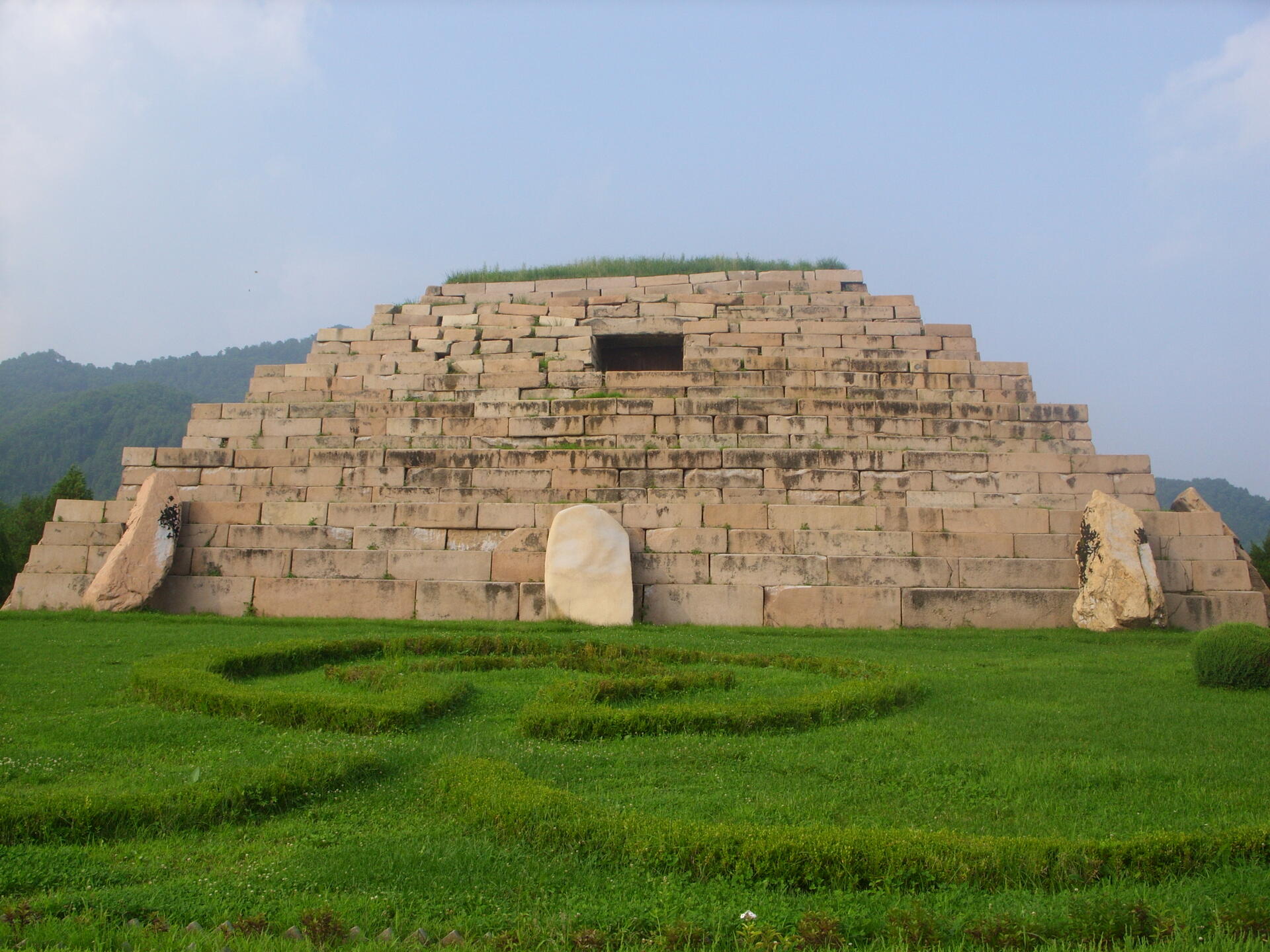
© Bart0278, CC BY-SA 3.0 Resized from original. (This derivative is under the same CC BY-SA license.)