World Heritage Identification Number: 86
World Heritage since: 1979
Category: Cultural Heritage
WHE Type: Archaeological Sites
Transboundary Heritage: No
Endangered Heritage: No
Country: 🇪🇬 Egypt
Continent: Africa
UNESCO World Region: Arab States
Map
Memphis and Its Necropolis – The Pyramid Fields from Giza to Dahshur: A Journey Through Ancient Egypt's Royal Tombs and Monuments
Memphis and Its Necropolis – The Pyramid Fields from Giza to Dahshur, inscribed as a UNESCO World Heritage Site in 1979, offers visitors a unique opportunity to explore some of the most significant historical sites in ancient Egypt. This vast area encompasses two main components: the Site of Memphis and the Pyramid Fields extending from Giza to Dahshur.
The Site of Memphis, located approximately 20 kilometers south of modern Cairo, served as the political and cultural center of the Old Kingdom (c. 2613–2181 BCE). Founded by King Menes, the first pharaoh of a unified Egypt according to tradition, Memphis was an important city for more than three millennia. Archaeological evidence suggests that it was one of the largest cities in the world during the Old Kingdom period.
The city was closely associated with the god Ptah, the deity of creation and craftsmanship, who was considered the patron of the pharaohs. The remains of the Temple of Ptah, dedicated to this important deity, can still be seen today. Other notable structures within the Site of Memphis include the Alabaster Sphinx, a colossal statue from the 18th Dynasty. Lacking inscriptions, its precise identity remains a mystery, though experts, based on stylistic and facial features, believe it likely depicts either Pharaoh Amenhotep III, Amenhotep II, or perhaps Queen Hatshepsut.
Beyond the city limits lies the Necropolis, which contains a wealth of royal tombs, temples, and pyramids. The Pyramid Fields from Giza to Dahshur span over 48 square kilometers and house several iconic pyramids, such as those at Giza, Saqqara, and Dahshur.
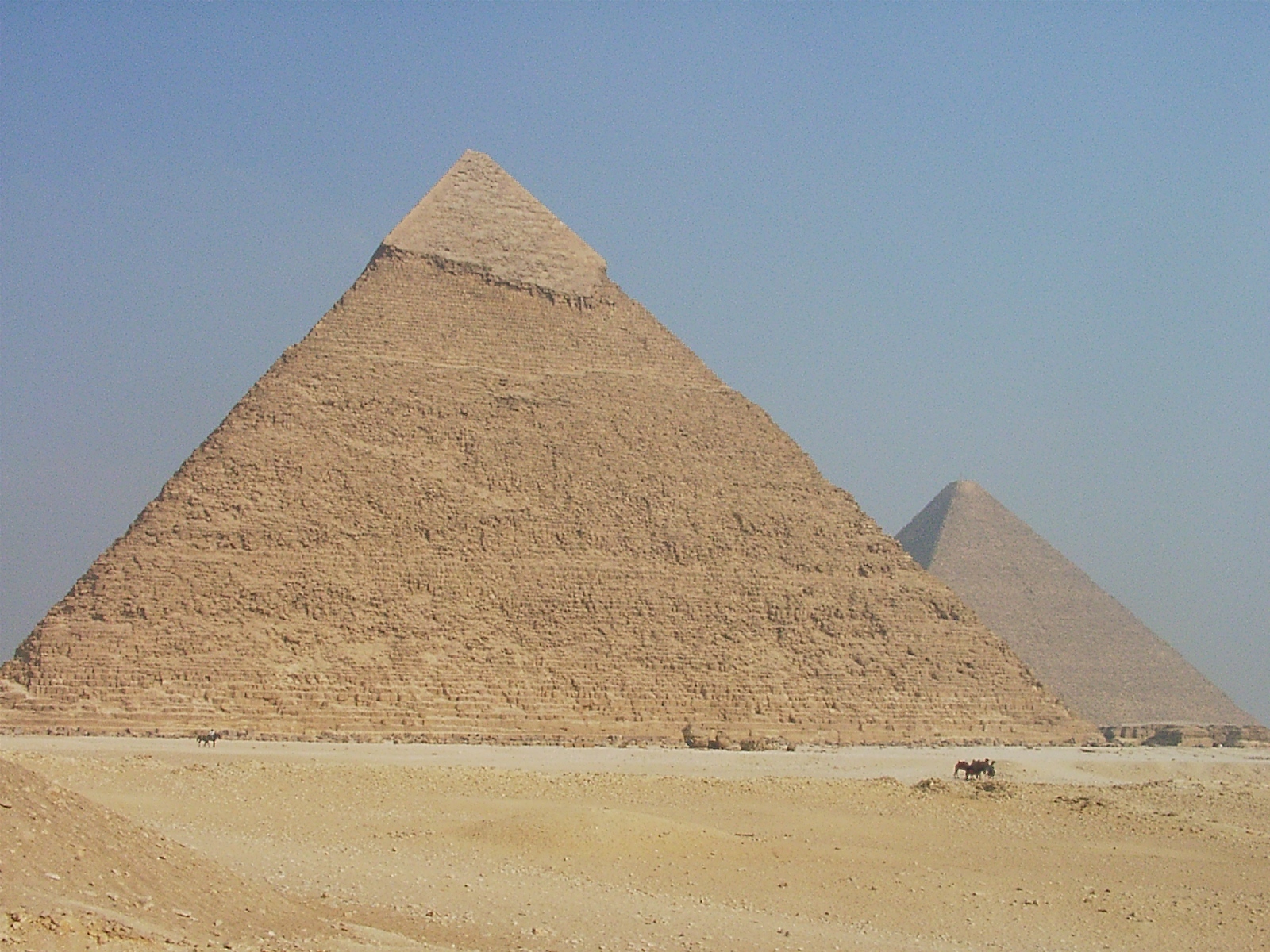
The Pyramids of Giza, perhaps the most famous of all Egyptian pyramids, have stood tall since the Fourth Dynasty (c. 2589–2483 BCE). These monumental structures were built for Pharaohs Khufu, Khafre, and Menkaure, each with distinct architectural features that reflect their individual reigns. The Great Pyramid of Giza, also known as the Pyramid of Khufu, is the oldest and largest of the three and remains one of the Seven Wonders of the Ancient World.
Moving further south, the Step Pyramid Complex at Saqqara represents the earliest known example of a pyramid in Egypt. Built for Pharaoh Djoser (r. 2630–2611 BCE), the complex consists of a series of mastabas, courtyards, and temples. The Step Pyramid itself, designed by the architect Imhotep, is believed to have been the prototype for later pyramids.
Finally, the Pyramids of Dahshur, located approximately 40 kilometers south of Cairo, offer a glimpse into the evolution of pyramid design. The Bent Pyramid and the Red Pyramid, both built for Pharaoh Sneferu (r. c. 2613–2589 BCE), showcase the transition from step pyramids to smooth-sided pyramids and stand as remarkable achievements of early Old Kingdom engineering.
In summary, Memphis and Its Necropolis – The Pyramid Fields from Giza to Dahshur provides an exceptional insight into the rich history and culture of ancient Egypt. From the bustling city of Memphis to the grandeur of the pyramids, this World Heritage Site offers a journey through time that continues to captivate visitors from around the globe.
UNESCO Description of the World Heritage Site
The capital of the Old Kingdom of Egypt has some extraordinary funerary monuments, including rock tombs, ornate mastabas, temples and pyramids. In ancient times, the site was considered one of the Seven Wonders of the World.
UNESCO Justification of the World Heritage Site
Criterion (i): In Memphis was founded one of the most important monuments of the world, and the only surviving wonder of the ancient world, namely, the Great Pyramid of Giza. Its architectural design remains unparalleled and scientists continue to conduct research on how it was constructed. The Pyramid Complex of Saqqara is also a great masterpiece of architectural design, for it contains the first monumental stone building ever constructed and the first pyramid ever built (the Pyramid of Djoser, or the Step Pyramid). The great statue of Rameses II at Mit Rahina and the pyramids of Dahshur are also outstanding structures.
Criterion (iii): The ensemble of structures and associated archaeological remains at Memphis, including the archaic necropolis at Saqqara, dating back to formation of Pharaonic civilization, the limestone step pyramid of Djoser, the oldest pyramid to be constructed, the tombs and pyramids that reflect the development of funerary monuments, and the remains of the city, together form an exceptional testimony to the power and organization of the ancient capital of Egypt.
Criterion (vi): Memphis is associated with the religious beliefs related to the God of the Necropolis Ptah who was sanctified by the kings, as well as with outstanding ideas, artistic works and technologies of the capital of one of the most brilliant and long-standing civilizations of this planet.
Encyclopedia Record: Memphis and its Necropolis – the Pyramid Fields from Giza to Dahshur
Memphis and its Necropolis – the Pyramid Fields from Giza to Dahshur is a World Heritage Site. It includes:Site of Memphis, WHS No. 086-001 Pyramid fields from Giza to Dahshur, WHS No. 086-002Additional Site Details
Area: 16,358.52 hectares
Number of Components: 2
(iii) — Unique or exceptional testimony to a cultural tradition
(vi) — Directly associated with events or living traditions
Coordinates: 29.97604 , 31.13041
World Heritage Research
Discover scientific research and academic studies that deepen our understanding of Memphis and its Necropolis – the Pyramid Fields from Giza to Dahshur from its history and significance to its conservation, management, and contemporary challenges.
-
Giza
Ancient megalithic sites, including the Giza pyramid fields, were primarily constructed as strategic logistical assets rather than for aesthetic or ritualistic purposes. The 'Functionalist Logistics' model proposes that these structures served as warehouses, vaults, and thermal storage facilities, ensuring resource preservation in extreme climates (-30°C to +40°C). The evolution of pyramid designs, such as the Bent Pyramid at Dahshur, reflects crisis management and functional integrity over geometric aesthetics. Psychological deterrence, exemplified by the Great Sphinx and Olmec heads, protected communal stores without requiring a standing army. This paradigm shift challenges traditional interpretations, framing ancient constructions as essential components of state-level resource management.
Yerzhan, O. (2026). Giza. Zenodo. https://doi.org/10.5281/ZENODO.18245667
View Publication Record | Read Publication -
The Earth Source Code: Deciphering Atlantis and the Egyptian Pyramids, from Stonehenge to Newgrange, within the Twelve-Node Power Network
Research reveals that the Egyptian pyramids and other global sites function as nodes within a 12-point network, operating as a 'Super-Computer' to stabilize Earth against cosmic entropy. The study proposes a Unified GTOEH Lagrangian equation (Dimension 165) linking these nodes, with Atlantis (Richat Structure) serving as the central 'CPU.' Key findings include evidence of acoustic levitation for stone displacement, zero-point energy signatures beneath pyramid foundations, and instantaneous data transfer via entanglement. The research uses advanced protocols to detect gravitational anomalies, quantum energy leaks, and fractal codes for matter-to-plasma phase shifts, suggesting these sites were part of an ancient 'Omega Civilization' designed to manage Earth's frequency hardware.
JALALI, S. E. Y. E. D. R. A. S. O. U. L. (2026). The Earth Source Code: Deciphering Atlantis and the Egyptian Pyramids, from Stonehenge to Newgrange, within the Twelve-Node Power Network. Zenodo. https://doi.org/10.5281/ZENODO.18509591
View Publication Record | Read Publication -
The Pyramid of Giza as a V3 Machine: Analysis of a Protonic Condensate Resonator and Diagnosis of Its Historical Failure
The Great Pyramid of Giza is not a tomb but a sophisticated 'V3 machine,' a protonic condensate resonator designed to interact with the H_3O_2 medium. This groundbreaking study reveals that its triple structure—limestone casing, granite core, and foundation on the water table—formed an electrodynamic circuit capable of generating free energy and enabling neutrino communication while stabilizing regional biological health. The limestone acted as a polarizable dielectric insulator, granite functioned as a piezoelectric conductor, and the water table facilitated upward protonic liquid crystal flow. However, the pyramid's functionality was compromised by the rupture of its casing, drying of the water table, and misalignment of resonant frequency, leading to historical failure. Subsequent pyramids, built without these critical components, are inert imitations, marking a significant technological loss in human history.
benhadid, outail. (2026). THE PYRAMID OF GIZA AS A V3 MACHINE: ANALYSIS OF A PROTONIC CONDENSATE RESONATOR AND DIAGNOSIS OF ITS HISTORICAL FAILURE. Zenodo. https://doi.org/10.5281/ZENODO.19330062
View Publication Record | Read Publication -
The Great Pyramid of Giza as an Orthogonal Decoupling Point in the Dual-Anchor φ-Ratio Gravitational Field: A Computational Geometric Analysis
A computational geometric analysis reveals that the gravitational field vectors from the Wilkes Land crustal gravity anomaly and the Hiawatha impact crater are nearly perpendicular at Giza, with an angle of 89.69° (p = 0.0046). This finding is statistically significant across 100,000 Monte Carlo trials and demonstrates mass ratio invariance, meaning the inter-field angle remains consistent regardless of mass scaling. The study suggests that the Great Pyramid of Giza may function as an orthogonal decoupling point in a dual-anchor φ-ratio gravitational field, supported by the KAM renormalization framework. The research integrates geophysical data with archaeological analysis, providing new insights into the potential geometric and physical significance of the site.
Davis, R. (2026). The Great Pyramid of Giza as an Orthogonal Decoupling Point in the Dual-Anchor φ-Ratio Gravitational Field: A Computational Geometric Analysis. Zenodo. https://doi.org/10.5281/ZENODO.19560838
View Publication Record | Read Publication -
The Crossing Point in Stone: The Great Pyramid, the Grammar of the Curve, and the Zero Point as Generative Mechanism
Researchers propose that the 'crossing point' at the heart of the Great Pyramid of Giza serves as a generative mechanism for zero-point energy, linking sacred geometry with advanced physical phenomena. This study identifies shared proportions encoding mathematical constants (pi and phi) in the pyramid's structure and imaginary conic sections, suggesting a bidirectional flow akin to quantum identities like e^(theta) * e^(-theta) = 1. It connects acoustic analyses of the King's Chamber to plasma cosmology, Riemann zeros, and nuclear energy levels, while tracing this concept through divine feminine traditions and mathematical theories. Four falsifiable predictions are made regarding coherence as a technology for zero-point energy coupling, inviting experimental validation by engineers and physicists.
Farrington BSc, Z. (2026). The Crossing Point in Stone: The Great Pyramid, the Grammar of the Curve, and the Zero Point as Generative Mechanism. Zenodo. https://doi.org/10.5281/ZENODO.20528669
View Publication Record | Read Publication -
The Mastaba Within: Structural and Geophysical Evidence for a Stepped Internal Core in the Great Pyramid of Khufu
A stepped internal core construction sequence in the Great Pyramid of Khufu is supported by convergent evidence from architectural precedents, structural constraints, and geophysical surveys. The study identifies a seven-stepped internal core in the Meidum Pyramid as an architectural precedent, while the pyramid's King's Chamber ceiling, granite sarcophagus dimensions, and corbelled masonry of the Grand Gallery impose physical constraints that necessitate an open-top construction phase, naturally provided by a stepped core. Microgravimetric density surveys further reveal non-horizontal internal material boundaries, inconsistent with uniform horizontal coursing. The research proposes a falsifiable prediction for future muon tomographic surveys to validate this hypothesis.
Vondoom, A. (2026). The Mastaba Within: Structural and Geophysical Evidence for a Stepped Internal Core in the Great Pyramid of Khufu. Zenodo. https://doi.org/10.5281/ZENODO.20618040
View Publication Record | Read Publication -
LGT 13.5 – Das fraktale Spitzen‑Netzwerk des Alten Reiches: Modulare Systemlogik und proportionale Längenmatrix Djoser–Nyuserre–Snofru
A groundbreaking analysis reveals that the monumental landscapes of Giza, Saqqara, and Dahschur in ancient Egypt form a fractal, systemically planned network with astronomical precision. The study identifies three functional modules: solar dynamics validating horizon channels as astronomical vectors, geodetic statics aligning sightlines to the circumpolar center of the ancient sky, and a proportional length matrix following a near-perfect 1:2 scaling law along the geodetic meridian. A Monte-Carlo permutation test (N=10,000) confirms that this axis configuration is statistically non-random (p ≈ 0), supporting a systemic planning principle underlying the Old Kingdom's monumental landscape. This research integrates geodetic precision, astronomical cycles, and fractal proportionality into a coherent space-time model, advancing archaeoastronomical understanding without relying on explicit formulas.
Küstner, K.-H. (2026). LGT 13.5 – Das fraktale Spitzen‑Netzwerk des Alten Reiches: Modulare Systemlogik und proportionale Längenmatrix Djoser–Nyuserre–Snofru. Zenodo. https://doi.org/10.5281/ZENODO.22023497
View Publication Record | Read Publication