World Heritage Identification Number: 90
World Heritage since: 1979
Category: Cultural Heritage
WHE Type: Archaeological Sites
Transboundary Heritage: No
Endangered Heritage: No
Country: 🇪🇬 Egypt
Continent: Africa
UNESCO World Region: Arab States
Map
Abu Mena: An Early Christian Holy City
Abu Mena, located approximately 50 kilometers southwest of Alexandria, Egypt, is a significant archaeological site that holds immense historical value due to its role as a major center for early Christian pilgrimage. Designated as a UNESCO World Heritage Site in 1979, the site comprises various structures built around the tomb of Saint Menas, a third-century martyr from Alexandria.
More to come…UNESCO Description of the World Heritage Site
The church, baptistry, basilicas, public buildings, streets, monasteries, houses and workshops in this early Christian holy city were built over the tomb of the martyr Menas of Alexandria, who died in A.D. 296.
UNESCO Justification of the World Heritage Site
Criterion (iv): Abu Mena is an outstanding example of one of the first early Christian monastic Centre developed in the Near East. It was also a major pilgrim Centre with a much larger settlement than many of its contemporary sites in the Near East. Its architectural elements, in a wide range of building types, were strongly influenced by Egyptian practice, and express clearly the articulation of traditional Egyptian architecture with various other styles from the Mediterranean basin and were a significant advancement of early Christian architecture and practices.
Encyclopedia Record: Abu Mena
Abu Mena was a town, monastery complex and Christian pilgrimage centre in Late Antique Egypt, about 50 km (31 mi) southwest of Alexandria, near New Borg El Arab city. Its remains were designated a World Heritage Site in 1979 for the site's importance in early Christianity. There are very few standing remains, but the foundations of most major buildings, such as the great basilica, are easily discernible.Additional Site Details
Area: 182.72 hectares
Number of Components: 1
Coordinates: 30.8358333333 , 29.66666667
Image
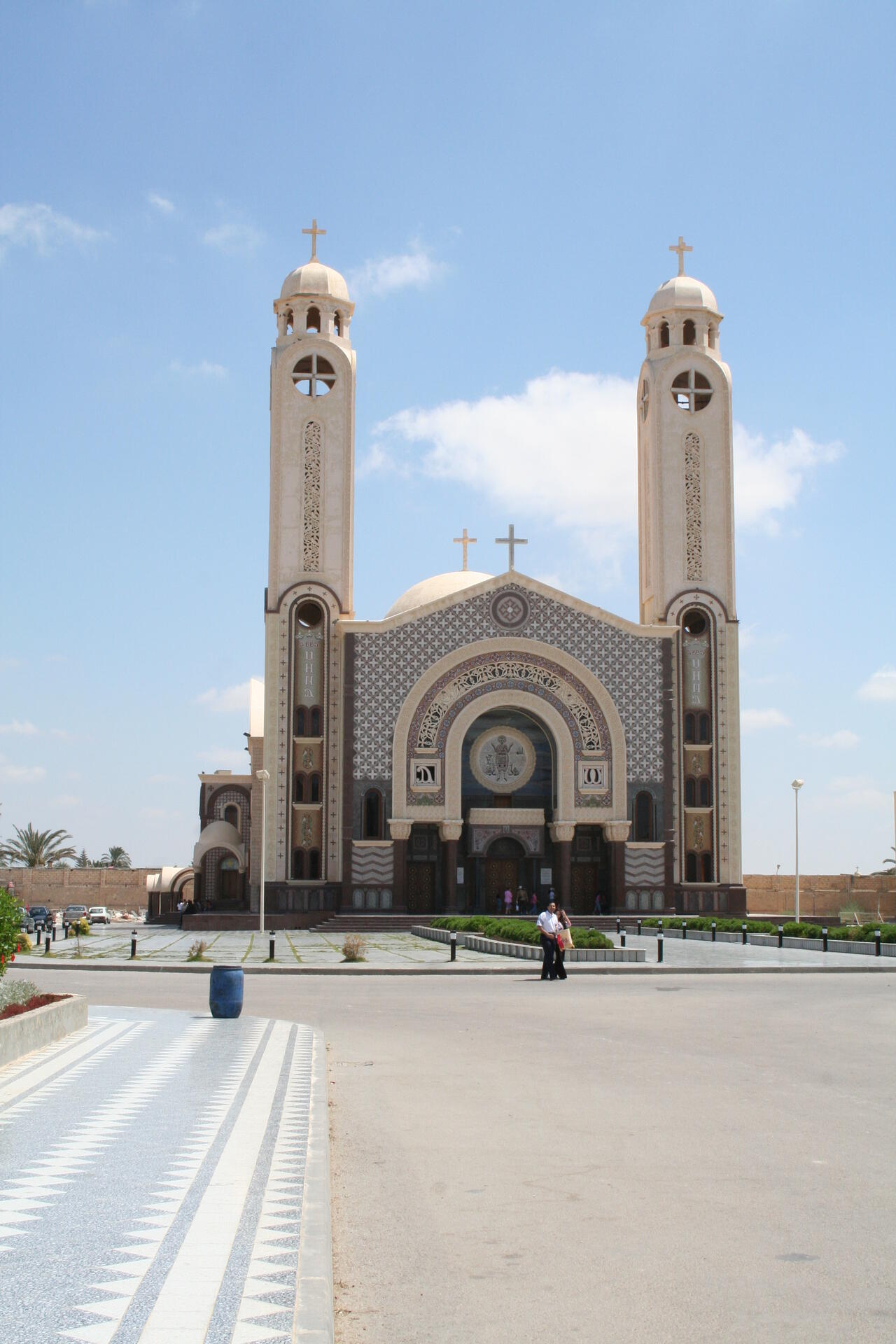
© Einsamer Schütze, CC BY-SA 3.0 Resized from original. (This derivative is under the same CC BY-SA license.)
World Heritage Research
Discover scientific research and academic studies that deepen our understanding of Abu Mena from its history and significance to its conservation, management, and contemporary challenges.
-
An Ampulla of Saint Menas from Dara (Anastasiopolis)
A recently discovered Menas ampulla from the Agora excavations in Dara (Anastasiopolis), dating between 620 and 640 AD, provides tangible evidence of the city's historical connection to Egypt and Abu Mina, a significant Christian pilgrimage site. These small terracotta flasks, typically adorned with depictions of Saint Menas flanked by camels, were produced in Abu Mina and carried holy water or oil by pilgrims returning from their journeys. The ampulla's excavation stratigraphy confirms its late date, offering insights into the enduring influence of Abu Mina during Late Antiquity (500–640 AD) and the broader network of Christian devotion across regions.
Metin, H. (2025). An Ampulla of Saint Menas from Dara (Anastasiopolis). Art-Sanat, 0(23), 64–78. https://doi.org/10.26650/artsanat.2025.23.0004
View Publication Record | Read Publication -
Bizans’ta Eulogia Olgusuna Manisa Müzesi Pişmiş Toprak Ampullalarıyla Bir Bakış
Ampullas, traditionally seen as simple containers made of metal, glass, or fired clay, are revealed to hold deeper significance in Byzantine Christian art. These small vessels, often filled with water, oil, or dust from sacred sites, symbolize eulogia—blessings tied to revered objects like the Holy Cross or holy oils. Unlike other eulogia items, ampullas stand out due to their mass production and religious iconography, creating a unique category. A study of eight fired-clay ampullas from Manisa Museum suggests they date back to the 5th–7th centuries, linking them to the Abu Mena pilgrimage site in Egypt. The research relies on comparisons with parallel examples since provenance remains unclear, offering insights into Byzantine religious artifacts and their cultural exchange between Anatolia and Egypt.
Hazinedar Coşkun, T. (2025). Bizans’ta Eulogia Olgusuna Manisa Müzesi Pişmiş Toprak Ampullalarıyla Bir Bakış. Sanat Tarihi Yıllığı / Journal of Art History, 0(34), 261–276. https://doi.org/10.26650/sty.2025.1620135
View Publication Record | Read Publication -
Pilgrims from the Province of Scythia
Archaeological evidence from eight ampullae unearthed in Scythia reveals sustained Christian pilgrimage activity during the late 6th and early 7th centuries, despite political instability. These small ceramic containers, likely used to transport holy water or oil from Abu Mena (Egypt) and Asia Minor, were found across five urban centers along the Lower Danube limes and Black Sea coast. The discovery underscores the resilience of pilgrimage traditions in Scythia during a turbulent period, challenging assumptions about its decline amid the fall of the Danubian limes.
Aparaschivei, D. (2025). Pilgrims from the Province of Scythia. Frontière·S, Supplément 3. https://doi.org/10.4000/14dyj
View Publication Record | Read Publication -
The Role of Participatory Tourism in Managing Abu Mena Archaeological Site in Mariout (Community Protection of Heritage): An Analytical Field Study
Participatory tourism emerges as a successful strategy for the conservation and management of Abu Mena, a UNESCO World Heritage Site that was previously listed as 'in danger' due to administrative and environmental challenges. This study demonstrates how active involvement of local communities, authorities, and tourists can restore the site's significance while balancing development needs with cultural preservation. By employing creative and practical approaches, participatory tourism fosters reciprocal benefits, enhancing sustainability and global recognition. The research highlights its potential as a model for other heritage sites facing similar threats.
Fadel, D. R., & Salama, S. M. (2025). The Role of Participatory Tourism in Managing Abu Mena Archaeological Site in Mariout (Community Protection of Heritage): An Analytical Field Study. Journal of Association of Arab Universities for Tourism and Hospitality, 29(2), 178–208. https://doi.org/10.21608/jaauth.2025.439718.1720
View Publication Record | Read Publication -
Osservazioni sui racconti di guarigione dalle malattie nelle raccolte di miracoli di san Mena (BHG 1256-1269) e di Mena καλλικέλαδος (BHG 1254m)
Abu Mena, a significant late antique pilgrimage site near Alexandria, Egypt, is renowned for its association with the martyr Saint Mena and a collection of miraculous tales attributed to him. This study focuses on 13 Greek miracle narratives (BHG 1256–1269), particularly those detailing miraculous healings from illnesses, while also considering an additional collection linked to another saint named Mena καλλικέλαδος (BHG 1254m). The research reveals that these accounts not only highlight the spiritual significance of Abu Mena but also provide valuable insights into the development and spread of its cult, especially in Constantinople from the 9th century onward. By analyzing these narratives, the study offers a deeper understanding of the cultural and religious dynamics surrounding this UNESCO World Heritage Site.
Varalda, P. (2025). Osservazioni sui racconti di guarigione dalle malattie nelle raccolte di miracoli di san Mena (BHG 1256-1269) e di Mena καλλικέλαδος (BHG 1254m). EUT Edizioni Università Di Trieste. https://doi.org/10.13137/2785-1346/37825
View Publication Record | Read Publication -
Management of the Endangered World Heritage in Egypt: A Case Study of the Abu Mena Site
Abu Mena, a UNESCO World Heritage Site inscribed in Egypt since 1979 and listed as 'in danger' in 2013 due to threats jeopardizing its Outstanding Universal Value (OUV), requires urgent risk management strategies. This study proposes a multi-stage approach to mitigate risks across physical, administrative, political, social, cultural, and economic dimensions. By synthesizing theoretical frameworks, empirical data from similar sites, and quantitative-qualitative analysis, the research develops an actionable plan to preserve Abu Mena's integrity, authenticity, and OUV. The strategy aims to ensure its long-term retention on Egypt's World Heritage List by addressing multifaceted vulnerabilities.
Elbahy, A. A., & Ghodya, M. K. (2024). Management of the Endangered World Heritage in Egypt: A Case Study of the Abu Mena Site. Delta University Scientific Journal, 7(3), 142–153. https://doi.org/10.21608/dusj.2024.433455
View Publication Record | Read Publication -
The Applicability of EOH Methodology as One of the Management Effectiveness Evaluation Methods: Case Study of Abu Mena Archaeological Site
Abu Mena, an Egyptian World Heritage Site, faces significant management challenges that threaten its archaeological values and tourism potential. A study applying the 'Enhancing Our Heritage' (EOH) methodology identified critical issues such as high groundwater levels and inconsistent developmental planning. The research proposes a model to assess management effectiveness at heritage sites in Egypt, using qualitative interviews with officials at Abu Mena. It highlights the need for partnerships with international and local organizations to implement development plans within a defined timeframe, aiming to mitigate risks and enhance site preservation.
Abdelfattah, S., Abdelhady, D., Hilaly, H., & Elgamil, R. (2023). The Applicability of EOH Methodology as One of the Management Effectiveness Evaluation Methods: Case Study of Abu Mena Archaeological Site. Journal of Tourism, Hotels and Heritage, 7(2), 112–135. https://doi.org/10.21608/sis.2023.252564.1157
View Publication Record | Read Publication