
World Heritage Identification Number: 1749
World Heritage since: 2024
Category: Cultural Heritage
WHE Type: Religious Sites & Sacred Architecture
Transboundary Heritage: No
Endangered Heritage: Yes
Country: 🇵🇸 State of Palestine
Continent: Asia
UNESCO World Region: Arab States
Map
Exploring the Ancient Saint Hilarion Monastery/Tell Umm Amer: A Significant Monastic Site in the Middle East
The Saint Hilarion Monastery, also known as Tell Umm Amer, is a remarkable archaeological site located in the Nuseirat Municipality, within the borders of the Gaza Strip, Palestine. Inscribed as a UNESCO World Heritage Site in 2024, this ancient monastery represents one of the earliest monastic settlements in the Middle East, dating back to the 4th century.
More to come…UNESCO Description of the World Heritage Site
Situated on the coastal dunes in Nuseirat Municipality, the ruins of Saint Hilarion Monastery/ Tell Umm Amer represent one of the earliest monastic sites in the Middle East, dating back to the 4th century. Founded by Saint Hilarion, the monastery began with solitary hermits and evolved into a coenobitic community. It was the first monastic community in the Holy Land, laying the groundwork for the spread of monastic practices in the region. The monastery occupied a strategic position at the crossroads of major trade and communication routes between Asia and Africa. This prime location facilitated its role as a hub of religious, cultural, and economic interchange, exemplifying the flourishing of monastic desert centres during the Byzantine period.
Encyclopedia Record: Saint Hilarion Monastery
Saint Hilarion Monastery, at the archaeological site of Tell Umm el-'Amr, was an ancient Christian monastery. Its excavated ruins lay close to Deir al-Balah in the Gaza Strip, Palestine.Additional Site Details
Area: 1.3293 hectares
Number of Components: 1
(iii) — Unique or exceptional testimony to a cultural tradition
(vi) — Directly associated with events or living traditions
Coordinates: 31.4473055556 , 34.3663611111
Image
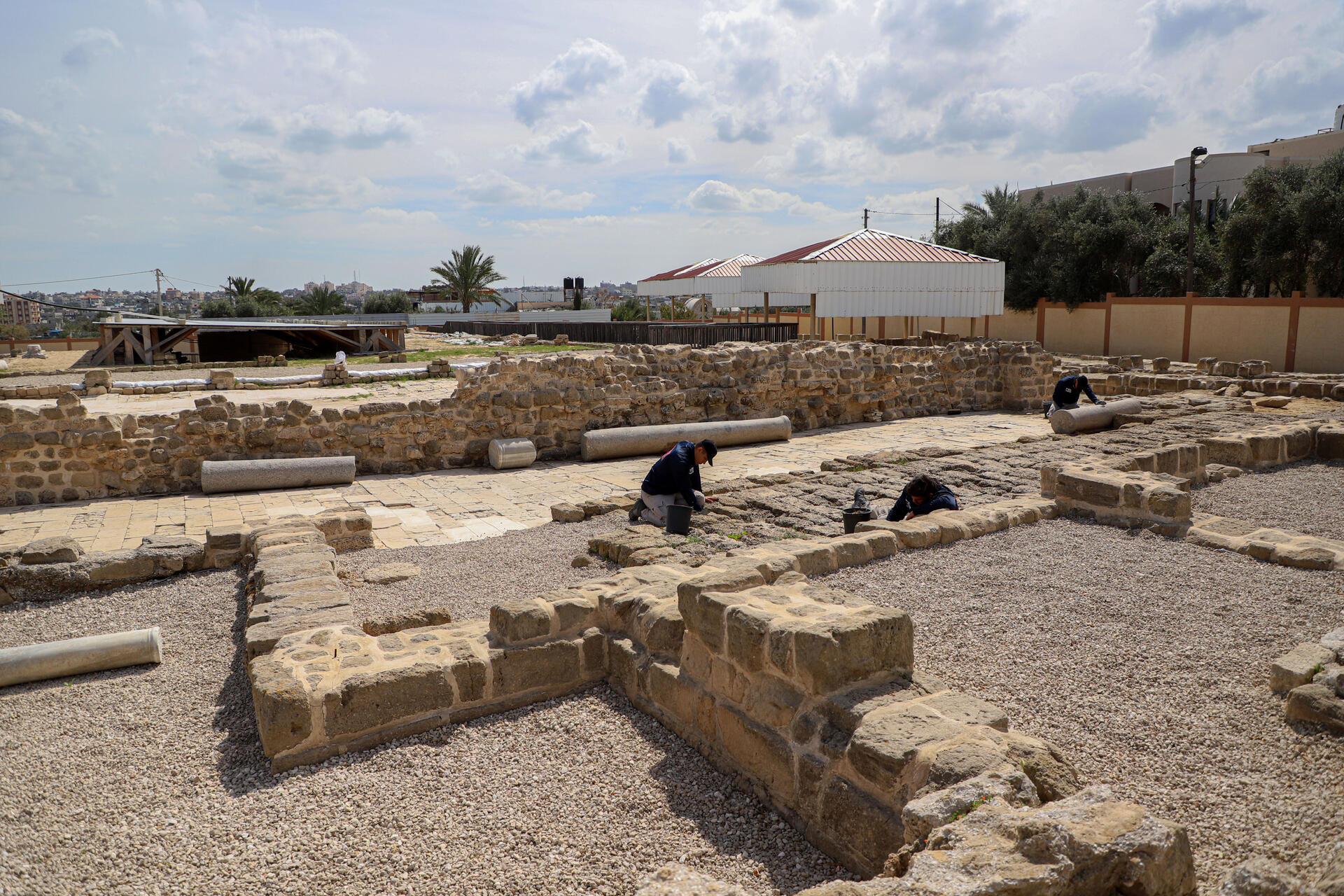
© RIZEK ABDELJAWAD, CC BY-SA 4.0 Resized from original. (This derivative is under the same CC BY-SA license.)
World Heritage Research
Discover scientific research and academic studies that deepen our understanding of Saint Hilarion Monastery/ Tell Umm Amer from its history and significance to its conservation, management, and contemporary challenges.
-
Creation of a 3D Reference Model of an Archaeological Site from a Large Set of Ground and UAV Images
A high-precision 3D reference model of the UNESCO World Heritage Site Saint Hilarion Monastery (Tell Umm Amer) was successfully generated using a combination of ground-based and UAV imagery, despite significant geopolitical and logistical challenges. The study demonstrates that large-scale archaeological documentation can be achieved remotely with minimal on-site control points, leveraging advanced photogrammetric techniques to ensure data accuracy. This approach addresses critical gaps in preserving complex sites under restricted access conditions while maintaining rigorous scientific standards for archaeological research.
Alby, E., & Dellarovere, T. (2023). CREATION OF A 3D REFERENCE MODEL OF AN ARCHAEOLOGICAL SITE FROM A LARGE SET OF GROUND AND UAV IMAGES. ISPRS Annals of the Photogrammetry, Remote Sensing and Spatial Information Sciences, X-M-1-2023, 19–25. https://doi.org/10.5194/isprs-annals-x-m-1-2023-19-2023
View Publication Record | Read Publication -
Ten Years of Digital Documentation of the Archaeological Site of the Monastery of Saint Hilarion in Tell Umm El-Amr, Gaza Strip
Photogrammetry emerges as a resilient tool for documenting UNESCO World Heritage Sites, even under challenging geopolitical conditions. This study highlights its adaptability and continuity over ten years at Saint Hilarion Monastery in the Gaza Strip, where access constraints necessitated innovative survey delegation strategies. By integrating evolving acquisition techniques with on-site practices, researchers demonstrated significant advancements in both field data collection and processing of historical datasets. The findings underscore photogrammetry's potential to bridge gaps in archaeological documentation, ensuring long-term preservation despite logistical hurdles.
Alby, E. (2021). TEN YEARS OF DIGITAL DOCUMENTATION OF THE ARCHAEOLOGICAL SITE OF THE MONASTERY OF SAINT HILARION IN TELL UMM EL-AMR, GAZA STRIP. The International Archives of the Photogrammetry, Remote Sensing and Spatial Information Sciences, XLVI-M-1-2021, 17–21. https://doi.org/10.5194/isprs-archives-xlvi-m-1-2021-17-2021
View Publication Record | Read Publication
