World Heritage Identification Number: 280
World Heritage since: 1984
Category: Natural Heritage
WHE Type: Protected Areas & National Parks
Transboundary Heritage: No
Endangered Heritage: No
Country: 🇨🇩 Democratic Republic of the Congo
Continent: Africa
UNESCO World Region: Africa
Map
Salonga National Park: A Giant Tropical Rainforest Reserve in the Heart of Central Congo Basin
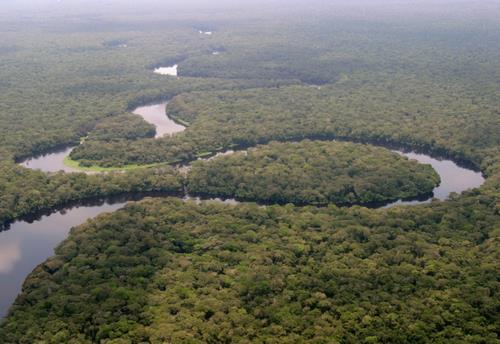
Salonga National Park, situated in the Democratic Republic of the Congo (DRC), is a vast expanse of pristine tropical rainforest that covers approximately 36,000 square kilometers or 3.6 million hectares. This expansive protected area, which stretches across the provinces of Mai Ndombe, Equateur, Kasaï, and Sankuru, is Africa's largest tropical rainforest reserve and holds significant importance for biodiversity conservation.
More to come…UNESCO Description of the World Heritage Site
Salonga National Park is Africa's largest tropical rainforest reserve. Situated at the heart of the central basin of the Congo river, the park is very isolated and accessible only by water. It is the habitat of many endemic endangered species, such as the dwarf chimpanzee, the Congo peacock, the forest elephant and the African slender-snouted or 'false' crocodile.
UNESCO Justification of the World Heritage Site
Criterion (vii): Salonga National Park represents one of the very rare existing biotopes absolutely intact in central Africa. Moreover, it comprises vast marshland areas and practically inaccessible gallery forests, which have never been explored and may still be considered as practically virgin.
Criterion (ix): The plant and animal life in Salonga National Park constitute an example of biological evolution and the adaptation of life forms in a complex equatorial rainforest environment. The large size of the Park ensures the continued possibility for evolution of both species and biotic communities within the relatively undisturbed forest.
Encyclopedia Record: Salonga National Park
Salonga National Park is a national park in the Democratic Republic of the Congo located in the Congo River basin. It is Africa's largest tropical rainforest reserve covering about 36,000 km2 or 3,600,000 hectares. It extends into the provinces of Mai Ndombe, Equateur, Kasaï and Sankuru. In 1984, the national park was inscribed on the UNESCO World Heritage List for its protection of a large swath of relatively intact rainforest and its important habitat for many rare species. In 1999, the site has been listed as endangered due to poaching and housing construction. Following the improvement in its state of conservation, the site was removed from the endangered list in 2021.Additional Site Details
Area: 3,600,000 hectares
Number of Components: 2
(ix) — Outstanding example representing ecological and biological processes
Coordinates: -2 , 21
IUCN World Heritage Outlook
The 2025 Conservation Outlook on Salonga National Park reports the following assessment:
Source: International Union for Conservation of Nature (IUCN) · View assessment
World Heritage Research
Discover scientific research and academic studies that deepen our understanding of Salonga National Park from its history and significance to its conservation, management, and contemporary challenges.
-
Hunting strategies, success, and sustainability: A case study in a community forest on the edge of Salonga National Park, DRC
Excessive hunting pressure on ungulate populations threatens biodiversity sustainability in Salonga National Park, DRC. Analysis of 1769 hunting trips revealed that metal snares (41%), bow and arrow (30%), and guns (25%) were the primary methods used, with significant seasonal variations. Ungulates accounted for 76.4% of biomass harvested, while reproductive data indicated potential population decline, with only 16.7% of hunted females pregnant and 10.3% lactating. These findings underscore the need for adaptive hunting management policies, including quotas and seasonal closures, to balance wildlife conservation with local livelihoods.
Ausse Baraka, J., Bessone, M., Baraka Lucungu, P., Admettons, Z., Beguide Bobo, D. N., Engombe Botomia, J., Miezi, E., Nkamisha Mukole, J., Nsilu, B., Semeki Ngabinzeke, J., & Fruth, B. (2026). Hunting strategies, success, and sustainability: A case study in a community forest on the edge of Salonga National Park, DRC. Ecological Solutions and Evidence, 7(2). Portico. https://doi.org/10.1002/2688-8319.70241
View Publication Record | Read Publication -
Importance of non-timber forest products in the livelihoods of rural communities in the Democratic Republic of the Congo
Rural communities in the Democratic Republic of the Congo rely heavily on non-timber forest products (NTFPs) for food and medicine, with 74 species used by households near Salonga National Park. While commercialization could diversify income and reduce wildlife pressure, infrastructure limitations hinder its viability. The study, monitoring 457 households over a year, found that NTFP consumption was consistent but varied seasonally, with cultural differences in usage patterns. Though NTFPs provided economic benefits, their contribution to household wealth was minimal due to poor market access. Researchers recommend further research on sustainable harvesting before promoting NTFP commercialization.
Engombe Botomia, J., Bessone, M., Baraka Lucungu, P., Admettons, Z., Ausse Baraka, J., Miezi, E., Nkamisha Mukole, J., Nsilu, B., Semeki Ngabinzeke, J., & Fruth, B. (2026). Importance of non-timber forest products in the livelihoods of rural communities in the Democratic Republic of the Congo. Trees, Forests and People, 25, 101266. https://doi.org/10.1016/j.tfp.2026.101266
View Publication Record | Read Publication -
Conception culturelle de la conservation des ressources forestières par les Twa (Pygmées) dans le corridor biologique du Parc national de Salonga en République Démocratique du Congo
A study reveals that the Twa (Pygmies) in Salonga National Park, DRC, employ ancestral strategies for sustainable forest management, including self-consumption and respect for customary taboos. These practices, rooted in indigenous ecological knowledge, are threatened by modern conservation policies perceived as exclusionary. The research highlights the potential of integrating traditional knowledge into national environmental policies to foster inclusive forest governance and ecological sustainability.
Ngongo Lolatui, P. (2026). Conception culturelle de la conservation des ressources forestières par les Twa (Pygmées) dans le corridor biologique du Parc national de Salonga en République Démocratique du Congo. Revue Congolaise Des Sciences & Technologies, 5(2), 566–575. https://doi.org/10.59228/rcst.026.v5.i2.267
View Publication Record | Read Publication -
A Spatio-Temporal Machine Learning Benchmark for Forest-Habitat Disturbance Prediction around Salonga National Park
Forest-habitat disturbance around Salonga National Park exhibits strong spatial clustering and temporal persistence. Machine learning models, particularly Random Forest, achieved high predictive accuracy (ROC-AUC: 0.980, PR-AUC: 0.980) for one-year-ahead disturbance prediction, outperforming simpler baselines like persistence and historical hotspot models. The study leveraged open geospatial data and a grid-cell-year dataset to classify disturbances based on forest loss thresholds. While tree-based models demonstrated superior performance, the findings underscore the reproducibility of machine learning benchmarks in tropical protected areas and their potential for biodiversity management support.
Mboyo, D. N., Konka, D. N. N. Y., Kambale, E. M., Djenga, G. N., Wayikanga, D., Lucungu, P. B., & Kyamakya, K. (2026). A Spatio-Temporal Machine Learning Benchmark for Forest-Habitat Disturbance Prediction around Salonga National Park. Procedia Computer Science, 290, 812–818. https://doi.org/10.1016/j.procs.2026.08.466
View Publication Record | Read Publication -
An eastern Congolian endemic, or widespread but secretive? New data on the recently described Afrixalus lacustris (Anura, Hyperoliidae) from the Democratic Republic of the Congo
New research reveals that the Great Lakes spiny reed frog (Afrixalus lacustris), previously thought to be endemic to the Albertine Rift mountains, has a broader range extending westward into lowland rainforests of the Northeastern and Central Congolian Lowlands. DNA barcoding and phylogeographic analysis indicate that A. lacustris likely diversified in isolated forest refugia during the Middle Pleistocene, while its sister species, A. phantasma, thrived in montane forests. The study also highlights distinct differences in oviposition behavior between A. lacustris and related species, such as laying eggs in folded leaves—a trait not previously documented for this frog.
Nečas, T., Badjedjea, G., Czurda, J., & Gvoždík, V. (2025). An eastern Congolian endemic, or widespread but secretive? New data on the recently described Afrixalus lacustris (Anura, Hyperoliidae) from the Democratic Republic of the Congo. ZooKeys, 1224, 55–68. https://doi.org/10.3897/zookeys.1224.128761
View Publication Record | Read Publication -
Spatial Ecology and Home Range Drivers of the Weyns's Duiker (Cephalophus weynsi) in Rainforest Habitat
Weyns's duikers (Cephalophus weynsi) in Salonga National Park exhibit stable core home ranges averaging 29.38 hectares, with dynamic boundaries influenced by breeding status and anthropogenic disturbances. A study using GPS/VHF collars revealed that breeding pairs overlap significantly (72.8%), maintaining close proximity (~288 m), while non-breeding individuals show minimal overlap (4.5–52.2%) and greater spacing (~533 m). The research, employing both day net captures and night torch captures, highlights the species' spatial behavior as critical to its reproductive success and conservation, emphasizing the need for further study on forest ungulate ecology in Central Africa.
Bobo, D. N. B., Bessone, M., Cleva, R., & Fruth, B. (2025). Spatial Ecology and Home Range Drivers of the Weyns’s Duiker (Cephalophus weynsi) in Rainforest Habitat. African Journal of Ecology, 63(3). Portico. https://doi.org/10.1111/aje.70041
View Publication Record | Read Publication -
A new Xymmer Santschi, 1914 (Formicidae: Amblyoponinae) species from the Congo Basin, with male and female descriptions of X. muticus (Santschi, 1914)
Researchers have identified a new species of ant, Xymmer paniscus, within the Amblyoponinae subfamily, marking the third known species in the genus and the second from the Afrotropical region. This discovery was made during a biodiversity survey in Salonga National Park, Democratic Republic of Congo (DRC). Additionally, the study provides detailed descriptions of the previously known Xymmer muticus, including its alate gyne and male forms, which were hitherto undescribed. The findings contribute to our understanding of ant diversity in the Congo Basin and offer a dichotomous key for identifying Xymmer species.
HAMER, M. T., GÓMEZ, K., & JOCQUE, M. (2025). A new Xymmer Santschi, 1914 (Formicidae: Amblyoponinae) species from the Congo Basin, with male and female descriptions of X. muticus (Santschi, 1914). Zootaxa, 5647(5), 479–495. https://doi.org/10.11646/zootaxa.5647.5.7
View Publication Record | Read Publication