World Heritage Identification Number: 1511
World Heritage since: 2017
Category: Cultural Heritage
WHE Type: Historic Cities & Urban Areas
Transboundary Heritage: No
Endangered Heritage: No
Country: 🇦🇴 Angola
Continent: Africa
UNESCO World Region: Africa
Map
Mbanza Kongo: A Testament to the Rich History of the Former Kingdom of Kongo
Mbanza Kongo, situated in the Zaire Province of Angola, stands as a significant testament to the rich history of the former Kingdom of Kongo. Inscribed as a UNESCO World Heritage Site in 2017, this ancient city offers a unique insight into the profound cultural and architectural transformations that occurred when Christianity and European influences met African traditions.
More to come…UNESCO Description of the World Heritage Site
The town of Mbanza Kongo, located on a plateau at an altitude of 570 m, was the political and spiritual capital of the Kingdom of Kongo, one of the largest constituted states in Southern Africa from the 14th to 19th centuries. The historical area grew around the royal residence, the customary court and the holy tree, as well as the royal funeral places. When the Portuguese arrived in the 15th century they added stone buildings constructed in accordance with European methods to the existing urban conurbation built in local materials. Mbanza Kongo illustrates, more than anywhere in sub-Saharan Africa, the profound changes caused by the introduction of Christianity and the arrival of the Portuguese into Central Africa.
UNESCO Justification of the World Heritage Site
Criterion (iii): The contribution of the Kingdom of Kongo to the history of the African continent is attested and undeniable, thanks to the documentation available covering five centuries (from 1483 to the present day) and to the archaeological findings. Its capital has retained the ritual and symbolic powers embodied in the brotherhood of the Leopard Ngo. After the arrival of the Portuguese, the Kingdom adopted Christianity, while however retaining elements of pre-existing Kongo customs. The vestiges of Mbanza Kongo thus evoke the political and symbolic importance of the Kingdom in its territory and its role as a gateway enabling the Christian world to enter the African continent.
Criterion (iv): The political and religious centre of Mbanza Kongo is an outstanding example of an architectural ensemble that illustrates, as nowhere else can in sub-Saharan Africa, the profound changes that emanated from the introduction of Christianity and the arrival of the Portuguese into Central Africa in the 15th century, events that influenced, not only religion but also trade, learning and contact between Central Africa and Europe, particularly Italy and Portugal. The Cathedral was standing when in 1608, the Pope accredited in Rome the first ambassador of a sub-Saharan African state to the Vatican. The Jesuit College reflects the status given to Mbanza Kongo as a seat of learning and is the place where in 1624 the first catechism was written in the Kikongo language to be used to spread Christianity across the Kingdom. The city was at the heart of the vast Kongo Kingdom that in turn was linked to a vast intercontinental network.
Encyclopedia Record: M'banza-Kongo
Mbanza Kongo is the capital of Angola's northwestern Zaire Province with a population of 148,000 in 2014. Mbanza Kongo was the capital of the Kingdom of Kongo since its foundation before the arrival of the Portuguese in 1483 until the abolition of the kingdom in 1915, aside from a brief period of abandonment during civil wars in the 17th century. In 2017, Mbanza Kongo was declared a UNESCO World Heritage Site.Additional Site Details
Area: 89.29 hectares
Number of Components: 1
(iv) — Outstanding example of a type of building or landscape
Coordinates: -6.2688888889 , 14.2497222222
Image
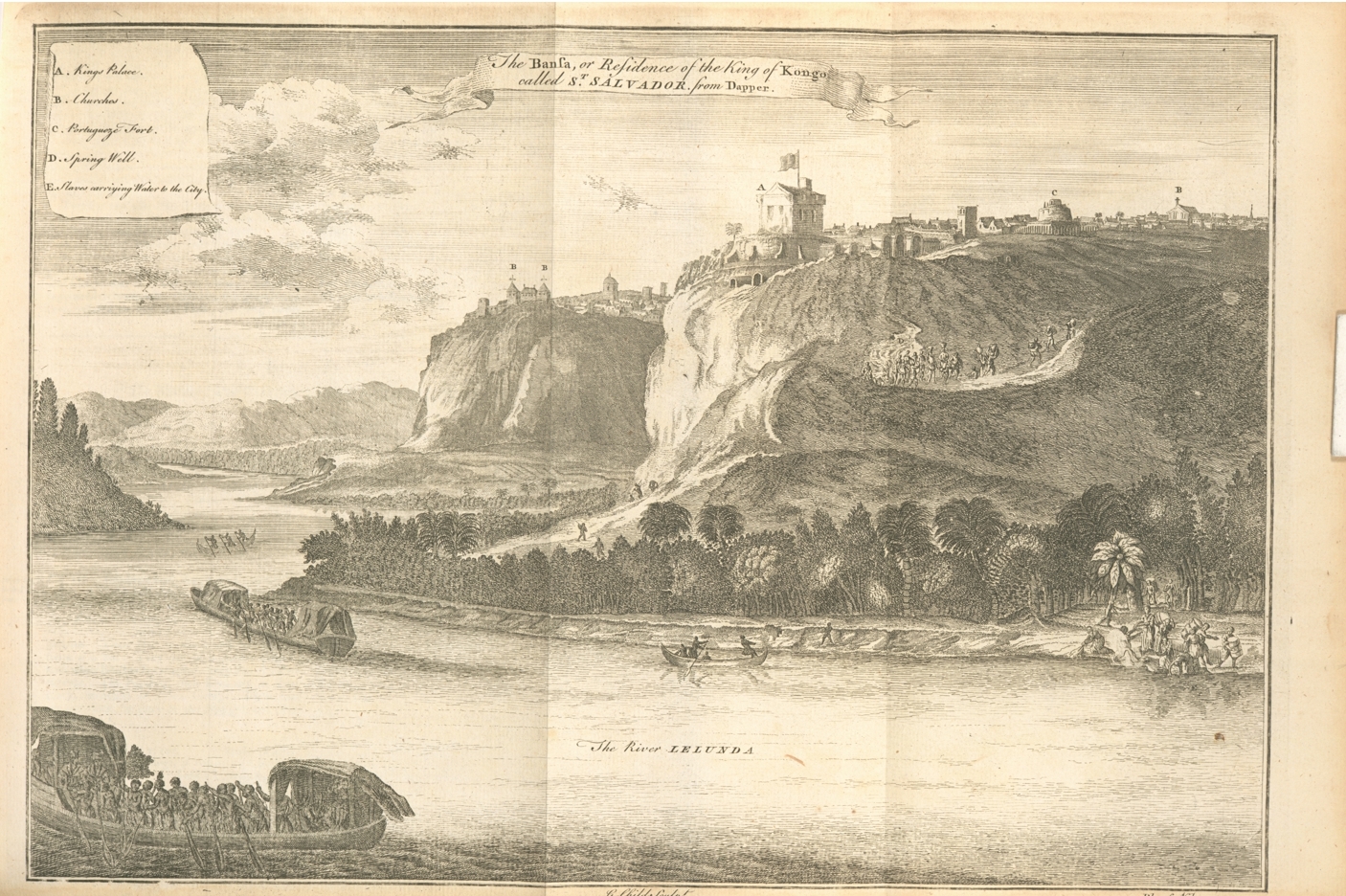
Thomas Astley, Public domain