World Heritage Identification Number: 692
World Heritage since: 2023
Category: Natural Heritage
WHE Type: Natural Landscapes & Geographic Features
Transboundary Heritage: No
Endangered Heritage: No
Country: 🇨🇬 Congo
Continent: Africa
UNESCO World Region: Africa
Map
Odzala-Kokoua National Park: A Biodiversity Hotspot in Central Africa
Odzala-Kokoua National Park, located in the Republic of the Congo, stands out as a significant conservation area in Central Africa. Inscribed as a UNESCO World Heritage Site in 2023, this expansive park offers a unique glimpse into the process of post-glacial forest recolonization of savanna ecosystems.
More to come…UNESCO Description of the World Heritage Site
This property is an excellent example, at an exceptionally large-scale, of the process of post-glacial forest recolonization of savanna ecosystems. It is therefore ecologically significant as a convergence point of multiple ecosystem types (Congolese Forest, Lower Guinean Forest and Savanna). The broad range of age classifications across the forest succession spectrum contributes to the park’s highly distinct ecology, incorporating a broad range of remarkable ecological processes. It is one of the most important strongholds for forest elephants in Central Africa, and is recognized as the park with the richest primate diversity in the region.UNESCO Justification of the World Heritage Site
Criterion (ix): The forest ecosystem is characterized by its great diversity of formations of very different ages over an enormous area. The property represents all stages of the savanna-to-forest succession process. Marantaceae forests cover around 60% of the property. These forests are highly diversified, representing both progressive succession stages, as seen in other sites in west-central Africa, and regressive stages where mature forests are invaded by the highly aggressive Marantaceae species Haumania liebrechtsiana. The forest dynamics within FMOK are driven by complex and still insufficiently understood ecological processes. The presence of more than 130 marshy clearings maintained by wildlife is not exceptional in itself, but contributes greatly to the significance of the property. These clearings function as vital exchange hubs for nutrients and play a critical role in determining the movements of elephants, which are essential agents of forest dynamics. Moreover, this forest ecosystem, with predominant Lower Guinean affinities, is highly representative of the forests within the Sangha interval and, more specifically, of the advancing front of Lower Guinean forests as they reclaim savanna areas. This virtually untouched forest ecosystem helps to preserve the integrity of the waters of the Mambili basin, and thus the vast interface between terrestrial and aquatic environments.
Criterion (x): The FMOK's intact forest ecosystem is home to little-studied forest formations, including old-growth, saxicolous and mist forests. These mist forests are unique to northern Congo and the Sangha interval, and they provide habitat for at least 32 plant species that are not found elsewhere in the region, including one endemic species. In all, 1,150 plant species have been identified, of which four are endemic and 15 are classified as threatened to varying degrees. In terms of fauna, this ecosystem supports at least 120 species of mammals. These include 20 threatened species and 17 primate species, including 9 species endemic or sub-endemic to Lower Guinea. The populations of 6,246 forest elephants, 11,481 gorillas, and 2,240 chimpanzees represent significant strongholds for the conservation of these threatened species. Notably, the only known population of forest-dwelling spotted hyenas in the Congo Basin occurs within the property. In terms of avian diversity, 463 bird species have been recorded, including 64% of the 278 forest species restricted to the Guinean-Congolese region, or 88% of the Guineo-Congolian bird species documented in Congo, two of the six endemic species of Lower Guinea and four threatened species. The insect fauna includes at least 647 species of diurnal butterflies, featuring one locally endemic species, numerous sub-endemic species of Lower Guinea, and several species that appear to be confined to the region’s Marantaceae forests. Lastly, the FMOK is also home to significant populations of threatened long-snouted crocodiles, dwarf crocodiles and two endemic fish species.
Encyclopedia Record: Odzala-Kokoua National Park
Odzala-Kokoua National Park is a national park in the Republic of the Congo. The park was first protected in 1935, declared a biosphere reserve in 1977, and granted official designation by presidential decree in 2001. Odzala-Kokoua has approximately 100 mammal species, and one of the continent's most diverse primate populations. The nonprofit conservation organization African Parks began managing the park in collaboration with the Ministry of Forest Economy, Sustainable Development and Environment of the Republic of the Congo in 2010.Additional Site Details
Area: 1,179,376 hectares
Number of Components: 1
(x) — Contains most important habitats for biodiversity
Coordinates: 1.3355555556 , 14.8602777778
IUCN World Heritage Outlook
The 2025 Conservation Outlook on Forest Massif of Odzala-Kokoua reports the following assessment:
Source: International Union for Conservation of Nature (IUCN) · View assessment
Image
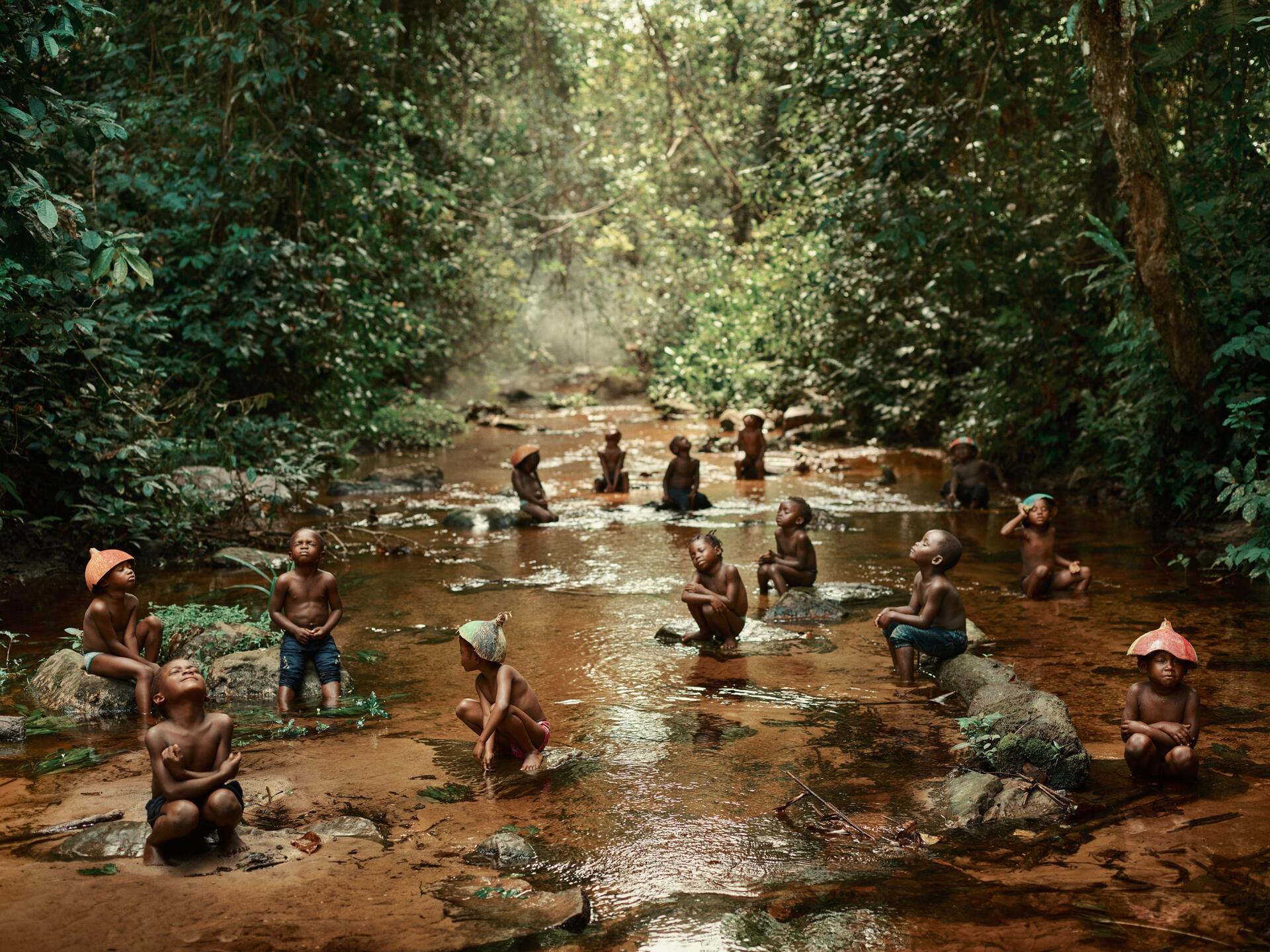
© Leighcn, CC BY-SA 4.0 Resized from original. (This derivative is under the same CC BY-SA license.)
World Heritage Research
Discover scientific research and academic studies that deepen our understanding of Forest Massif of Odzala-Kokoua from its history and significance to its conservation, management, and contemporary challenges.
-
A Comparison of Chimpanzee Density Estimators in Southern Congo
A groundbreaking study in the Tchimpounga Nature Reserve (TNR), Republic of Congo, reveals that Spatially Explicit Capture-Recapture (SECR) analysis is the most precise and cost-effective method for estimating chimpanzee density. Using camera trap data collected over six months, researchers identified 116 chimpanzees across a 252 km² grid, yielding a density estimate of 0.87 individuals per km² (95% CI: 0.58-1.30). This finding aligns with the distance sampling method's estimate of 0.81/km² but underscores SECR's superior reliability. The study marks the first application of SECR to great apes in Congo, providing critical insights for conservation efforts in the Odzala-Kokoua Forest Massif. This approach offers a robust foundation for monitoring chimpanzee populations amid habitat loss and illegal hunting pressures.
Villamarin, E., Fourrier, M., Espinosa‐Ruiz, S., Sutherland, C., & Atencia, R. (2026). A Comparison of Chimpanzee Density Estimators in Southern Congo. American Journal of Primatology, 88(4). Portico. https://doi.org/10.1002/ajp.70154
View Publication Record | Read Publication -
Contribution to the knowledge of the Nolinae of the Republic of Congo, with descriptions of four new genera and 54 new species (Lepidoptera, Noctuoidea, Nolidae, Nolinae)
A groundbreaking study reveals the rich biodiversity of Nolinae moths (Lepidoptera) in the Republic of Congo, identifying four new genera and 54 new species from Odzala-Kokoua and Nouabalé-Ndoki National Parks. This comprehensive account, based on seven sampling expeditions, documents a total of 114 species, significantly expanding our understanding of this taxonomic group. The research also establishes three new synonymies, providing clarity to the region's moth taxonomy. Comparative analysis highlights distinct distribution patterns between the two parks, offering insights into ecological differences and conservation priorities in these UNESCO World Heritage Sites.
László, G. M. (2026). Contribution to the knowledge of the Nolinae of the Republic of Congo, with descriptions of four new genera and 54 new species (Lepidoptera, Noctuoidea, Nolidae, Nolinae). Ecologica Montenegrina, 100, 3–113. https://doi.org/10.37828/em.2026.100.2
View Publication Record | Read Publication -
Diversity of Leaf Katydids of Odzala-Kokoua National Park, Republic of Congo, Central Tropical Africa (Insecta: Orthoptera: Tettigoniidae)
A groundbreaking study of Odzala-Kokoua National Park, Republic of Congo, has uncovered significant biodiversity within the leaf katydid (Tettigoniidae) community. Researchers described one new genus and six new species, including Phanreticula fenestrata n. sp., Habrocomes piotri n. sp., and Conocephalus (Anisoptera) mollyae n. sp. Additionally, the first female specimens of Paraeulioptera emitflesti were collected, allowing for its reclassification within the tribe Catoptropterigini. The study also rediscovered Pleothrix conradti after 118 years and described the male of Griffinipteryx mukonja for the first time. An updated taxonomy of the genus Tetraconcha now includes 24 species, with two new additions from Ivory Coast. Overall, 108 Tettigoniidae species were documented, highlighting the park's rich entomological diversity.
Massa, B. (2025). Diversity of Leaf Katydids of Odzala-Kokoua National Park, Republic of Congo, Central Tropical Africa (Insecta: Orthoptera: Tettigoniidae). Insects, 16(3), 241. https://doi.org/10.3390/insects16030241
View Publication Record | Read Publication -
Natural Forest Clearings Enable the Persistence of Stable Spotted Hyena Populations in Congo Basin Rainforests
Research reveals that spotted hyenas (Crocuta crocuta) can sustain stable populations within Congo Basin rainforests, challenging the long-held assumption that they are primarily transient through such ecosystems. A study conducted over five years in Odzala-Kokoua National Park (OKNP), Republic of Congo, used camera trap imagery, GPS telemetry data from hyenas, and remote sensing to analyze their presence across 10 natural forest clearings known as bais. The findings indicate that hyena persistence is linked to the availability of large prey and open-canopy areas surrounding these clearings, suggesting remarkable behavioral adaptability in this species. This discovery prompts a reevaluation of spotted hyena distribution maps, potentially extending their recognized range to include forested regions beyond OKNP.
Bradford, E. M., Hockridge, E. G., Gibbon, G. E. M., Kibongui, G., Mouamana, A., Ngama, G., Osner, N., & Davies, A. B. (2025). Natural Forest Clearings Enable the Persistence of Stable Spotted Hyena Populations in Congo Basin Rainforests. Biotropica, 57(5). Portico. https://doi.org/10.1111/btp.70065
View Publication Record | Read Publication -
LWRsand condition factors of 32 fish species from the Odzala-Kokoua National Park(Republic of Congo, Central Africa)
A comprehensive analysis of length-weight relationships (LWRs) and condition factors for 32 fish species in the Odzala-Kokoua National Park, Republic of Congo, reveals significant variability in growth patterns and physiological states. The allometric coefficient b of LWRs ranged from 2.158 to 3.546, while condition factor values spanned from 0.524-0.937 for Xenomystus nigri to an exceptionally high 10.402-14.967 for Distichodus teugelsi, indicating species-specific differences in growth dynamics and body composition. This study provides critical baseline data on fish biology in the Congo Basin, contributing to broader understanding of aquatic ecosystems in this biodiverse region.
Batchi, L. A., Zamba, A. I., Boungou, M., Boussiengue, D. A., Louvinguila, T. H. D., Ngot, F. H. P., & Mikembi, A. L. B. (2025). LWRsand condition factors of 32 fish species from the Odzala-Kokoua National Park(Republic of Congo, Central Africa). International Journal of Fisheries and Aquatic Studies, 13(6), 158–163. https://doi.org/10.22271/fish.2025.v13.i6b.3191
View Publication Record | Read Publication -
Antheua lobo Laszlo & Schintlmeister 2025, sp. nov.
A new moth species, Antheua lobo, has been discovered within the Odzala-Kokoua National Park, a UNESCO World Heritage Site in the Republic of Congo. This species is distinguished by its smaller size (forewing length 19–22 mm in males and 23 mm in females), unique genitalia morphology, and absence of a pale discal spot characteristic of related species like A. obtusipuncta. Key distinguishing features include a blackish shadow at the base of the forewing anal margin, bilobated uncus tip, shorter socius processes, and less sclerotized female genitalia. The discovery was made through extensive light-trapping surveys conducted near the Lobo research camp, which revealed A. lobo's restriction to isolated savannah and grassland habitats within the Congo Basin. This finding highlights the biodiversity richness of Odzala-Kokoua, emphasizing the importance of protected areas in conserving unique species.
Schintlmeister, A., & László, G. M. (2025). Antheua lobo Laszlo & Schintlmeister 2025, sp. nov. Zenodo. https://doi.org/10.5281/ZENODO.20166728
View Publication Record | Read Publication -
Spatulosia lobo Volynkin, 2025, sp. n.
A new species of moth, Spatulosia lobo, has been discovered in the Odzala-Kokoua National Park within the UNESCO-listed Forest Massif of Odzala-Kokoua. This species is distinguished by its ochreous yellow coloration and reduced forewing markings, setting it apart from sympatric and allopatric congeners like S. gemina and S. similis. Key distinguishing features include differences in male and female genitalia structures, such as the broader uncus and valvula in females, and a distally downcurved phallus with fewer carinal thorns in males. The discovery was made through light trapping at Lobo Research Camp, with type material collected between 2024 and 2025. Molecular data for this species is currently unavailable.
Volynkin, A. V. (2025). Spatulosia lobo Volynkin, 2025, sp. n. Zenodo. https://doi.org/10.5281/ZENODO.20166325
View Publication Record | Read Publication