World Heritage Identification Number: 1335
World Heritage since: 2010
Category: Natural Heritage
WHE Type: Natural Landscapes & Geographic Features
Transboundary Heritage: No
Endangered Heritage: No
Country: 🇨🇳 China
Continent: Asia
UNESCO World Region: Asia and the Pacific
Map
Exploring the Spectacular Landscapes of China Danxia: A Unique Geological Wonder
The China Danxia landscape, inscribed as a UNESCO World Heritage Site in 2010, offers a breathtaking display of nature's grandeur and geological complexity. Comprising six distinct areas scattered across southwestern China, these regions are characterized by their striking red cliffs, towering pillars, deep ravines, and cascading waterfalls. This article delves into the unique geological features, formation processes, and biodiversity of this remarkable landform.
More to come…UNESCO Description of the World Heritage Site
China Danxia is the name given in China to landscapes developed on continental red terrigenous sedimentary beds influenced by endogenous forces (including uplift) and exogenous forces (including weathering and erosion). The inscribed site comprises six areas found in the sub-tropical zone of south-west China. They are characterized by spectacular red cliffs and a range of erosional landforms, including dramatic natural pillars, towers, ravines, valleys and waterfalls. These rugged landscapes have helped to conserve sub-tropical broad-leaved evergreen forests, and host many species of flora and fauna, about 400 of which are considered rare or threatened.
UNESCO Justification of the World Heritage Site
Criterion (vii): China Danxia is an impressive and unique landscape of great natural beauty. The reddish conglomerate and sandstone that form this landscape of exceptional natural beauty have been shaped into spectacular peaks, pillars, cliffs and imposing gorges. Together with the contrasting forests, winding rivers and majestic waterfalls, China Danxia presents a significant natural phenomenon.
Criterion (viii): China Danxia contains a wide variety of well developed red-beds landforms such as peaks, towers, mesas, cuestas, cliffs, valleys, caves and arches. Being shaped by both endogenous forces (including uplift) and exogenous forces (including weathering and erosion), China Danxia provides a range of different aspects of the phenomenon of physical landscape developed from continental (terrestrial) reddish conglomerate and sandstone in a warm, humid monsoon climate, illustrating both the range of landforms in relation to the forces and processes that formed them. The component parts represent the best examples of least eroded to most eroded Danxia landforms, displaying a clear landform sequence from young through mature to old age, and with each component site displaying characteristic geomorphologic features of a given stage.
Encyclopedia Record: Danxia landform
The Danxia landform is a set of landscapes found in southeast, southwest and northwest China that "consist of a red bed characterized by steep cliffs". It is a unique type of petrographic geomorphology found in China. Danxia landform is formed from red-coloured sandstones and conglomerates of largely Cretaceous age. The landforms look very much like karst topography that forms in areas underlain by limestones, but since the rocks that form danxia are sandstones and conglomerates, they have been called "pseudo-karst" landforms. They were formed by endogenous forces and exogenous forces.Additional Site Details
Area: 82,151 hectares
Number of Components: 9
(viii) — Outstanding example representing major earth stages
Coordinates: 28.4219444444 , 106.0425
IUCN World Heritage Outlook
The 2025 Conservation Outlook on China Danxia reports the following assessment:
Source: International Union for Conservation of Nature (IUCN) · View assessment
Image
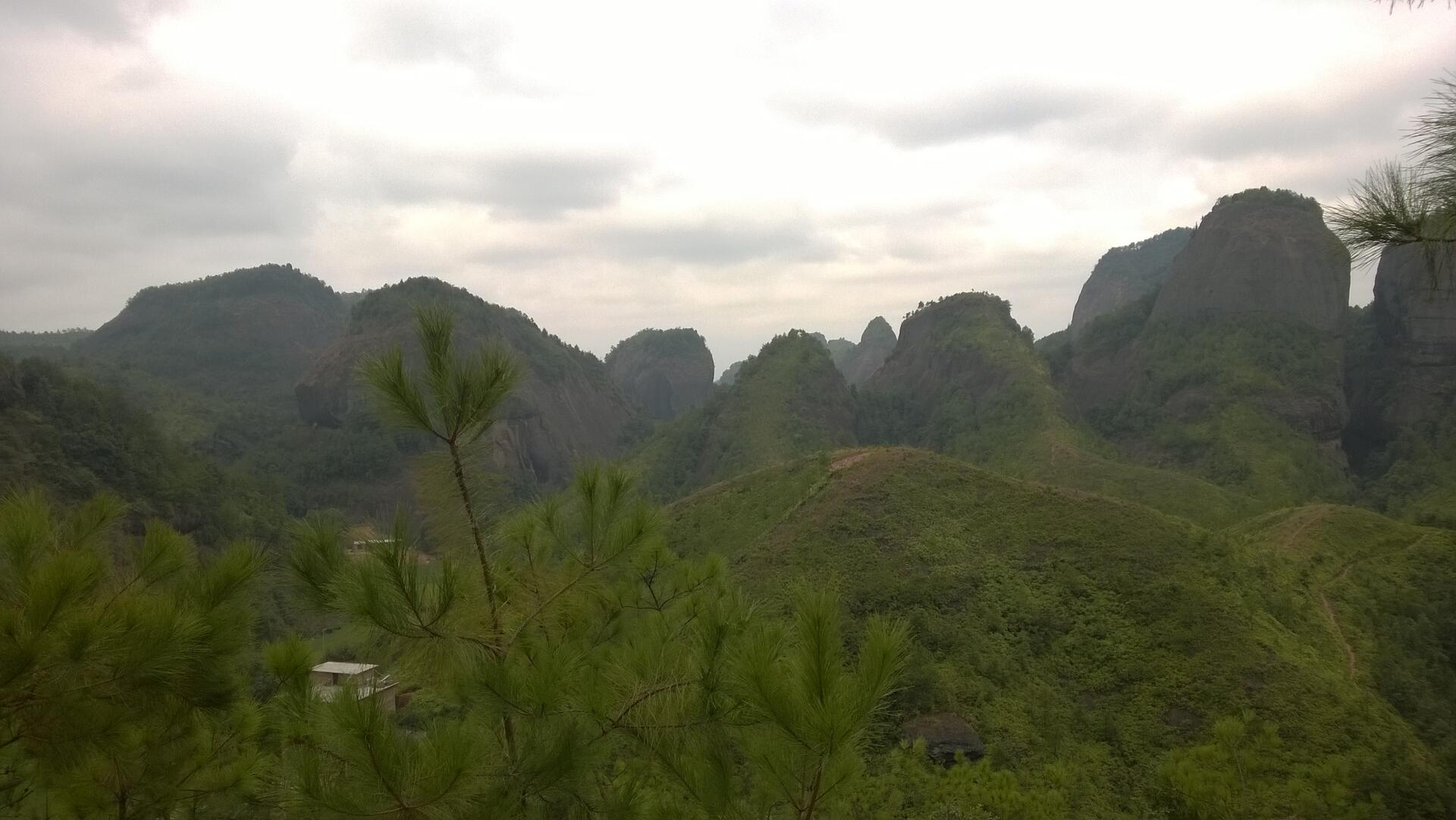
© Sino Yu, CC BY-SA 4.0 Resized from original. (This derivative is under the same CC BY-SA license.)
World Heritage Research
Discover scientific research and academic studies that deepen our understanding of China Danxia from its history and significance to its conservation, management, and contemporary challenges.
-
Camellia shangshii (Theaceae), a new species endemic to danxia landscape from Guangdong Province, China
Researchers have identified Camellia shangshii, a new species of tea plant endemic to the danxia landscapes of Danxiashan Mountain, Guangdong Province, China. This discovery was confirmed through morphological analysis and phylogenetic studies using chloroplast genomes, revealing that C. shangshii is closely related to C. grijsii but distinguished by unique traits such as connate petals at the base, smaller leaves, and fewer bracteoles and sepals. The study integrates both genetic and physical characteristics to validate its recognition as a new species within the Camellia sect. Paracamellia. This finding contributes to the understanding of biodiversity in UNESCO-listed danxia landscapes and highlights the importance of these unique geological formations as hotspots for plant endemism.
Wang, S., Liu, H., Tan, S., Shen, L., Chen, Z., Chen, F., & Fan, Q. (2026). Camellia shangshii (Theaceae), a new species endemic to danxia landscape from Guangdong Province, China. PhytoKeys, 270, 13–23. https://doi.org/10.3897/phytokeys.270.172597
View Publication Record | Read Publication -
Responses of soil labile organic carbon stocks and the carbon pool management index to different vegetation restoration types in the Danxia landform region of southwest China
Vegetation restoration significantly enhances soil organic carbon (SOC) and its labile fractions, with bamboo forest (BF) and evergreen broad-leaved forest (EBF) showing the highest carbon sequestration potential in the Danxia landform region of southwest China. These vegetation types exhibited higher total SOC stocks (92.75 t ha⁻¹ for BF and 60.13 t ha⁻¹ for EBF) compared to other restoration types, along with elevated dissolved organic carbon (DOC), microbial biomass organic carbon (MBC), and easily oxidizable organic carbon (EOC). The study also found that the carbon pool management index (CPMI) increased by 49.7% in BF and 32.9% in EBF compared to shrub (SH), indicating superior carbon storage efficiency. SOC and its fractions were closely linked to soil physicochemical properties, with total nitrogen, phosphorus, and moisture playing a crucial role. These findings underscore the importance of selecting appropriate vegetation types for ecological restoration to maximize carbon sequestration and improve soil quality.
Xiao, Y., Zhang, Y., Long, J., Luo, K., & Huang, Z. (2025). Responses of soil labile organic carbon stocks and the carbon pool management index to different vegetation restoration types in the Danxia landform region of southwest China. Plos One, 20(2), e0318195. https://doi.org/10.1371/journal.pone.0318195
View Publication Record | Read Publication -
Gap analysis of Firmiana danxiaensis, a rare tree species endemic to southern China
A gap analysis reveals that over 78% of the potential habitat for Firmiana danxiaensis, a rare tree species endemic to southern China's Mount Danxia, lacks conservation protection. Using Biomod2 and Maxent models, researchers estimated its habitat at 6,255.28 km² and 4,114.19 km² respectively, with key climatic preferences including high temperature seasonality (6000–7000) and warmest-month maxima of 36–37°C. Alarming anthropogenic disturbances affect over 40% of its habitat, particularly in unprotected areas like Yingde and Shixing. The study urges adjustments to existing reserves and expansion of protected zones to safeguard this vulnerable species.
LI, R., HU, X., LI, Q., LIU, L., HE, Y., & CHEN, C. (2024). Gap analysis of Firmiana danxiaensis, a rare tree species endemic to southern China. Ecological Indicators, 158, 111606. https://doi.org/10.1016/j.ecolind.2024.111606
View Publication Record | Read Publication -
Lysimachia danxiashanensis, a new species of Primulaceae from Guangdong, China
A new species of Primulaceae, Lysimachia danxiashanensis, has been discovered in the unique Danxia landscape of Guangdong Province, China. This endemic plant is morphologically distinct from its closest relatives, characterized by purplish-red plants, wingless petioles, an orange glandular calyx, and a serrated corolla margin with orange-red glandular punctates. Phylogenetic analysis using ITS and rbcL sequences confirmed its status as a distinct clade within Lysimachia subgen. Lysimachia sect. Nummularia. The species is classified as Endangered (EN) under the IUCN Red List, highlighting the urgent need for conservation efforts in its native habitat.
Zhang, X.-Y., Dai, J.-M., Fan, Q., Chen, Z.-X., Tang, G.-D., & Liao, W.-B. (2024). Lysimachia danxiashanensis, a new species of Primulaceae from Guangdong, China. PhytoKeys, 237, 257–268. https://doi.org/10.3897/phytokeys.237.114484
View Publication Record | Read Publication -
Camellia zijinica (Theaceae), a new species endemic to Danxia landscape from Guangdong Province, China
Researchers have identified Camellia zijinica, a new species of the genus Camellia endemic to the Danxia landscape in Guangdong Province, China. This discovery was supported by both morphological and molecular analyses, including phylogenetic analysis based on chloroplast genomes. While closely related to species like C. drupifera, C. oleifera, and C. fluviatilis, Camellia zijinica exhibits distinct characteristics such as glabrous young branchlets, fewer bracteoles and sepals, diverse leaf shape, and a midvein that is slightly raised with sparse or no pubescence. These traits set it apart from its closest relative, C. microphylla, which typically features densely pubescent branchlets and leaves. The study highlights the biodiversity of the Danxia landscape and contributes to the understanding of the genus Camellia, particularly within the section Paracamellia.
Lin, M., Ye, Q.-L., Zhang, Z.-J., Liao, W.-B., & Fan, Q. (2024). Camellia zijinica (Theaceae), a new species endemic to Danxia landscape from Guangdong Province, China. PhytoKeys, 237, 245–255. https://doi.org/10.3897/phytokeys.237.114768
View Publication Record | Read Publication -
Oxalis xishuiensis (Oxalidaceae), a new species from Danxia landforms in Guizhou, China
Researchers have identified Oxalis xishuiensis, a new species of Oxalidaceae, from the Danxia landforms in Xishui County, Guizhou, China. This discovery is notable for its distinct morphological traits compared to its closest relative, O. wulingensis, including nearly square-shaped lateral leaflets, shorter peduncles, elongated capsules (1.2–1.5 cm), and alveolate seeds. The study highlights the botanical diversity of Danxia landforms, which are renowned for their colorful rock formations and unique ecosystems. The identification was based on detailed morphological comparisons, emphasizing the importance of field surveys in uncovering new species within protected natural sites like UNESCO World Heritage areas.
Yang, Y.-B., Li, H., An, M.-T., Huang, L., Hu, G.-X., Yang, C.-H., & Dai, Z.-X. (2024). Oxalis xishuiensis (Oxalidaceae), a new species from Danxia landforms in Guizhou, China. PhytoKeys, 239, 267–273. https://doi.org/10.3897/phytokeys.239.119046
View Publication Record | Read Publication -
Landform and lithospheric development contribute to the assembly of mountain floras in China
Mountain floras in China exhibit distinct assembly patterns influenced by geological processes. Research reveals that igneous bedrock, such as granitic and karst-granitic landforms, fosters higher species richness and phylogenetic overdispersion, while sedimentary bedrock, including karst, Danxia, and desert landforms, promotes phylogenetic clustering. The study, based on a dataset of 17,576 angiosperm species across 140 Chinese mountain floras, demonstrates that landform type is the primary determinant for older species, whereas climate plays a greater role in younger species. This finding challenges traditional views and introduces the 'floristic geo-lithology hypothesis,' which emphasizes the critical role of bedrock and landform processes in shaping montane biodiversity. The research provides new insights into speciation, migration, and biodiversity dynamics in mountainous regions.
Zhao, W.-Y., Liu, Z.-C., Shi, S., Li, J.-L., Xu, K.-W., Huang, K.-Y., Chen, Z.-H., Wang, Y.-R., Huang, C.-Y., Wang, Y., Chen, J.-R., Sun, X.-L., Liang, W.-X., Guo, W., Wang, L.-Y., Meng, K.-K., Li, X.-J., Yin, Q.-Y., Zhou, R.-C., et al. (2024). Landform and lithospheric development contribute to the assembly of mountain floras in China. Nature Communications, 15(1). https://doi.org/10.1038/s41467-024-49522-4
View Publication Record | Read Publication