World Heritage Identification Number: 440
World Heritage since: 1987
Category: Cultural Heritage
WHE Type: Religious Sites & Sacred Architecture
Transboundary Heritage: No
Endangered Heritage: No
Country: 🇨🇳 China
Continent: Asia
UNESCO World Region: Asia and the Pacific
Map
Mogao Caves: A Journey Through Time Along the Silk Road
The Mogao Caves, inscribed on the UNESCO World Heritage List in 1987, stand as a testament to the rich cultural exchange that took place along the ancient Silk Road. Located approximately 25 kilometers southeast of Dunhuang, an oasis town in Gansu Province, China, these caves serve as a unique repository of Buddhist art spanning more than a millennium.
The Mogao Caves, also known as the Thousand Buddha Caves, consist of 492 preserved cave sanctuaries and cells carved into the cliffs above the Dachuan River, at the eastern foot of Mount Mingsha. The site's strategic location along the Silk Road placed it at a crossroads of trade and religious, cultural, and intellectual influences. This position contributed greatly to its historical importance and to the artistic exchanges reflected in the caves.
The caves contain an extraordinary collection of Buddhist sculptures and murals dating from the 4th to the 14th centuries. The first cave was constructed in 366 CE, and the site continued to develop for roughly 1,000 years. This long period of artistic activity reflects changes in Buddhist art and religious expression across successive dynasties, as well as the influence of cultural exchanges along the Silk Road.
One of the most striking features of the Mogao Caves is the intricate detail and vibrant colors of the murals. The approximately 45,000 square meters of wall paintings depict Buddhist subjects, including scenes from Buddhist scriptures, images of the Buddha and bodhisattvas, and representations of the religious and social life of different periods. The murals also contain valuable evidence of everyday activities, clothing, architecture, music, travel, and trade, providing a broader picture of life in ancient China and Central Asia.
The sculptures found within the caves are equally impressive. More than 2,000 painted sculptures survive at the site, ranging from relatively small figures to monumental images of Buddhist deities. Their forms, colors, and styles changed over the centuries, reflecting developments in Chinese Buddhist art as well as artistic influences that reached Dunhuang from Central Asia and India.
In addition to their artistic significance, the Mogao Caves have provided valuable historical and archaeological information. The discovery of the Library Cave, sealed around the 11th century and rediscovered in the early 20th century, revealed tens of thousands of manuscripts and other cultural relics. These materials include Buddhist texts as well as documents relating to administration, commerce, literature, and everyday life, providing important evidence for the history of China and Central Asia.
The Mogao Caves also provide exceptional evidence of cultural exchange along the Silk Road. For approximately 1,000 years, the site played a significant role in artistic exchanges among China, Central Asia, and India. Some murals and sculptures reflect the integration of foreign artistic influences with Chinese traditions, while depictions of merchants, travelers, animals, and trade activities reveal the wider world connected by the Silk Road.
Today, the Mogao Caves continue to attract visitors from around the world, offering a glimpse into the religious, artistic, and cultural history of ancient China. They also serve as a reminder of the enduring legacy of the Silk Road and the movement of ideas, beliefs, artistic traditions, and people across Eurasia. As a UNESCO World Heritage Site, the Mogao Caves represent an extraordinary achievement in Buddhist art and an enduring record of cultural exchange over more than a thousand years.
UNESCO Description of the World Heritage Site
Situated at a strategic point along the Silk Route, at the crossroads of trade as well as religious, cultural and intellectual influences, the 492 cells and cave sanctuaries in Mogao are famous for their statues and wall paintings, spanning 1,000 years of Buddhist art.
UNESCO Justification of the World Heritage Site
Criteria (i): The group of caves at Mogao represents a unique artistic achievement both by the organization of space into 492 caves built on five levels and by the production of more than 2,000 painted sculptures, and approximately 45,000 square meters of murals, among which are many masterpieces of Chinese art.
Criteria (ii): For 1,000 years, from the period of the Northern Wei Dynasty (386-534) to the Mongol-led Yuan Dynasty (1276-1386), the caves of Mogao played a decisive role in artistic exchanges between China, Central Asia and India.
Criteria (iii): The paintings at Mogao bear exceptional witness to the civilizations of ancient China during the Sui, Tang and Song dynasties.
Criteria (iv): The Thousand-Buddha Caves constitute an outstanding example of a Buddhist rock art sanctuary.
Criteria (v): Occupied by Buddhist monks from the end of the 19th century up to 1930, the rock art ensemble at Mogao, administered by the Dunhuang Cultural Relics Research Institute, preserves the example of a traditional monastic settlement.
Criteria (vi): The caves are strongly linked to the history of transcontinental relations and of the spread of Buddhism throughout Asia. For centuries the Dunhuang oasis, near which the two branches of the Silk Road forked, enjoyed the privilege of being a relay station where not only merchandise was traded, but ideas as well, exemplified by the Chinese, Tibetan, Sogdian, Khotan, Uighur and even Hebrew manuscripts found within the caves.
Encyclopedia Record: Mogao Caves
The Mogao Caves, also known as the Thousand Buddha Grottoes or Caves of the Thousand Buddhas, form a system of 500 temples 25 km (16 mi) southeast of the center of Dunhuang, an oasis located at a religious and cultural crossroads on the Silk Road, in Gansu province, China. The caves may also be known as the Dunhuang Caves; however, this term is also used as a collective term to include other Buddhist cave sites in and around the Dunhuang area, such as the Western Thousand Buddha Caves, Eastern Thousand Buddha Caves, Yulin Caves, and Five Temple Caves. The caves contain some of the finest examples of Buddhist art spanning a period of 1,000 years.Additional Site Details
Area: 23,392 hectares
Number of Components: 1
(ii) — Significant interchange of human values
(iii) — Unique or exceptional testimony to a cultural tradition
(iv) — Outstanding example of a type of building or landscape
(v) — Outstanding example of traditional human settlement
(vi) — Directly associated with events or living traditions
Coordinates: 40.13333 , 94.81667
Image
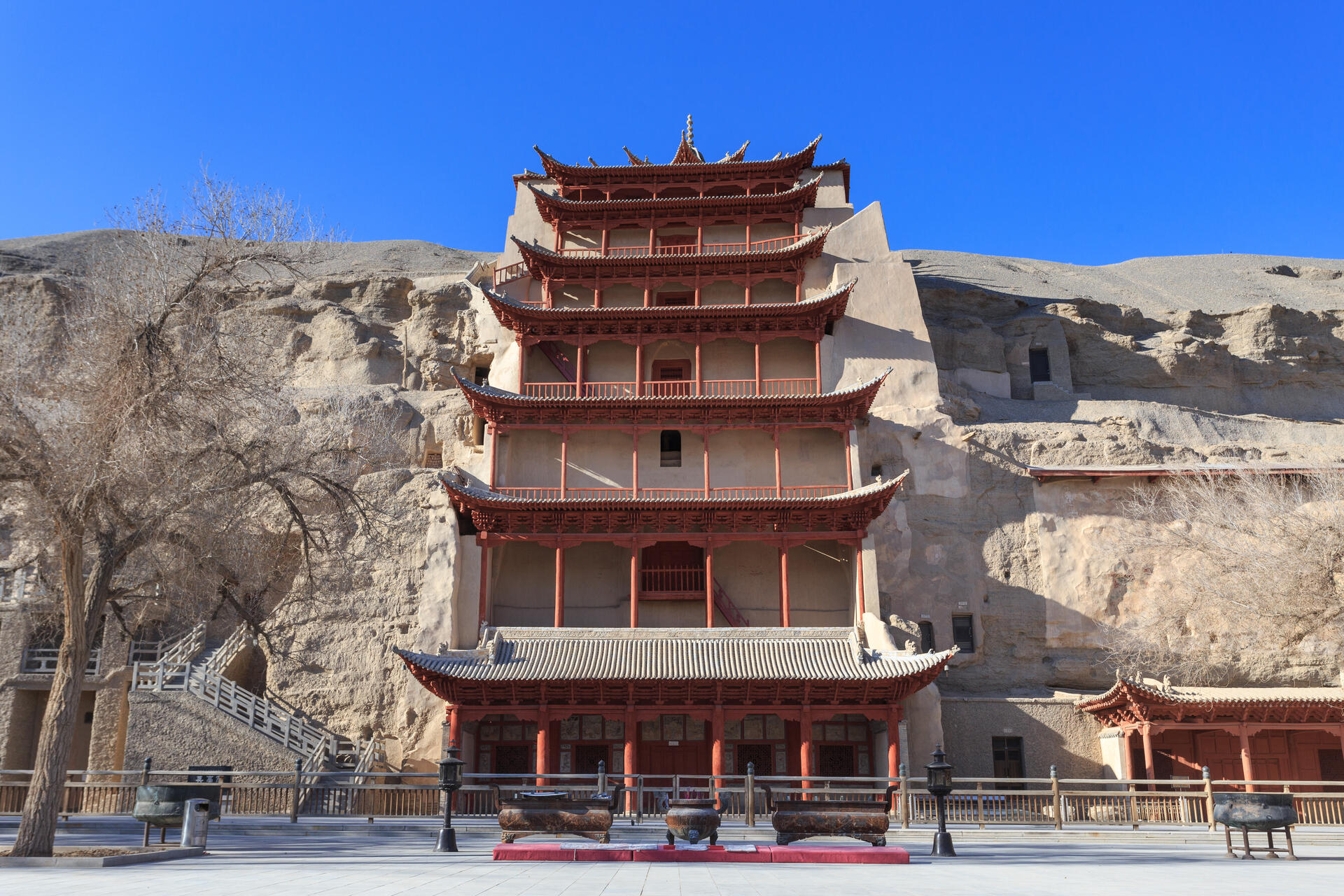
© Zhangzhugang, CC BY-SA 4.0 Resized from original. (This derivative is under the same CC BY-SA license.)
World Heritage Research
Discover scientific research and academic studies that deepen our understanding of Mogao Caves from its history and significance to its conservation, management, and contemporary challenges.
-
A Newly Identified Western Wei Medicine Buddha on the East Wall of Mogao Cave 285
A newly identified depiction of the Medicine Buddha, dating to the Western Wei Dynasty, has been discovered on the east wall of Mogao Cave 285. This finding predates previous records by several centuries and challenges existing chronologies of the Medicine Buddha cult in the Dunhuang region. The study employs textual, iconographic, and spatial analysis of sculptural programs and ink inscriptions to argue that two preaching scenes—one inscribed as 'Amitāyus Buddha' and another identified as the 'Medicine Buddha of Lapis Lazuli Crystal Radiance'—derive from the Guanding jing rather than Pure Land texts. This discovery revises our understanding of the artistic and textual foundations of Cave 285, underscoring the need for a reassessment of its broader cultural significance.
Xiong, Y. (2026). A Newly Identified Western Wei Medicine Buddha on the East Wall of Mogao Cave 285. Religions, 17(3), 334. https://doi.org/10.3390/rel17030334
View Publication Record | Read Publication -
Effect of Earth‐Air Movement on Water Transport in the Rock Surrounding Cave B113 in the Mogao Grottoes
Research at the Mogao Caves reveals that earth-air movement, driven by air pressure differences (APD), significantly influences water transport and moisture dynamics in the rock surrounding Cave B113. The study found that APD fluctuates inversely with atmospheric pressure (AP) and increases with depth, acting as a driving force for earth-air movement. This process affects humidity levels in the rock layers, with temperature influencing water vapor concentration while the movement of earth-air impacts relative and absolute humidities. The magnitude of AP fluctuations determines the volume of water migrating within the rock, ultimately affecting evaporation patterns and moisture characteristics. These findings provide critical insights into the degradation mechanisms of cave wall paintings, offering a scientific basis for developing targeted conservation strategies.
Wang, S., Li, H., Li, F., Gong, Y., & Wang, X. (2025). Effect of Earth‐Air Movement on Water Transport in the Rock Surrounding Cave
View Publication Record | Read PublicationB113 in the Mogao Grottoes. Hydrological Processes, 39(2). Portico. https://doi.org/10.1002/hyp.70073 -
From the Evolution of the “Flying Apsaras” Art in the Mogao Caves, the Influence of Taoism on Dunhuang Culture Observe
Research on the Mogao Caves' murals reveals that Taoist influences have significantly shaped Dunhuang's cultural and artistic evolution, particularly in the depiction of 'Flying Apsaras.' By analyzing changes in these figures across different periods, the study demonstrates how Taoism enriched Dunhuang's art and culture, suggesting deeper exploration of Taoist elements in future heritage studies. The findings highlight the profound impact of Taoism on the region's artistic style and cultural connotations.
Zhang, Y. (2025). From the Evolution of the “Flying Apsaras” Art in the Mogao Caves, the Influence of Taoism on Dunhuang Culture Observe. Sociology, Philosophy and Psychology, 2(1), 5–8. https://doi.org/10.70267/web5xr46
View Publication Record | Read Publication -
Exploring Narrative Techniques and Artistic Expression in the Buddhist Murals of the Mogao Caves
Buddhist murals at the Mogao Caves employ dynamic narrative techniques that blend visual storytelling, symbolic iconography, and historical context to engage viewers in spiritual education. The study reveals these murals as a distinct medium where color, composition, and symbolism work together to convey complex religious narratives effectively. Researchers analyzed representative murals using art historical methods and iconographic analysis, combined with literature review, to uncover how artists communicated intricate Buddhist stories through visual means. This approach highlights the murals' role in not just preserving but also actively educating viewers about spiritual themes.
Huen, K. W. (2025). Exploring Narrative Techniques and Artistic Expression in the Buddhist Murals of the Mogao Caves. Journal of Education, Humanities and Social Sciences, 51, 154–159. https://doi.org/10.54097/wry1na22
View Publication Record | Read Publication -
Impact of open visits on the indoor climate of Mogao Caves
Wavelet analysis reveals that tourist activity significantly alters the indoor climate of Mogao Caves, with temperature and humidity fluctuations more pronounced during open visitation periods compared to the COVID-19 lockdown. The study quantifies how external climate conditions and tourist influx contribute differently to these changes, offering critical insights for managing cave access to protect delicate murals and statues.
Gong, Y., Wang, X., Wang, S., Lin, W., & Jin, K. (2025). Impact of open visits on the indoor climate of Mogao Caves. Npj Heritage Science, 13(1). https://doi.org/10.1038/s40494-025-01740-9
View Publication Record | Read Publication -
Virtual reality and decolonial practice: a case study of Dunhuang Mogao Caves
Virtual reality (VR) technology can shift the narrative around UNESCO World Heritage Sites from one of colonial loss to one that celebrates their artistic and spiritual grandeur, according to a case study of the Shenyou Dunhuang project. The research analyzed user-generated feedback from a digital reconstruction of Cave 61 in the Mogao Caves, revealing how VR facilitates 'digital repatriation' by recontextualizing the site's cultural significance. This finding highlights VR's potential to transform heritage narratives and foster cross-cultural dialogue, while also raising concerns about digital sovereignty and interpretive diversity. The study situates these insights within China's broader cultural policies, such as the Chinese Dream and Civilizational Exchange.
Song, Z., Liu, H., & Zhao, X. (2025). Virtual reality and decolonial practice: a case study of Dunhuang Mogao Caves. Museum Management and Curatorship, 40(6), 801–818. https://doi.org/10.1080/09647775.2025.2539089
View Publication Record | Read Publication -
Visualizing the Spirit Consciousness: Reinterpreting the Medicine Buddha Tableau in Mogao Cave 220 (642 CE)
A groundbreaking interpretation of the Medicine Buddha tableau in Mogao Cave 220 (642 CE) reveals that Buddhist art from the early Tang dynasty visually encoded states of consciousness and spiritual transformations, particularly those of the transmigrating spirit consciousness (shenshi). The study suggests that lighting devices, dancers, and bodhisattvas were strategically integrated to depict this intangible entity, bridging physical objects with spiritual representations. This approach offers a novel cognitive framework for understanding Buddhist murals as visual expressions of ritualistic transformations, advancing the interpretation of Mogao Cave 220's pictorial program.
Peng, X. (. (2025). Visualizing the Spirit Consciousness: Reinterpreting the Medicine Buddha Tableau in Mogao Cave 220 (642 CE). Religions, 16(10), 1225. https://doi.org/10.3390/rel16101225
View Publication Record | Read Publication