World Heritage Identification Number: 1018
World Heritage since: 2015
Category: Cultural Heritage
WHE Type: Historic Cities & Urban Areas
Transboundary Heritage: No
Endangered Heritage: No
Country: 🇹🇷 Türkiye
Continent: Asia
UNESCO World Region: Europe and North America
Map
Ancient City of Ephesus: A Marvelous Blend of Greek and Roman Architecture
The Ancient City of Ephesus, located in modern-day Selçuk, İzmir Province, Turkey, stands as a testament to the rich cultural heritage shared between the Greeks and Romans. This remarkable urban center, established in the 10th century BC, boasts a history spanning over two millennia.
More to come…UNESCO Description of the World Heritage Site
Located within what was once the estuary of the River Kaystros, Ephesus comprises successive Hellenistic and Roman settlements founded on new locations, which followed the coastline as it retreated westward. Excavations have revealed grand monuments of the Roman Imperial period including the Library of Celsus and the Great Theatre. Little remains of the famous Temple of Artemis, one of the “Seven Wonders of the World,” which drew pilgrims from all around the Mediterranean. Since the 5th century, the House of the Virgin Mary, a domed cruciform chapel seven kilometres from Ephesus, became a major place of Christian pilgrimage. The Ancient City of Ephesus is an outstanding example of a Roman port city, with sea channel and harbour basin.
UNESCO Justification of the World Heritage Site
Criterion (iii): Ephesus is an exceptional testimony to the cultural traditions of the Hellenistic, Roman Imperial and early Christian periods as reflected in the monuments in the centre of the Ancient City and Ayasuluk. The cultural traditions of the Roman Imperial period are reflected in the outstanding representative buildings of the city centre including the Celsus Library, Hadrian’s Temple, the Serapeion and Terrace House 2, with its wall paintings, mosaics and marble panelling showing the style of living of the upper levels of society at that time.
Criterion (iv): Ephesus as a whole is an outstanding example of a settlement landscape determined by environmental factors over time. The ancient city stands out as a Roman harbour city, with sea channel and harbour basin along the Kaystros River. Earlier and subsequent harbours demonstrate the changing river landscape from the Classical Greek to Medieval periods.
Criterion (vi): Historical accounts and archaeological remains of significant traditional and religious Anatolian cultures beginning with the cult of Cybele/Meter until the modern revival of Christianity are visible and traceable in Ephesus, which played a decisive role in the spread of Christian faith throughout the Roman Empire. The extensive remains of the Basilica of St. John on Ayasuluk Hill and those of the Church of Mary in Ephesus are testament of the city’s importance to Christianity. Two important Councils of the early Church were held at Ephesus in 431 and 449 CE, initiating the veneration of Mary in Christianity, which can be seen as a reflection of the earlier veneration of Artemis and the Anatolian Cybele. Ephesus was also the leading political and intellectual centre, with the second school of philosophy in the Aegean, and Ephesus as a cultural and intellectual centre had great influence on philosophy and medicine.
Encyclopedia Record: Ephesus
Ephesus was an ancient Greek city on the coast of Ionia, in present-day Selçuk in İzmir Province, Turkey. It was built in the 10th century BC on the site of Apasa, a city-state that was also the capital of Arzawa, by Attic and Ionian Greek colonists. During the Classical Greek era, it was one of twelve cities that were members of the Ionian League. The city came under the control of the Roman Republic in 129 BC.Additional Site Details
Area: 662.62 hectares
Number of Components: 4
(iv) — Outstanding example of a type of building or landscape
(vi) — Directly associated with events or living traditions
Coordinates: 37.9291666667 , 27.3594444444
Image
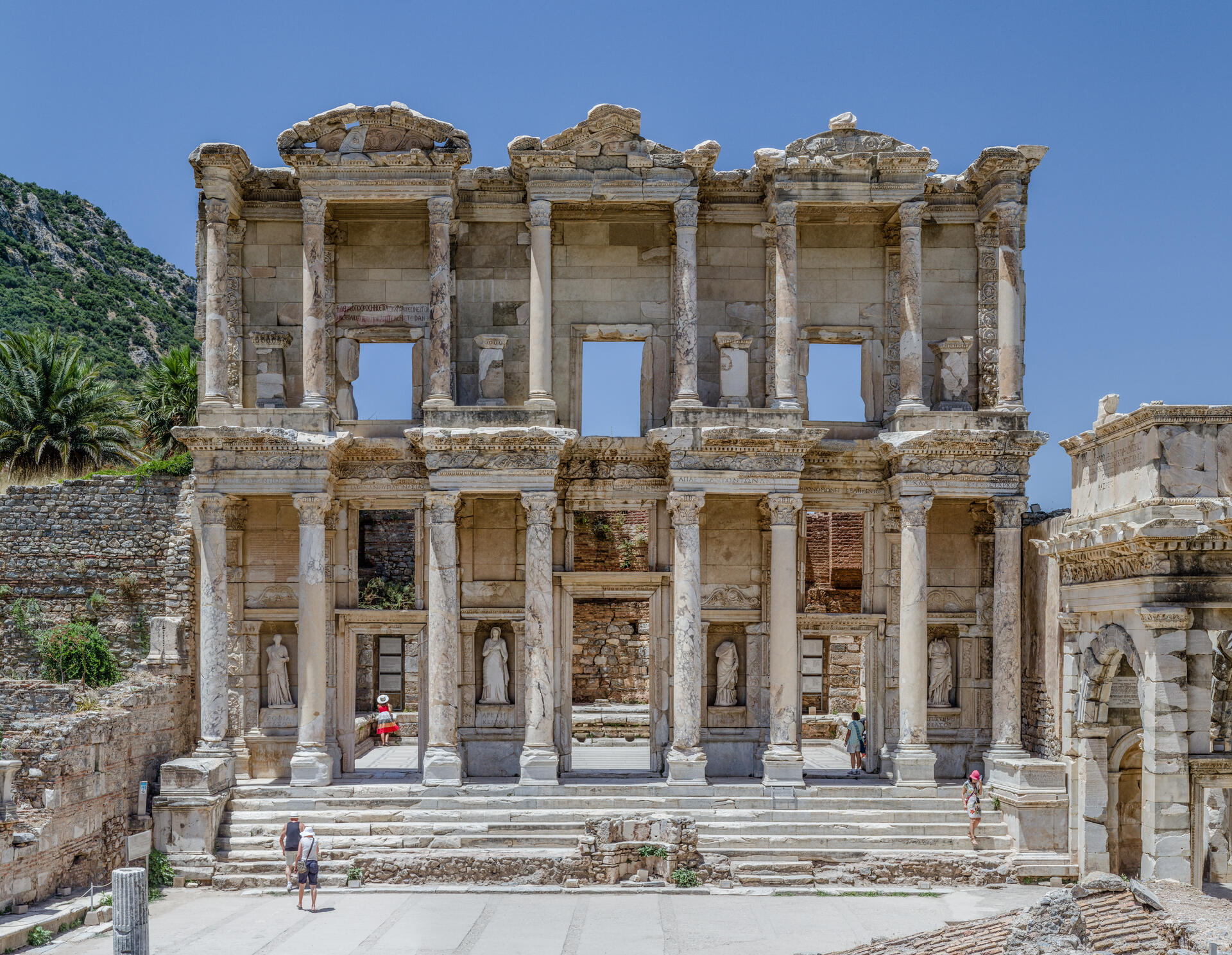
© Benh LIEU SONG, CC BY-SA 3.0 Resized from original. (This derivative is under the same CC BY-SA license.)
World Heritage Research
Discover scientific research and academic studies that deepen our understanding of Ephesus from its history and significance to its conservation, management, and contemporary challenges.
-
The Early Christians in Ephesus from Paul to Ignatius
A groundbreaking analysis of early Christian communities in Ephesus reveals significant shifts in religious practices and leadership from the time of Paul to Ignatius. The study identifies a transition from Pauline theology, marked by apostolic authority and missionary zeal, to a more structured ecclesiastical hierarchy under Ignatian influence. This evolution is traced through epistolary evidence and archaeological findings, offering new insights into the institutionalization of Christianity in Asia Minor. By integrating literary analysis with historical context, the research provides a nuanced understanding of how early Christian communities adapted to socio-political changes during the 1st and 2nd centuries CE.
Trebilco, P. (2019). The Early Christians in Ephesus from Paul to Ignatius. https://doi.org/10.1628/978-3-16-157484-9
View Publication Record | Read Publication