World Heritage Identification Number: 1337
World Heritage since: 2010
Category: Cultural Heritage
WHE Type: Historic Cities & Urban Areas
Transboundary Heritage: No
Endangered Heritage: No
Country: 🇫🇷 France
Continent: Europe
UNESCO World Region: Europe and North America
Map
The Episcopal City of Albi: A Medieval Architectural Ensemble in Southwestern France
The Episcopal City of Albi, located on the banks of the Tarn River in south-west France, stands as a testament to the culmination of a medieval architectural and urban ensemble. Inscribed as a UNESCO World Heritage Site in 2010, this ancient city offers a glimpse into the rich history, culture, and architecture of the region.
More to come…UNESCO Description of the World Heritage Site
On the banks of the Tarn river in south-west France, the old city of Albi reflects the culmination of a medieval architectural and urban ensemble. Today the Old Bridge (Pont-Vieux), the Saint-Salvi quarter and its church are testimony to its initial development (10th -11th centuries). Following the Albigensian Crusade against the Cathar heretics (13th century) it became a powerful episcopal city. Built in a unique southern French Gothic style from local brick in characteristic red and orange colours, the lofty fortified Cathedral (late 13th century) dominates the city, demonstrating the power regained by the Roman Catholic clergy. Alongside the Cathedral is the vast bishop’s Palais de la Berbie, overlooking the river and surrounded by residential quarters that date back to the Middle Ages. The Episcopal City of Albi forms a coherent and homogeneous ensemble of monuments and quarters that has remained largely unchanged over the centuries.
UNESCO Justification of the World Heritage Site
Criterion (iv): The historic city of Albi presents an outstanding medieval architectural and urban ensemble. It is homogeneous and is expressed through a high-quality urban landscape that possesses high visual coherence because of the generalised and enduring use of local fired brick. Sainte-Cécile Cathedral is an exceptional architectural and decorative example of the adaptation of the Gothic style to the context of Southern France.
Criterion (v): The Albi urban site developed gradually over the centuries, and notably from the Middle Ages. The events of the Albigensian Crusade transformed it into a symbolic Episcopal city structured around its Cathedral and its Episcopal fortress-palace. This is one of the rare examples of ensembles of this kind that are to such a high degree complete and well preserved. It expresses in a very comprehensive way a type of urban settlement that was characteristic of medieval and Renaissance Europe.
Encyclopedia Record: Albi
Albi is a commune in southern France. It is the prefecture of the Tarn department, on the river Tarn, 85 km northeast of Toulouse. Its inhabitants are called Albigensians. It is the seat of the Archbishop of Albi.Additional Site Details
Area: 19.47 hectares
Number of Components: 1
(v) — Outstanding example of traditional human settlement
Coordinates: 43.9291666667 , 2.1441666667
Image
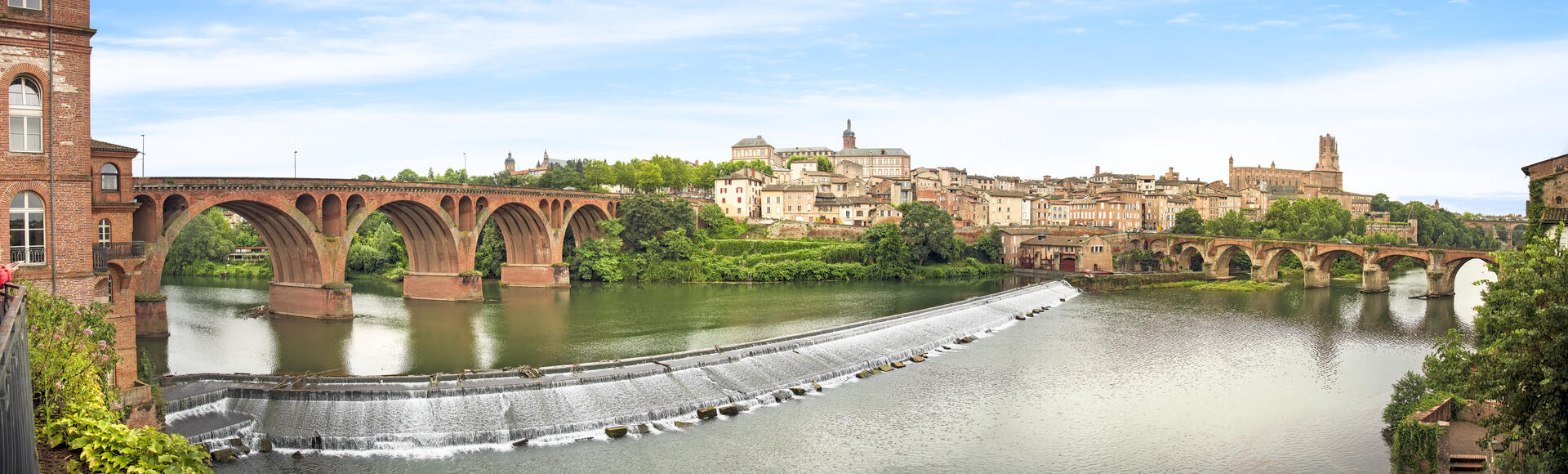
© Didier Descouens, CC BY-SA 4.0 Resized from original. (This derivative is under the same CC BY-SA license.)