World Heritage Identification Number: 1097
World Heritage since: 2004
Category: Cultural Heritage
WHE Type: Buildings & Architectural Ensembles
Transboundary Heritage: No
Endangered Heritage: No
Country: 🇷🇺 Russian Federation
Continent: Europe
UNESCO World Region: Europe and North America
Map
The Ensemble of the Novodevichy Convent: A Glimpse into the Historical and Architectural Richness of Russia
The Ensemble of the Novodevichy Convent, located in south-western Moscow, stands as a testament to the grandeur and intricate beauty of Russian architecture. This architectural masterpiece, built in the 16th and 17th centuries, was inscribed as a UNESCO World Heritage Site in 2004. The Novodevichy Convent, also known as Bogoroditse-Smolensky Monastery, holds significant historical, cultural, and religious importance for Russia.
More to come…UNESCO Description of the World Heritage Site
The Novodevichy Convent, in south-western Moscow, built in the 16th and 17th centuries in the so-called Moscow Baroque style, was part of a chain of monastic ensembles that were integrated into the defence system of the city. The convent was directly associated with the political, cultural and religious history of Russia, and closely linked to the Moscow Kremlin. It was used by women of the Tsar’s family and the aristocracy. Members of the Tsar’s family and entourage were also buried in its cemetery. The convent provides an example of the highest accomplishments of Russian architecture with rich interiors and an important collection of paintings and artefacts.
UNESCO Justification of the World Heritage Site
Criterion (i): The Novodevichy Convent is the most outstanding example of the so-called “Moscow Baroque”, which became a fashionable style in the region of Moscow. Apart from its fine architecture and decorative details, the site is characterised by its town-planning values.
Criterion (iv): The Novodevichy Convent is an outstanding example of an exceptionally well preserved monastic complex, representing particularly the “Moscow baroque” style in the architecture of the late 17th century.
Criterion (vi): The Novodevichy Convent ensemble integrates the political and cultural nature of the existing World Heritage property of Moscow Kremlin. It is itself closely related to Russian Orthodoxy, as well as with Russian history especially in the 16th and 17th centuries.
Encyclopedia Record: Novodevichy Convent
Novodevichy Convent, also known as Bogoroditse-Smolensky Monastery, is probably the best-known cloister of Moscow. Its name, sometimes translated as the New Maidens' Monastery, was devised to differ from the Old Maidens' Monastery within the Moscow Kremlin.The convent was founded by Grand Duke Vasily III on May 13, 1524 in honor of the Smolensk Icon of the Mother of God " Hodegetria " - the main shrine of Smolensk, in gratitude for the capture of Smolensk in 1514. Unlike other Moscow cloisters, it has remained virtually intact since the 17th century. In 2004, it was proclaimed a UNESCO World Heritage Site.Additional Site Details
Area: 5.18 hectares
Number of Components: 1
(iv) — Outstanding example of a type of building or landscape
(vi) — Directly associated with events or living traditions
Coordinates: 55.72611111 , 37.55508333
Image
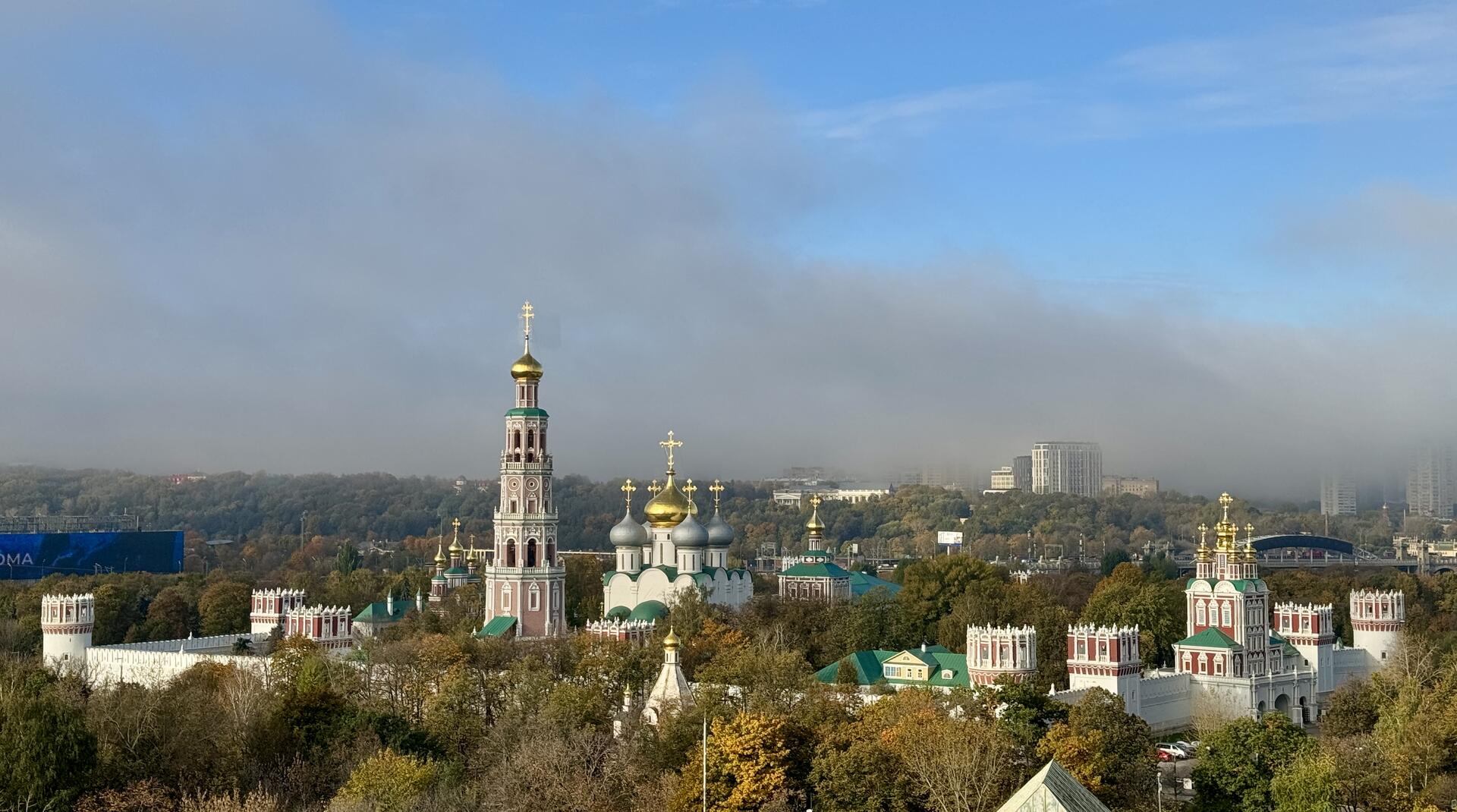
© Ivtorov, CC BY-SA 4.0 Resized from original. (This derivative is under the same CC BY-SA license.)
World Heritage Research
Discover scientific research and academic studies that deepen our understanding of Ensemble of the Novodevichy Convent from its history and significance to its conservation, management, and contemporary challenges.
-
The Exhibition “Russian Tile” in the Novodevichy Convent (1980–1998). From the History of the Exhibiting of Architectural Ceramics Collection of the State Historical Museum
A significant milestone in the exhibition history of Russian tile art, the 'Russian Tile' exhibition (1980–1998) held in the Novodevichy Convent's Choir Hall—then a branch of the State Historical Museum (SHM)—demonstrated the potential of architectural ceramics as both decorative and applied art. The exhibition showcased approximately 2,000 tiles, primarily from the SHM's collection, alongside other decorative objects and slides, offering a comprehensive presentation that advanced contemporary understandings of tile as a historical source. Analyzing unpublished archives from the museum's departments—Ceramics and Glass, Written Sources, and Accounting—Iordanskaya reveals how this exhibition shaped modern approaches to exhibiting and studying Russian tiles, bridging traditional and research-oriented perspectives.
Iordanskaya, N. I. (2025). THE EXHIBITION “RUSSIAN TILE” IN THE NOVODEVICHY CONVENT (1980–1998). FROM THE HISTORY OF THE EXHIBITING OF ARCHITECTURAL CERAMICS COLLECTION OF THE STATE HISTORICAL MUSEUM. RSUH/RGGU Bulletin. “Literary Theory. Linguistics. Cultural Studies” Series, (7), 139–159. https://doi.org/10.28995/2686-7249-2025-7-139-159
View Publication Record | Read Publication -
Features of detection and interpretation of intravital and postmortem changes according to the results of traditional X-ray and X-ray computed tomography of objects from historical graves and artefacts
A groundbreaking study leverages traditional X-ray and X-ray computed tomography to unravel the mechanisms, physical nature, and patterns of intravital and postmortem changes in biological and non-biological objects dating from 1550 to 1918. By analyzing relics such as those of Saint Macarius the Roman of Novgorod, remains of Mother Superior Theophania, and a chair leg linked to Tsesarevich Alexey, researchers demonstrated these methods' high informativity in accurately interpreting historical changes in skeletal bones and artefacts. The findings underscore the necessity for specialized forensic radiology expertise to avoid diagnostic errors, offering valuable insights into the preservation and interpretation of historical remains.
Kovalev, A. V., Molin, Yu. A., Gribunov, Yu. P., Kriuchkova, O. V., & Putintsev, V. A. (2024). Features of detection and interpretation of intravital and postmortem changes according to the results of traditional X-ray and X-ray computed tomography of objects from historical graves and artefacts. Forensic Medical Expertise, 67(2), 20. https://doi.org/10.17116/sudmed20246702120
View Publication Record | Read Publication -
New data on the necropolis of Novodevichy monastery: the funerary vault of Smolensk cathedral and the restoration of the 1880s
A recent study has uncovered previously unpublished materials from the restoration of the 1880s, providing new insights into the funerary vault of Smolensk Cathedral within the Novodevichy Convent's necropolis. This significant burial site for Russian aristocracy in the 16th-17th centuries was examined during a comprehensive restoration (2017-2019) by the Institute of Archaeology of the Russian Academy of Sciences, which re-evaluated burial objects and prepared historical materials for publication. The study reveals that while inscriptions on monuments were known since the late 18th century, stone sarcophagi and their inscriptions were only discovered during the 1880s restoration—details of which had remained unpublished until now.
Belyaev, L., & Davidenko, D. (2024). New data on the necropolis of Novodevichy monastery: the funerary vault of Smolensk cathedral and the restoration of the 1880s. St. Tikhons’ University Review. Series V. Christian Art, 54, 157–173. https://doi.org/10.15382/sturv202454.157-173
View Publication Record | Read Publication -
The History of the Luzhniki Stadium: From the Settlement to the Arena
Luzhniki Stadium, a symbol of Soviet Moscow, emerged from a long history tied to the Novodevichy Convent and its surrounding territory. This study reveals how the area's name, natural features, and urban development evolved over centuries, culminating in the construction of one of the Soviet Union's most significant sports complexes. By analyzing historical records and social factors, the research traces Luzhniki's transformation from a rural settlement to a modern landmark, highlighting its cultural and architectural significance within Moscow's landscape.
Gorlov, V. N. (2024). THE HISTORY OF THE LUZHNIKI STADIUM: FROM THE SETTLEMENT TO THE ARENA. Post–Soviet Continent, (3), 169–181. https://doi.org/10.48137/23116412_2024_3_169
View Publication Record | Read Publication -
Stones-notes on Maximilian Voloshin’s Grave
A comparative analysis of vernacular 'cults' at two sacred sites—Maximilian Voloshin’s grave in Crimea and a tower of the Novodevichy Convent in Moscow—reveals that both attract visitors who leave inscribed stones with requests for health, family well-being, prosperity, and success. While these appeals mirror societal values reflected in sociological surveys, they primarily serve as aesthetic or symbolic gestures rather than expressions of urgent need. The study quantifies the structure of these messages, demonstrating parallels between the two sites despite differences in context, and underscores their role as tourist attractions where 'honoring' the mythologized figures is more about ritualistic gaming than practical petitioning.
Gromov, D. V. (2024). STONES-NOTES ON MAXIMILIAN VOLOSHIN’S GRAVE. RSUH/RGGU Bulletin. “Literary Theory. Linguistics. Cultural Studies” Series, (4), 92–111. https://doi.org/10.28995/2686-7249-2024-4-92-111
View Publication Record | Read Publication -
Orthodoxy. Science. Culture. To the 500th Anniversary of the Moscow Novodevichy Convent
A significant exploration of the Novodevichy Convent's role as a bridge between spiritual and secular traditions reveals its enduring influence on Russian culture. The 500th anniversary celebration book highlights how the convent's legacy, preserved through literature from the 18th to 19th centuries—such as sermons, memoirs, diaries, and letters—embedded Christian values and national ideals into Russia's societal fabric. This continuity underscores the convent's historical significance in fostering a harmonious union of faith and governance, offering a unique lens on Orthodox-Science-Culture interactions.
Shcherbakova, M. I. (Eds.). (2024). Orthodoxy. Science. Culture. To the 500th Anniversary of the Moscow Novodevichy Convent. https://doi.org/10.22455/978-5-9208-0793-9
View Publication Record | Read Publication -
Nikolai Gogol and the Psalter: Four Unpubliched Autographs of the Writer
Four previously unpublished autographs of Nikolai Gogol, featuring his extracts from the Psalter dating to the 1840s, reveal a deeper connection between sacred poetry and Gogol's artistic vision. One manuscript, intended for A.O. Smirnova, was published for the first time in this study, while three others highlight Gogol's engagement with a rare 1770 translation of the Psalter by His Grace Ambrose, a key figure in the construction of Moscow's Novodevichy Convent. These autographs, housed in Pushkin House and the Russian State Library, demonstrate Gogol's unique approach to the Psalter—both as a devotional text and an inspiration for Russian poetry. The research also links these manuscripts to Gogol's correspondence with poet N.M. Yazykov, offering new insights into his reflections on the future of lyric poetry.
Vinogradov, I. A. (2024). Nikolai Gogol and the Psalter: Four Unpubliched Autographs of the Writer. Orthodoxy. Science. Culture. To the 500th Anniversary of the Moscow Novodevichy Convent, 298–347. https://doi.org/10.22455/978-5-9208-0793-9-298-347
View Publication Record | Read Publication