
Architectural Ensemble of the Trinity Sergius Lavra in Sergiev Posad


World Heritage Identification Number: 657

World Heritage since: 1993

Category: Cultural Heritage

WHE Type: Buildings & Architectural Ensembles

Transboundary Heritage: No

Endangered Heritage: No

Country: 🇷🇺 Russian Federation

Continent: Europe

UNESCO World Region: Europe and North America

Map

The Architectural Ensemble of the Trinity Sergius Lavra in Sergiev Posad: A Spiritual and Historical Landmark

The Architectural Ensemble of the Trinity Sergius Lavra in Sergiev Posad, inscribed as a UNESCO World Heritage Site in 1993, stands as a testament to the rich history, spiritual significance, and architectural prowess of Russia. Situated approximately 70 kilometers northeast of Moscow, this lavra, or monastery complex, serves as the spiritual center of the Russian Orthodox Church and is home to over 300 monks.

More to come…

UNESCO Description of the World Heritage Site

This is a fine example of a working Orthodox monastery, with military features that are typical of the 15th to the 18th century, the period during which it developed. The main church of the Lavra, the Cathedral of the Assumption (echoing the Kremlin Cathedral of the same name), contains the tomb of Boris Godunov. Among the treasures of the Lavra is the famous icon, The Trinity , by Andrei Rublev.

UNESCO Justification of the World Heritage Site

Criterion (ii): The Trinity Sergius Lavra Monastery complex represents the fusion of traditional Russian architecture with that of Western Europe, creating an Eastern European tradition with a strong influence on architectural developments in a large area of Eastern Europe.

Criterion (iv): The Lavra is an outstanding and remarkably complete example of an active Orthodox monastery complex with a military function that is characteristic of the period of its growth and expansion from the 15th to the 18th century.

Encyclopedia Record: Trinity Lavra of St. Sergius

The Trinity Lavra of St. Sergius is a lavra and the most important Russian monastery, being the spiritual centre of the Russian Orthodox Church. The monastery is situated in the town of Sergiyev Posad, about 70 kilometres (43 mi) to the northeast from Moscow by the road leading to Yaroslavl, and currently is home to over 300 monks.

Read more on Wikipedia

Additional Site Details

Area: 22.75 hectares

Number of Components: 1

UNESCO Criteria: (ii) — Significant interchange of human values
(iv) — Outstanding example of a type of building or landscape

Coordinates: 56.31035 , 38.1312

Image
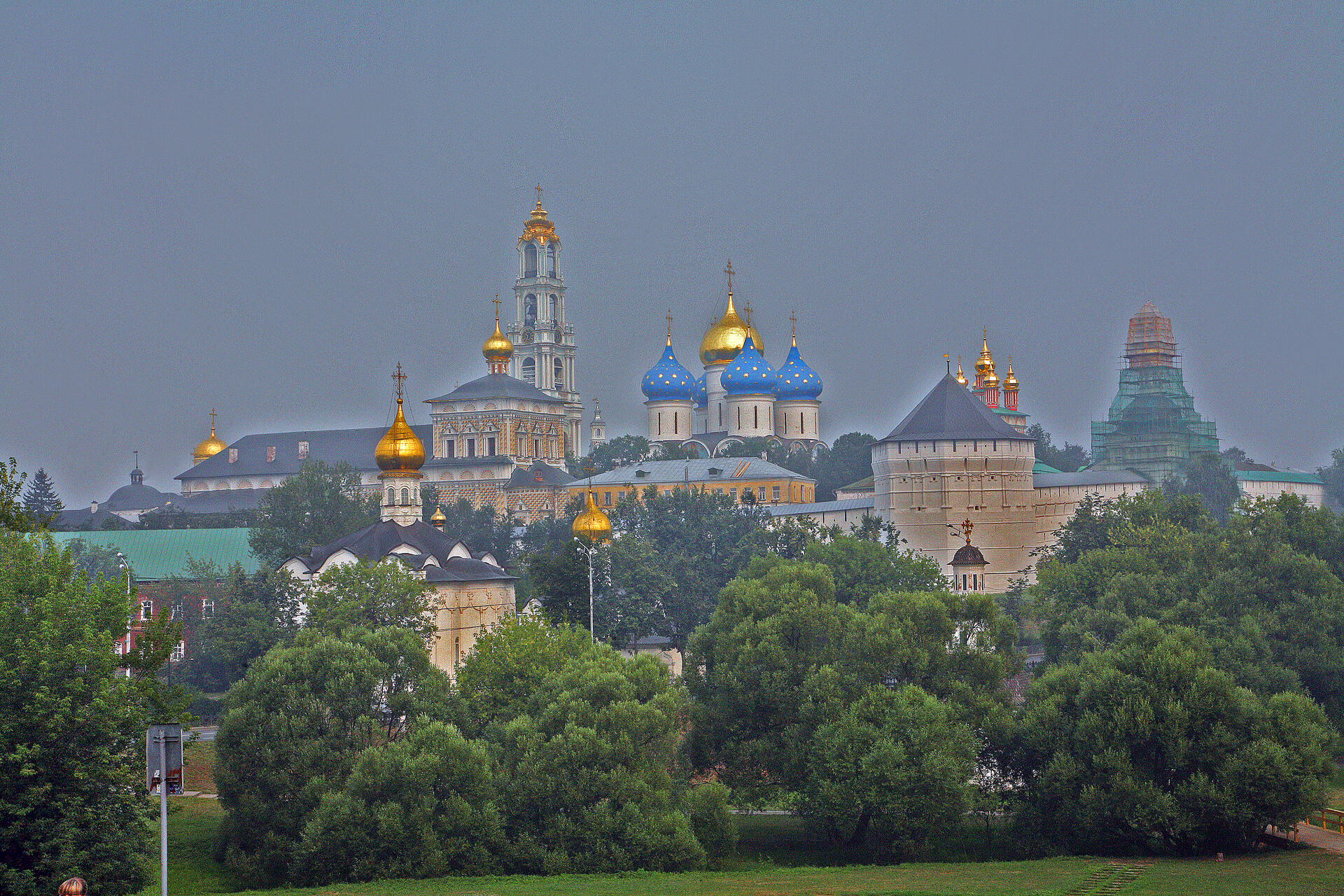
Image of Architectural Ensemble of the Trinity Sergius Lavra in Sergiev Posad

© W. Bulach, CC BY-SA 4.0 Resized from original. (This derivative is under the same CC BY-SA license.)
World Heritage Research

Discover scientific research and academic studies that deepen our understanding of Architectural Ensemble of the Trinity Sergius Lavra in Sergiev Posad from its history and significance to its conservation, management, and contemporary challenges.

  • Memoires and historical commentaries on the way to The Trinity Lavra of St. Sergius by Nikolay Karamzin in the structure of the periodical “Vestnik Evropy” and Karamzin’s literary output

    Nikolay Karamzin's historical sketch and description of the journey from Moscow to The Trinity Lavra of St. Sergius, published in 'Vestnik Evropy' (1802), offers a unique blend of travel itinerary, Russian history, and commentary on its rulers. This work stands out as both a significant contribution to Karamzin's literary output and an integral part of the periodical's 'Literature and miscellaneous' section. Analyzing this sketch reveals Karamzin's multifaceted role as a prose writer, historian, and chronicler of Russian history, often referred to as 'the Columbus of the Russian history.' The study explores how this piece fits within Karamzin's broader oeuvre, including his works like 'Letters of a Russian traveller' and 'History of the Russian State,' highlighting its thematic depth and historical significance.

    Dąbrowska, M. (2018). Memoires and historical commentaries on the way to The Trinity Lavra of St. Sergius by Nikolay Karamzin in the structure of the periodical “Vestnik Evropy” and Karamzin’s literary output. Polilog Studia Neofilologiczne Nr 8. https://doi.org/10.34858/POLILOG.8.2018.003

    View Publication Record | Read Publication
  • On the materials and methods of the renovation of the late 18th-century church painting (in the context of the work at The Holy Trinity - St Sergius Lavra)

    A unique analysis of archival documents reveals the materials and methods used in the 18th-century renovation of church paintings at The Holy Trinity - St Sergius Lavra. By examining working estimates for purchases, researchers identified pigments, adhesives, and special equipment, shedding light on the composition and application techniques of paints. This study provides practical insights for restoration work, offering a deeper understanding of late 18th-century pictorial works.

    Nemova, O. V. (2020). On the materials and methods of the renovation of the late 18th-century church painting (in the context of the work at The Holy Trinity - St Sergius Lavra). Academia, 1. https://doi.org/10.37953/2079-0341-2020-1-1-120-127

    View Publication Record | Read Publication
  • The formation of the monastic communal living traditions in the Trinity Lavra of St. Sergius

    The Trinity Lavra of St. Sergius, a pivotal monastery in Medieval Rus, saw the revival of communal living traditions under the leadership of St. Sergius of Radonezh. This study reconstructs aspects of the monks' daily life, highlighting their routines, obedience, nutrition, and clothing while analyzing deviations from monastic standards. Using historical anthropological and hermeneutic approaches, the research identifies internal and external factors shaping these traditions, offering insights into the embodiment of Christian ideals and the continuity of lost practices. The findings underscore the significance of St. Sergius's role in restoring and enhancing monastic life principles.

    Vasikhovskaya, N. S. (2019). The formation of the monastic communal living traditions in the Trinity Lavra of St. Sergius. Tyumen State University Herald. Humanities Research. Humanitates, 5(2), 107–120. https://doi.org/10.21684/2411-197x-2019-5-2-107-120

    View Publication Record | Read Publication
  • Newly Discovered Letters and Petitions of the Time of Trouble from the Trinity Lavra of St. Sergius and its Patrimony

    Newly uncovered letters and petitions from the Trinity Lavra of St. Sergius, dating to the Time of Troubles (1608–1610), offer unprecedented insights into the social dynamics, linguistic norms, and daily hardships during Russia's turbulent early 17th century. These documents, found in a reconstructed archive of mercenary hetman Jan Sapieha, detail both the monastery's siege and the broader impact on noble and ordinary people. The findings enrich historical understanding by revealing formal and informal written communication practices while addressing gaps in existing knowledge about this pivotal period.

    Tyumentsev, I. O., Tupikova, N. A.,. (2018). Newly Discovered Letters and Petitions of the Time of Trouble from the Trinity Lavra of St. Sergius and its Patrimony. Vestnik of Saint Petersburg University. History, 63(3), 935–948. https://doi.org/10.21638/11701/spbu02.2018.317

    View Publication Record | Read Publication
  • The Trinity Lavra of St. Sergius in the Context of the “Museum” Perception of the Pre-Revolutionary Russia

    The Trinity Lavra of St. Sergius was perceived as a 'National museum' in pre-revolutionary Russia, blending religious and cultural significance. This study reveals how the site's historical and artistic heritage was interpreted through a museum lens, reflecting complex interactions between the Church and society. By analyzing examples of this approach, the research demonstrates that the Lavra functioned not only as a spiritual center but also as a repository of national identity, bridging religious devotion with cultural preservation. The findings underscore the Lavra's dual role in shaping collective memory and heritage perception during a pivotal period in Russian history.

    Gaganova, M. A. (2015). The Trinity Lavra of St. Sergius in the Context of the “Museum” Perception of the Pre-Revolutionary Russia. Observatory of Culture, (4), 69–75. https://doi.org/10.25281/2072-3156-2015-0-4-69-75

    View Publication Record | Read Publication

About World Heritage Explorer

World Heritage Explorer is an independent educational project designed to uncover and share the richness of our world’s cultural and natural heritage. Dive into detailed site profiles, immersive imagery, interactive maps, and tools that help you explore UNESCO World Heritage Sites across the globe. Drawing extensively on open data sources, the project delivers authoritative, well-structured information for learners, educators, travelers, and younger explorers alike.

Learn more about the project

Nearby World Heritage Sites

Kremlin and Red Square, Moscow
70 km — Russian Federation
Ensemble of the Novodevichy Convent
74 km — Russian Federation
Church of the Ascension, Kolomenskoye
78 km — Russian Federation
White Monuments of Vladimir and Suzdal
142 km — Russian Federation
Historical Centre of the City of Yaroslavl
183 km — Russian Federation
Flag of Russian Federation

Russian Federation and the World Heritage Convention

State Party since: October 12, 1988

Status: Ratification

Mandates to the World Heritage Committee: 2001-2005, 2009-2013, 2019-2023

Total of Mandate Years: 12

Total of Mandates: 3

WHC Electoral Group: II (Eastern Europe)

Learn more about Russian Federation

Weather at the World Heritage Site

World Heritage Insights

Monasteries and Abbeys on the World Heritage List: Sacred Landscapes of Monastic and Spiritual Life

From vast cave universities and cliffside hermitages to monumental abbeys and temple cities, monastic heritage on the UNESCO World Heritage List reflects one of the most persistent ways in which human societies have organized spiritual life, learning, and landscape transformation. These sites are not only architectural achievements but also long-lived institutional systems—sometimes still active, sometimes archaeological—where religious practice shaped settlement patterns, artistic production, and political authority.

Last updated: September 8, 2026

Portions of the page Architectural Ensemble of the Trinity Sergius Lavra in Sergiev Posad are based on data from UNESCO — World Heritage List Dataset and on text from the Wikipedia article Trinity Lavra of St. Sergius, licensed under CC BY-SA 4.0. Changes made. Additional original content by World Heritage Explorer (WHE), licensed under CC BY-SA 4.0. WHE is not affiliated with UNESCO or the World Heritage Committee. Legal Notice. Privacy Policy.

Open Data for an Open World