World Heritage Identification Number: 1196
World Heritage since: 2005
Category: Cultural Heritage
WHE Type: Buildings & Architectural Ensembles
Transboundary Heritage: No
Endangered Heritage: No
Country: 🇧🇾 Belarus
Continent: Europe
UNESCO World Region: Europe and North America
Map
The Architectural, Residential and Cultural Complex of the Radziwill Family at Nesvizh: A Testament to European History and Culture
The Architectural, Residential and Cultural Complex of the Radziwill Family at Nesvizh, nestled in the heart of Belarus, stands as a testament to the rich tapestry of European history and culture. This remarkable ensemble, inscribed on the UNESCO World Heritage List in 2005, offers a unique glimpse into the lives of one of the most influential families in European history – the Radziwills.
More to come…UNESCO Description of the World Heritage Site
The Architectural, Residential and Cultural Complex of the Radziwill Family at Nesvizh is located in central Belarus. The Radziwill dynasty, who built and kept the ensemble from the 16th century until 1939, gave birth to some of the most important personalities in European history and culture. Due to their efforts, the town of Nesvizh came to exercise great influence in the sciences, arts, crafts and architecture. The complex consists of the residential castle and the mausoleum Church of Corpus Christi with their setting. The castle has ten interconnected buildings, which developed as an architectural whole around a six-sided courtyard. The palaces and church became important prototypes marking the development of architecture throughout Central Europe and Russia.
UNESCO Justification of the World Heritage Site
Criterion (ii): The Architectural, Residential and Cultural Complex of the Radziwill Family at Nesvizh was the cradle for the introduction of new concepts based on the synthesis of Western traditions, leading to the establishment of a new architectural school in Central Europe.
Criterion (iv): The Radziwill complex represents an important stage in the development of new a building typology and in the history of Central European architecture during the 16th and 17th centuries. In particular, this concerns Corpus Christi Church with its domed basilica typology.
Criterion (vi): The Radziwill family was particularly significant for its association with the interpretation of influences from Southern and Western Europe and the transmission of ideas within Central and Eastern Europe.
Encyclopedia Record: Nesvizh Castle
Nesvizh Castle or Nyasvizh Castle is a residential castle of the Radziwiłł family in Nyasvizh (Nesvizh), Belarus. It is 183 metres (600 ft) above sea level. Built originally in the 16th and 17th centuries, throughout its history the site has been sacked, damaged and abandoned repeatedly, and has seen multiple different uses including as a storehouse. Finally it has been extensively rebuilt and restored from 2004–2012. In 2005, the castle, church, and surrounding environment were inscribed on the UNESCO World Heritage List. The castle and the nearby Corpus Christi Church were instrumental in the development of Central European and Russian architecture.Additional Site Details
Area: Not available
Number of Components: 1
(iv) — Outstanding example of a type of building or landscape
(vi) — Directly associated with events or living traditions
Coordinates: 53.22278 , 26.69139
Image
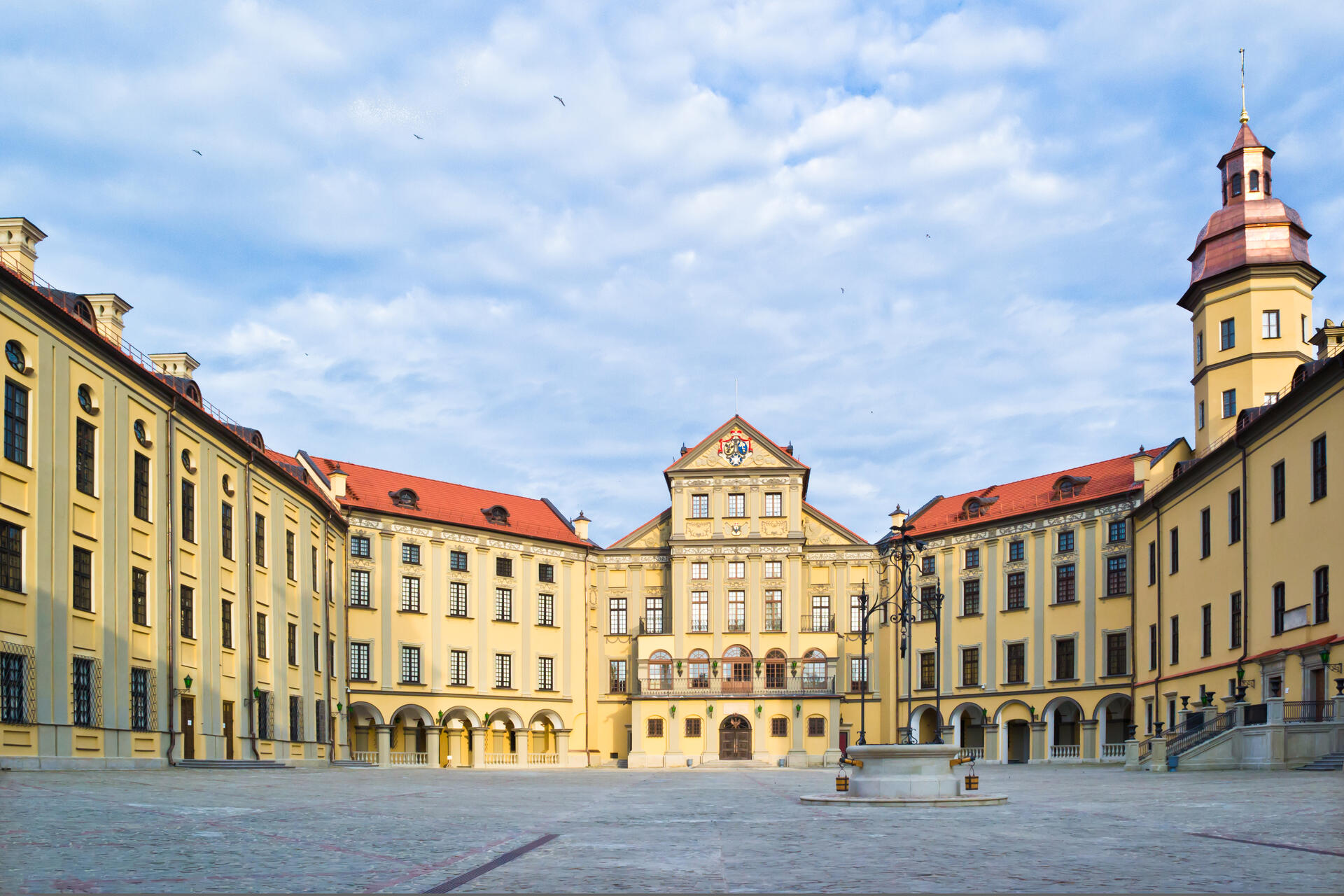
© Dmitry Gerasimov, CC BY-SA 3.0 Resized from original. (This derivative is under the same CC BY-SA license.)
World Heritage Research
Discover scientific research and academic studies that deepen our understanding of Architectural, Residential and Cultural Complex of the Radziwill Family at Nesvizh from its history and significance to its conservation, management, and contemporary challenges.
-
The first thousand-year pine tree-ring chronology in Belarus
A groundbreaking thousand-year pine tree-ring chronology (997–2020 AD) for Belarus has been developed, offering unprecedented insights into climate variability and wood provenance. This chronology, BY02b, was constructed using tree-ring series from living trees, as well as historic and archaeological timbers sourced from Nesvizh Castle, the Holy Intercession Church in Turets, Hrodna Castle, and Navahrudak. The analysis reveals strong correlations with neighboring regional chronologies, including those from Poland, Lithuania, Latvia, Estonia, and Northern Belarus, suggesting shared climatic influences during the 14th century. Tree-ring width demonstrates stable positive relationships with June precipitation and March temperatures, positioning this chronology as a valuable climate proxy for Baltic pine wood dating and provenancing.
Yermokhin, M. (2025). The first thousand-year pine tree-ring chronology in Belarus. Dendrochronologia, 90, 126287. https://doi.org/10.1016/j.dendro.2025.126287
View Publication Record | Read Publication -
Nesvyžiaus Radvilų Bibliotekos Paveldas Lietuvoje
The Radziwills, a prominent aristocratic family from the Great Duchy of Lithuania, assembled one of the largest private book collections in the region during the 16th to 18th centuries. However, after the first partition of Poland in 1772, this extensive library was relocated to St. Petersburg, leaving only scattered remnants in Lithuanian libraries today. Recent international efforts, including virtual reconstructions and collaborative projects, have revived interest in preserving and studying this dispersed cultural heritage. Key surviving copies, marked with Radziwill ex-librises, are housed in institutions such as the Library of the Lithuanian Academy of Sciences, Vilnius University, Kaunas University of Technology, and the Kazys Varnelis house-museum. A digital catalogue compiled by the Karol Estreicher Institute of Polish Bibliography further documents this legacy, highlighting its significance for both academic research and cultural preservation.
NARBUTIENĖ, D. (2015). THE HERITAGE OF THE LIBRARY OF THE NESVIZH RADZIWILLS IN LITHUANIA. Knygotyra, 51, 31–45. https://doi.org/10.15388/kn.v51i0.7888
View Publication Record | Read Publication