World Heritage Identification Number: 982
World Heritage since: 2000
Category: Cultural Heritage
WHE Type: Religious Sites & Sacred Architecture
Transboundary Heritage: No
Endangered Heritage: No
Country: 🇷🇺 Russian Federation
Continent: Europe
UNESCO World Region: Europe and North America
Map
The Ensemble of the Ferapontov Monastery: A Masterpiece of Russian Orthodox Architecture and Art
The Ensemble of the Ferapontov Monastery, located in the Vologda region in northern Russia, stands as a testament to the rich cultural heritage and architectural prowess of medieval Russia. This exceptional monastic complex, dating from the 15th to the 17th centuries, was inscribed as a UNESCO World Heritage Site in 2000.
More to come…UNESCO Description of the World Heritage Site
The Ferapontov Monastery, in the Vologda region in northern Russia, is an exceptionally well-preserved and complete example of a Russian Orthodox monastic complex of the 15th-17th centuries, a period of great significance in the development of the unified Russian state and its culture. The architecture of the monastery is outstanding in its inventiveness and purity. The interior is graced by the magnificent wall paintings of Dionisy, the greatest Russian artist of the end of the 15th century.
UNESCO Justification of the World Heritage Site
Criterion (i): The wall paintings of Dionisy in the Cathedral of the Nativity of the Virgin at Ferrapontov Monastery are the highest expression of Russian mural art in the 15th-16th centuries.
Criterion (iv): The complex of Ferrapontov Monastery is the purest and most complete example of an Orthodox monastic community from the 15th-17th centuries, a crucial period in the cultural and spiritual development of Russia.
Encyclopedia Record: Ferapontov Monastery
The Ferapontov Monastery is a monastery of the Russian Orthodox Church in Ferapontovo, Kirillovsky District, Vologda Oblast, Russia. The monastery was founded by Saint Ferapont in 1398. The In 2000, the monastery was added to the UNESCO list of World Heritage Sites.Additional Site Details
Area: 2.1 hectares
Number of Components: 1
(iv) — Outstanding example of a type of building or landscape
Coordinates: 59.95 , 38.56666667
Image
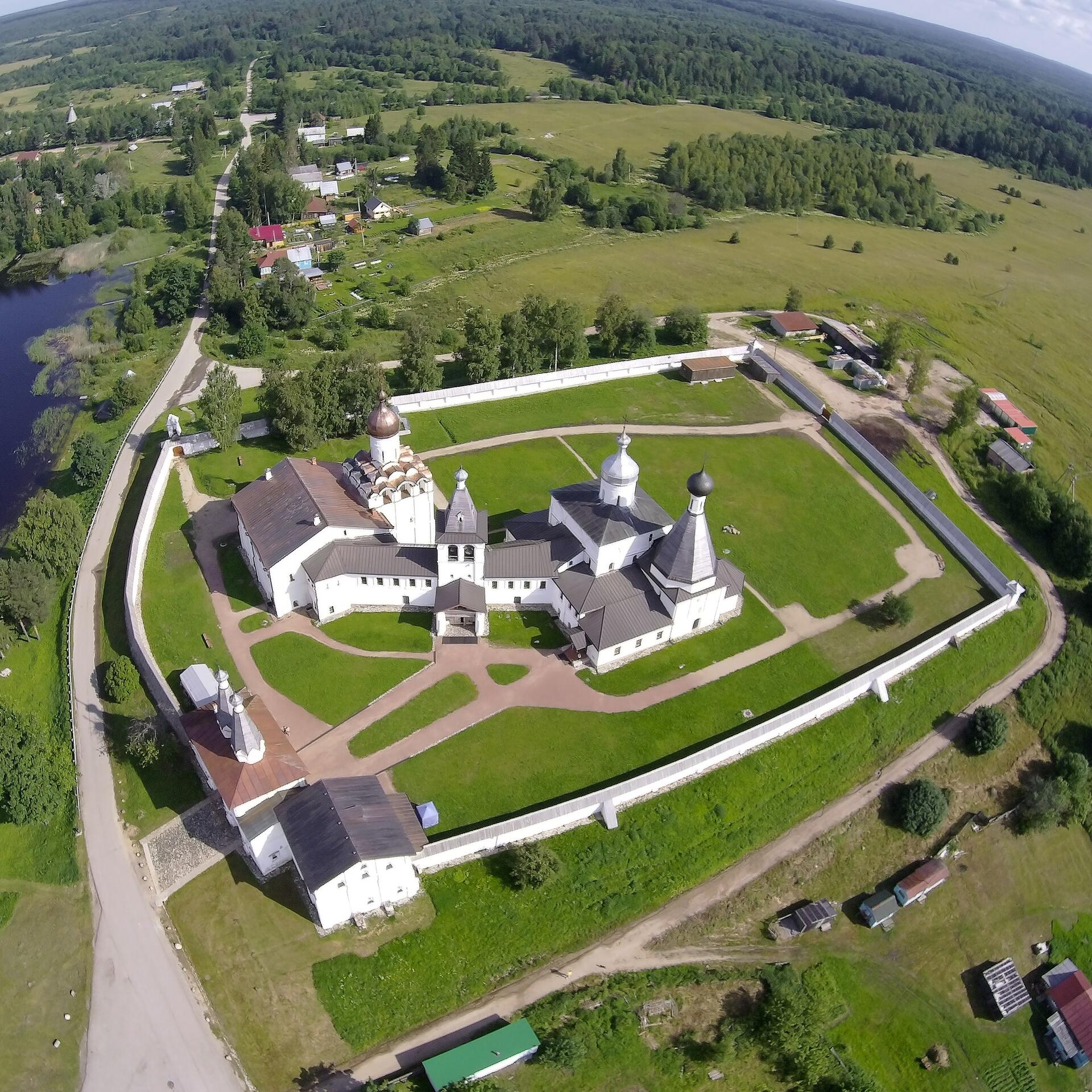
© Trasprd, CC BY-SA 4.0 Resized from original. (This derivative is under the same CC BY-SA license.)