World Heritage Identification Number: 1475
World Heritage since: 2016
Category: Mixed Cultural Heritage and Natural Heritage
WHE Type: Natural Landscapes & Geographic Features
Transboundary Heritage: No
Endangered Heritage: No
Country: 🇹🇩 Chad
Continent: Africa
UNESCO World Region: Africa
Map
The Ennedi Massif: A Unique Blend of Nature and Culture in Northeastern Chad
The Ennedi Massif, a natural and cultural landscape, is a remarkable geological formation situated in the northeastern regions of Chad. This vast sandstone plateau, a testament to the power of wind and water erosion, offers an extraordinary landscape characterized by deep canyons, towering cliffs, natural arches, and distinctive pitons.
More to come…UNESCO Description of the World Heritage Site
In the northeast of the country, the sandstone Ennedi Massif has been sculpted over time by water and wind erosion into a plateau featuring canyons and valleys that present a spectacular landscape marked by cliffs, natural arches and pitons. In the largest canyons, the permanent presence of water plays an essential role in the Massif’s ecosystem, sustaining flora and fauna as well as human life. Thousands of images have been painted and carved into the rock surface of caves, canyons and shelters, presenting one of the largest ensembles of rock art in the Sahara.
Encyclopedia Record: Ennedi Plateau
The Ennedi Plateau is located in the northeast of Chad, in the regions of Ennedi-Ouest and Ennedi-Est. It is considered a part of the group of mountains known as the Ennedi Massif found in Chad, which is one of the nine countries that make up the Sahelian belt that spans the Atlantic Ocean to Sudan. The Ennedi is a sandstone bulwark in the middle of the Sahara, which was formed by erosion from wind and temperature. Many people occupied this area, such as hunters-gatherers and pastoralists. The Ennedi area is also known for its large collection of rock art depicting mainly cattle, as these animals had the greatest financial, environmental, and cultural impact. This art dates back nearly 7,000 years ago. Today, two semi-nomadic groups, mainly Muslim, live in the Ennedi during the rainy months and pass through the area during the dry season. They rely on their herds of camels, donkeys, sheep, and goats to survive.Additional Site Details
Area: 2,441,200 hectares
Number of Components: 1
(vii) — Contains superlative natural phenomena or beauty
(ix) — Outstanding example representing ecological and biological processes
Coordinates: 17.0416666667 , 21.8627777778
IUCN World Heritage Outlook
The 2025 Conservation Outlook on Ennedi Massif: Natural and Cultural Landscape reports the following assessment:
Source: International Union for Conservation of Nature (IUCN) · View assessment
Image
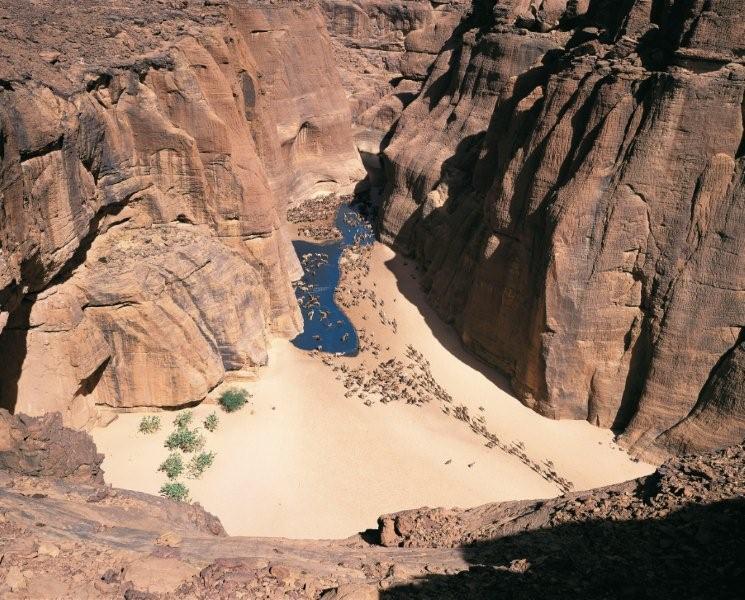
© Desertman, CC BY-SA 3.0 Resized from original. (This derivative is under the same CC BY-SA license.)
World Heritage Research
Discover scientific research and academic studies that deepen our understanding of Ennedi Massif: Natural and Cultural Landscape from its history and significance to its conservation, management, and contemporary challenges.
-
A YOLO-Based Workflow for Detecting and Mapping Archaeological Stone Cairns in Satellite Imagery: A Case Study from Western Ennedi, Chad
A deep learning framework using the YOLOv8 model achieves highly accurate detection of archaeological stone cairns in high-resolution satellite imagery, with precision and recall rates exceeding 83.5%. This non-invasive approach offers a scalable solution for documenting vulnerable heritage landscapes, such as those in the Ennedi Massif, where traditional field surveys are impractical due to remote terrain. The model, trained on GPS-verified cairns, demonstrated stable performance across diverse illumination conditions and outperformed YOLOv5n in localization accuracy while maintaining competitive precision and F1-scores. This workflow enables large-scale archaeological prospection and heritage monitoring, providing a critical tool for preserving and studying remote desert environments.
Ghaderpour, E., Nekoulnang, C. D., Noudjiko, H. M., Rossi, P. P., Rotunno, R., & di Lernia, S. (2026). A YOLO-Based Workflow for Detecting and Mapping Archaeological Stone Cairns in Satellite Imagery: A Case Study from Western Ennedi, Chad. Heritage, 9(6), 237. https://doi.org/10.3390/heritage9060237
View Publication Record | Read Publication -
The Ordovician strata of the Ennedi Plateau, northeastern Chad (Erdi Basin)
The Ennedi Massif, a UNESCO World Heritage Site in northeastern Chad, preserves a critical record of Early to Middle Ordovician flooding events and the end-Ordovician glaciation. This study reveals that the Lower Sandstones, characterized by fluvial-dominated deposits with NW to NNE paleocurrent trends, were interrupted by high-frequency marine incursions marked by tidal deposits and ichnofacies such as Cruziana and Arthrophycus. Above an erosional unconformity, evidence of glaciation is documented through fluvioglacial conglomeratic deposits, which are overlain by the fine-grained Bedo Formation. The latter contains glaciomarine deposits at its base and possibly extends into the Lower Silurian in its upper part, onlapping an exhumed erosion surface with north-trending glacial lineations. This research provides insights into the paleogeographic dynamics of the Gondwana platform during a pivotal period of Earth's history.
Ghienne, J.-F., Moussa, A., Saad, A., Djatibeye, B., & Youssouf, H. M. (2023). The Ordovician strata of the Ennedi Plateau, northeastern Chad (Erdi Basin). Comptes Rendus. Géoscience, 355(G1), 63–84. https://doi.org/10.5802/crgeos.180
View Publication Record | Read Publication -
Late Paleozoic glaciated landscape in northern Africa as an outstandingly well-preserved analogue to Quaternary deglaciated areas
The Ennedi Massif in Chad reveals an exceptionally well-preserved Paleozoic ice stream landscape, offering a unique analogue to Quaternary deglaciated regions. This study identifies a grounding zone wedge—a feature that reconstructs the former coastline—using large-scale glacial lineations and convex topography orthogonal to these structures. The absence of vegetation in the desert environment highlights subglacial, ice-marginal, and proglacial features, including inverted channel sediments that may record meltwater release phases during ice retreat. This landscape provides a rare opportunity to study the spatial relationships between components of an ancient ice sheet, enhancing our understanding of modern glaciated areas.
Wohlschlägl, R., Kettler, C., Le Heron, D., & Zboray, A. (2023). Late Paleozoic glaciated landscape in northern Africa as an outstandingly well-preserved analogue to Quaternary deglaciated areas. https://doi.org/10.5194/egusphere-egu23-7230
View Publication Record | Read Publication -
A world-class example of a Late Palaeozoic glaciated landscape in Chad
A newly discovered pristine channel belt on the Ennedi Plateau, Chad, reveals complex palaeo-morphological features that provide unprecedented insight into the Late Carboniferous glaciation. This 300 km² network of braided and meandering channels, up to 250 m wide, shows distinctive point bar deposits and scroll bar geometries, indicating a terrestrial, subaerial environment rather than subglacial origin. These features are intercalated with glacial lineations (GLs), suggesting ice activity both preceded and succeeded fluvial activity during the advance-retreat cycles of the Late Palaeozoic Ice Age. Remote sensing techniques revealed that the Chadian ice sheet covered at least 20,000 km²—three times larger than previously estimated—with GLs arranged in widespread ice stream networks, indicating palaeo-ice flow to the north.
Kettler, C., Wohlschlägl, R., Russell, C., Scharfenberg, L., Ghienne, J.-F., & Le Heron, D. P. (2023). A world-class example of a Late Palaeozoic glaciated landscape in Chad. Sedimentary Geology, 455, 106470. https://doi.org/10.1016/j.sedgeo.2023.106470
View Publication Record | Read Publication -
Chad's cabinet of icy curiosities: Sharpening the interpretation of subglacial and ice marginal environments during the LPIA glaciation of the Ennedi Plateau
Researchers have uncovered the first known evidence of soft-sediment striated surfaces and a fully preserved grounding zone wedge (GZW) in the Ennedi Massif, Chad, offering unprecedented insights into the behavior of a mid-latitude, marine-terminating ice sheet during the Late Palaeozoic Ice Age (LPIA). These findings suggest the presence of a soft-deformable bed that could explain extensive mega-scale glacial lineations across the plateau. The study utilized satellite imagery and band-ratio techniques to analyze proglacial, ice-marginal, and subglacial structures, providing a detailed interpretation of this exceptional palaeo-ice stream landscape.
Wohlschlägl, R., Kettler, C., Le Heron, D. P., & Zboray, A. (2023). Chad’s cabinet of icy curiosities: Sharpening the interpretation of subglacial and ice marginal environments during the LPIA glaciation of the Ennedi Plateau. Sedimentary Geology, 455, 106483. https://doi.org/10.1016/j.sedgeo.2023.106483
View Publication Record | Read Publication -
Cartographie des zones de reproduction et de grégarisation du criquet pèlerin au Tchad
A recent study has identified three key zones in Chad—Kanem/lac Tchad, Batha, and Ennedi—as critical areas for the reproduction and gregarization (swarming) of the desert locust (Schistocerca gregaria), a major agricultural pest. These findings suggest that Kanem/lac Tchad may represent a new focal area for locust swarm formation, expanding our understanding of their spatial distribution. Researchers analyzed over 7,000 historical observations (1965–2017) using spatial density smoothing techniques to map seasonal patterns during invasion and remission phases. While the Tibesti massif remains a known hotspot, reports from this region have declined due to security challenges. The study highlights the need for more consistent monitoring to assess potential shifts in locust distribution over time.
Kayalto, M., Idrissi Hassani, M., Lecoq, M., Gay, P.-E., & Piou, C. (2020). Cartographie des zones de reproduction et de grégarisation du criquet pèlerin au Tchad. Cahiers Agricultures, 29, 14. https://doi.org/10.1051/cagri/2020011
View Publication Record | Read Publication -
Pre-Islamic Oasis Settlements in the Southern Sahara
Pre-Islamic oasis settlements in the southern Sahara, particularly those around mountain massifs like Ennedi, Tibesti, Aïr, and Tassili n’Ajjer, are characterized by limited agricultural suitability due to variable rainfall and dynamic wadi systems. These regions, though historically important for pastoralism, lack stable conditions for oasis agriculture, contributing to the poor preservation of archaeological remains. The study highlights that while these areas once supported crocodile populations—evidenced by 19th- and early-20th-century reports—their environmental constraints have hindered long-term settlement stability.
Sterry, M., & Mattingly, D. J. (2020). Pre-Islamic Oasis Settlements in the Southern Sahara. Urbanisation and State Formation in the Ancient Sahara and Beyond, 277–329. https://doi.org/10.1017/9781108637978.008
View Publication Record | Read Publication