World Heritage Identification Number: 1400
World Heritage since: 2012
Category: Natural Heritage
WHE Type: Natural Landscapes & Geographic Features
Transboundary Heritage: No
Endangered Heritage: No
Country: 🇹🇩 Chad
Continent: Africa
UNESCO World Region: Africa
Map
The Enigmatic Oasis: The Lakes of Ounianga in the Heart of the Sahara
The Lakes of Ounianga, nestled within the heart of the Sahara Desert, present an extraordinary spectacle that defies the harsh and unforgiving nature often associated with this vast expanse of arid land. This unique ensemble of interconnected lakes, located in the hyper-arid Ennedi region of Chad, was inscribed as a UNESCO World Heritage Site in 2012.
More to come…UNESCO Description of the World Heritage Site
The site includes eighteen interconnected lakes in the hyper arid Ennedi region of the Sahara desert covering an area of 62,808 ha. It constitutes an exceptional natural landscape of great beauty with striking colours and shapes. The saline, hyper saline and freshwater lakes are supplied by groundwater and are found in two groups 40 km apart. Ounianga Kebir comprises four lakes, the largest of which, Yoan, covers an area of 358 ha and is 27 m deep. Its highly saline waters only sustain algae and some microorganisms. The second group, Ounianga Serir, comprises fourteen lakes separated by sand dunes. Floating reeds cover almost half the surface of these lakes reducing evaporation. At 436 ha, Lake Teli has the largest surface area but is less than 10 m deep. With their high quality freshwater, some of these lakes are home to aquatic fauna, particularly fish.
UNESCO Justification of the World Heritage Site
Criterion (vii): The property represents an exceptional example of permanent lakes in a desert setting, a remarkable natural phenomenon which results from an aquifer and associated complex hydrological system which is still to be fully understood. The aesthetic beauty of the site results from a landscape mosaic which includes the varied coloured lakes with their blue, green and /or reddish waters, in reflection of their chemical composition, surrounded by palms, dunes and spectacular sandstone landforms, all of it in the heart of a desert that stretches over thousands of kilometres. In addition, about one third of the surface of the Ounianga Serir Lakes is covered with floating reed carpets whose intense green colour contrasts with the blue open waters. Rock exposures which dominate the site offer a breathtaking view on all the lakes, of which the colours contrast with the brown sand dunes separated by bare rock structures. The shape and distribution of the lakes, combined with the effect of the wind moving the floating vegetation in the lakes, gives the impression of “waves of water flowing in the desert”.
Encyclopedia Record: Lakes of Ounianga
The Lakes of Ounianga is a series of lakes in the Sahara Desert, occupying a basin in the mountains of West Tibesti and Ennedi East in north-eastern Chad. It was added as a UNESCO World Heritage site in 2012.Additional Site Details
Area: 62,808 hectares
Number of Components: 1
Coordinates: 19.055 , 20.5055555556
IUCN World Heritage Outlook
The 2025 Conservation Outlook on Lakes of Ounianga reports the following assessment:
Source: International Union for Conservation of Nature (IUCN) · View assessment
Image
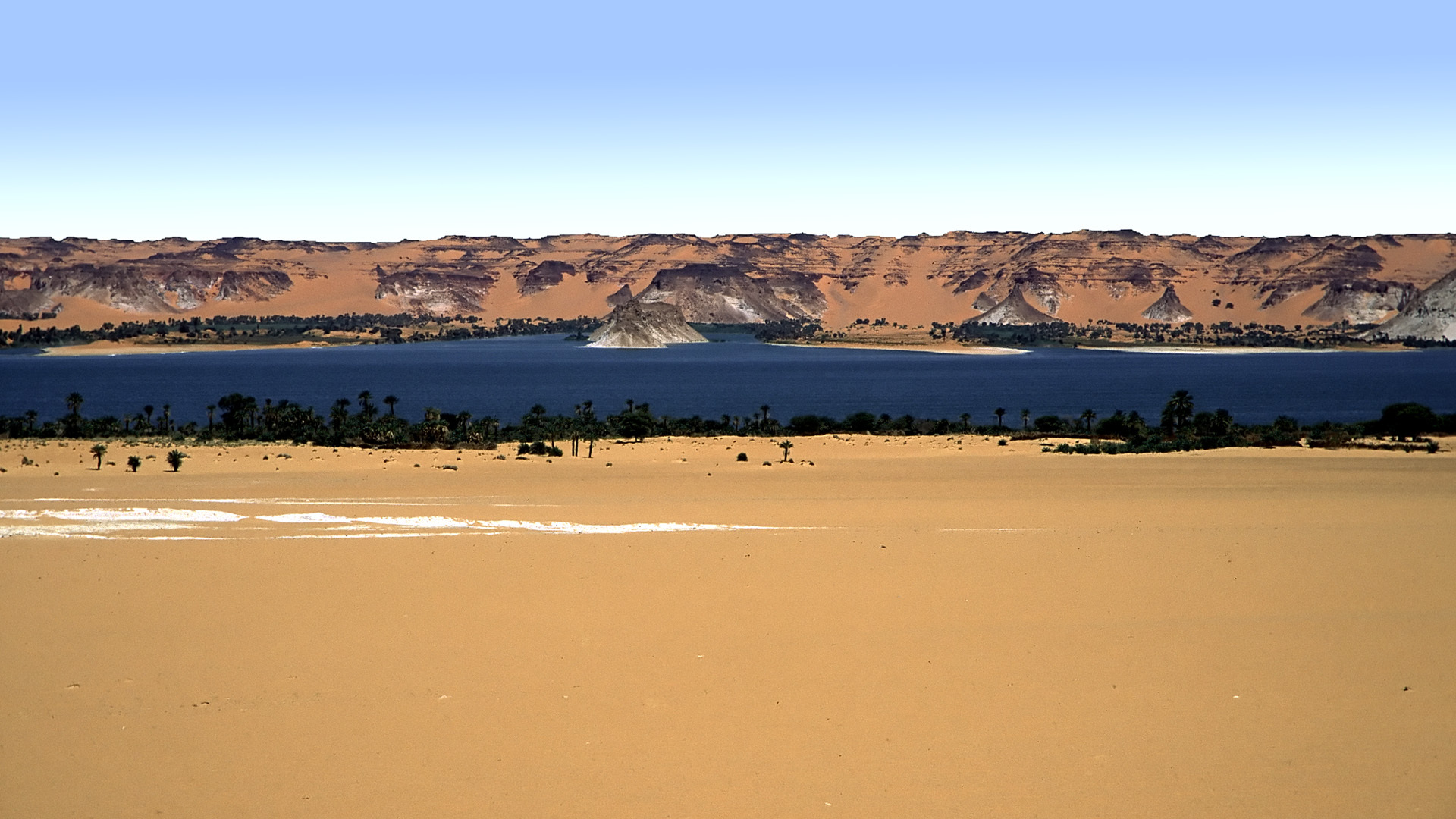
© Jacques Taberlet, CC BY-SA 3.0 Resized from original. (This derivative is under the same CC BY-SA license.)
World Heritage Research
Discover scientific research and academic studies that deepen our understanding of Lakes of Ounianga from its history and significance to its conservation, management, and contemporary challenges.
-
A predominantly tropical influence on late Holocene hydroclimate variation in the hyperarid central Sahara
A new lake sediment record from Ounianga Serir oasis reveals that the central Sahara experienced hyperaridity more extreme than today around 4200 years ago. The hypersaline terminal lake, sustained by fossil groundwater inflow, remained stable throughout the late Holocene but exhibited sensitivity to local rainfall and evaporation variations. Geochemical proxies indicate that century-scale hydroclimate changes in this region were primarily driven by tropical West African monsoon intensity, with shorter-term fluctuations influenced by midlatitude Atlantic Ocean circulation shifts.
Van der Meeren, T., Verschuren, D., Sylvestre, F., Nassour, Y. A., Naudts, E. L., Aguilar Ortiz, L. E., Deschamps, P., Tachikawa, K., Bard, E., Schuster, M., & Abderamane, M. (2022). A predominantly tropical influence on late Holocene hydroclimate variation in the hyperarid central Sahara. Science Advances, 8(14). https://doi.org/10.1126/sciadv.abk1261
View Publication Record | Read Publication -
High prevalence of urinary schistosomiasis in a desert population: results from an exploratory study around the Ounianga lakes in Chad
A high prevalence of urinary schistosomiasis, reaching nearly 40%, was discovered among populations living around the UNESCO World Heritage Site Lakes of Ounianga in Chad. This finding challenges the assumption that such water-borne diseases are confined to tropical regions. The study, conducted in January 2019, employed a cross-sectional survey, focus group discussions, and malacological surveys to detect infections with Schistosoma haematobium and Schistosoma mansoni, as well as to identify intermediate host snails. Molecular genetic methods confirmed the presence of S. haematobium, with 51.5% of infected individuals suffering from heavy infections. The study also highlighted significant morbidity associated with urinary schistosomiasis and a critical lack of access to diagnostics and treatment in this desert population.
Moser, W., Batil, A. A., Ott, R., Abderamane, M., Clements, R., Wampfler, R., Poppert, S., Steinmann, P., Allan, F., & Greter, H. (2022). High prevalence of urinary schistosomiasis in a desert population: results from an exploratory study around the Ounianga lakes in Chad. Infectious Diseases of Poverty, 11(1). https://doi.org/10.1186/s40249-021-00930-4
View Publication Record | Read Publication -
Staurophora ouniangaensis sp. nov. (Bacillariophyceae, Anomoeoneidaceae), a new diatom from the Ounianga Lakes in the Sahara, Chad
Researchers have identified and described a new species of diatom, Staurophora ouniangaensis, from the saline waters of the Ounianga Lakes in Chad's Sahara. This discovery, based on detailed microscopic observations, highlights the unique morphological traits of the species, including its valve outline and slightly twisted frustules. The study also distinguishes it from a similar species, Cymbella obtusa, by its finer stria density. Notably, Staurophora ouniangaensis supports the preference of this genus for inland saline environments, as it thrives in mesosaline to hypersaline waters within these lakes.
RIRONGARTI, R., COCQUYT, C., PAILLÈS, C., & SYLVESTRE, F. (2022). Staurophora ouniangaensis sp. nov. (Bacillariophyceae, Anomoeoneidaceae), a new diatom from the Ounianga Lakes in the Sahara, Chad. Phytotaxa, 558(1), 103–115. https://doi.org/10.11646/phytotaxa.558.1.7
View Publication Record | Read Publication -
High Prevalence of Urinary Schistosomiasis in a Desert Population: Results from an Exploratory Study Around the Ounianga Lakes in Chad
A high prevalence of urinary schistosomiasis, reaching nearly 40%, was discovered among populations living around the UNESCO World Heritage Site of Ounianga Lakes in Chad. This finding challenges the assumption that such water-borne diseases are limited to tropical regions, highlighting significant public health risks even in desert environments. The study employed a cross-sectional survey, focus group discussions, and environmental sampling to detect Schistosoma haematobium and S. mansoni, confirming infections through molecular genetics and identifying intermediate host snails (Bulinus truncatus) that facilitate local transmission. While S. mansoni infections were detected, the absence of its intermediate hosts suggests limited relevance. Qualitative data underscored the morbidity burden of urinary schistosomiasis and the lack of access to diagnostics or treatment in this remote region, emphasizing the need for tailored interventions.
Moser, W., Batil, A. A., Ott, R., Abderamane, M., Clements, R., Wampfler, R., Poppert, S., Steinmann, P., Allan, F., & Greter, H. (2021). High Prevalence of Urinary Schistosomiasis in a Desert Population: Results from an Exploratory Study Around the Ounianga Lakes in Chad. https://doi.org/10.21203/rs.3.rs-1016632/v1
View Publication Record | Read Publication -
A new cichlid fish in the Sahara: The Ounianga Serir lakes (Chad), a biodiversity hotspot in the desert
A previously undescribed cichlid fish, Astatotilapia tchadensis, has been discovered in Lake Boukou, part of the Ounianga Serir lakes in Chad, a UNESCO-listed desert landscape. This new species, characterized by distinctive features such as black bars, orange spots on its anal fin, and unique pharyngeal dentition, highlights the remarkable biodiversity of these lakes, which are sustained by subsurface groundwater inflow. The discovery underscores the Ounianga Serir lakes as a critical hotspot for vertebrate diversity in one of the world's most arid regions, with at least six fish species belonging to three families thriving in this extreme environment.
Trape, S. (2016). A new cichlid fish in the Sahara: The Ounianga Serir lakes (Chad), a biodiversity hotspot in the desert. Comptes Rendus. Biologies, 339(11-12), 529–536. https://doi.org/10.1016/j.crvi.2016.08.003
View Publication Record | Read Publication -
Varved sediments of Lake Yoa (Ounianga Kebir, Chad) reveal progressive drying of the Sahara during the last 6100 years
A 6100-year sediment record from Lake Yoa, part of the UNESCO World Heritage Site Lakes of Ounianga in Chad, reveals a progressive drying trend in the eastern Central Sahara. The study, utilizing high-resolution sedimentological and geochemical analyses, including X-ray fluorescence core scanning, demonstrates that decreasing monsoon rainfall combined with strong evaporation transformed the once hydrologically open and fresh lake into its current hypersaline state, which has persisted for about the last 1050 years. The data also indicate a gradual increase in aeolian input, supporting the notion of a progressive rather than abrupt transition from a humid to an arid Sahara during the Mid to Late Holocene.
Francus, P., von Suchodoletz, H., Dietze, M., Donner, R. V., Bouchard, F., Roy, A.-J., Fagot, M., Verschuren, D., & Kröpelin, S. (2013). Varved sediments of Lake Yoa (Ounianga Kebir, Chad) reveal progressive drying of the Sahara during the last 6100 years. Sedimentology, 60(4), 911–934. Portico. https://doi.org/10.1111/j.1365-3091.2012.01370.x
View Publication Record | Read Publication -
Modern and early Holocene mollusc fauna of the Ounianga lakes (northern Chad): implications for the palaeohydrology of the central Sahara
A rich early Holocene mollusc fauna, including a new species (Gabbiella ouniangaensis), was discovered at the Ounianga lakes in northern Chad, suggesting these lakes were hydrologically isolated during that period. The modern mollusc community is impoverished and likely resulted from recent colonization events after the eradication of the early Holocene fauna due to high salinity or desiccation. The study analyzed fossil molluscs from diatomaceous limestone outcrops at Ounianga Serir, comparing them with other Saharan lake sites to infer past hydrological conditions in the central Sahara.
Van Bocxlaer, B., Verschuren, D., Schettler, G., & Kröpelin, S. (2011). Modern and early Holocene mollusc fauna of the Ounianga lakes (northern Chad): implications for the palaeohydrology of the central Sahara. Journal of Quaternary Science, 26(4), 433–447. Portico. https://doi.org/10.1002/jqs.1469
View Publication Record | Read Publication