World Heritage Identification Number: 1519
World Heritage since: 2017
Category: Cultural Heritage
WHE Type: Buildings & Architectural Ensembles
Transboundary Heritage: No
Endangered Heritage: No
Country: 🇹🇷 Türkiye
Continent: Asia
UNESCO World Region: Europe and North America
Map
Aphrodisias: Ancient City of Love and Art in Southwestern Turkey
Aphrodisias, officially recognized as a UNESCO World Heritage Site in 2017, is a fascinating archaeological treasure located in the upper valley of the Morsynus River in southwestern Turkey. This ancient city, steeped in history and mythology, offers a unique blend of culture, art, and architectural wonders that have captivated scholars and tourists alike for centuries.
More to come…UNESCO Description of the World Heritage Site
Located in southwestern Turkey, in the upper valley of the Morsynus River, the site consists of two components: the archaeological site of Aphrodisias and the marble quarries northeast of the city. The temple of Aphrodite dates from the 3rd century BC and the city was built one century later. The wealth of Aphrodisias came from the marble quarries and the art produced by its sculptors. The city streets are arranged around several large civic structures, which include temples, a theatre, an agora and two bath complexes.
UNESCO Justification of the World Heritage Site
Criterion (ii): The exceptional production of sculpted marble at Aphrodisias blends local, Greek, and Roman traditions, themes and iconography. It is visible throughout the city in an impressive variety of forms, from large decorated architectural blocks to larger than life-size statues to small portable votive figures. The proximity of good quarries with both pure white and grey marbles was a strong catalyst for the swift development of the city as a noted centre for marble-carving and marble-carvers. The ability of Aphrodisian sculptors was sought after in metropolitan Rome where signatures of Aphrodisian sculptors appear on some of the finest surviving works – for example, from Hadrian’s Villa at Tivoli. These sculptors were major participants in the Empire’s art market between the 1st and 5th centuries AD.
Criterion (iii): Aphrodisias occupies a pre-eminent place in the study of sculpture in the Roman world. Its quarries and its sculpture workshops made it a major art centre, famous for the creativity and technical skill of its sculptors. Aphrodisias has one of the very few known and systematically excavated sculpture workshops of the Roman Empire, which provides a fuller understanding of the production of marble sculpture than anywhere else in the Roman world.
Criterion (iv): Aphrodisias is an exceptional example of the built environment of a Greco-Roman city in inland Asia Minor. Several of its monumental marble buildings have unique features in terms of architecture and design. The Sebasteion, an elaborate cult complex for the worship of Augustus and the Julio-Claudian emperors, represents a distinctive integration of Hellenistic, Roman and Aphrodisian artistic traditions. The “Archive Wall” in the theatre is a well-preserved collection of official imperial documents regarding the status of the city under the Empire. The Theatre also features an early example of a stage building with an aediculated façade. The Stadium has an unusual architectural form with two curved ends, known as “amphitheatral”, and is the best-preserved example of this type in the ancient world. The conversion of the Temple of Aphrodite into a cathedral, around AD 500, is unique among temple-to-church conversions in its engineering and transformative effect. The Tetrapylon, the conspicuous entrance to the outer Sanctuary of Aphrodite, is preserved with its elaborate and exquisitely carved architectural ornament.
Criterion (vi): Aphrodisias was famous in antiquity as the cult centre of a version of Aphrodite which amalgamates aspects of an archaic Anatolian fertility goddess with those of the Hellenic goddess of love and beauty. The Aphrodite of Aphrodisias appears in marble figures from the site of Aphrodisias as well as from many other locations around the Mediterranean. This dissemination of the cult image is strong evidence of the regional and supra-regional importance of the cult.
Encyclopedia Record: Aphrodisias
Aphrodisias was a Hellenistic Greek city in the historic Caria cultural region of western Asia Minor, today's Anatolia in Turkey. It is located near the modern village of Geyre, about 100 km (62 mi) east/inland from the coast of the Aegean Sea, and 230 km (140 mi) southeast of İzmir.Additional Site Details
Area: 152.25 hectares
Number of Components: 2
(iii) — Unique or exceptional testimony to a cultural tradition
(iv) — Outstanding example of a type of building or landscape
(vi) — Directly associated with events or living traditions
Coordinates: 37.7083333333 , 28.7236111111
Image
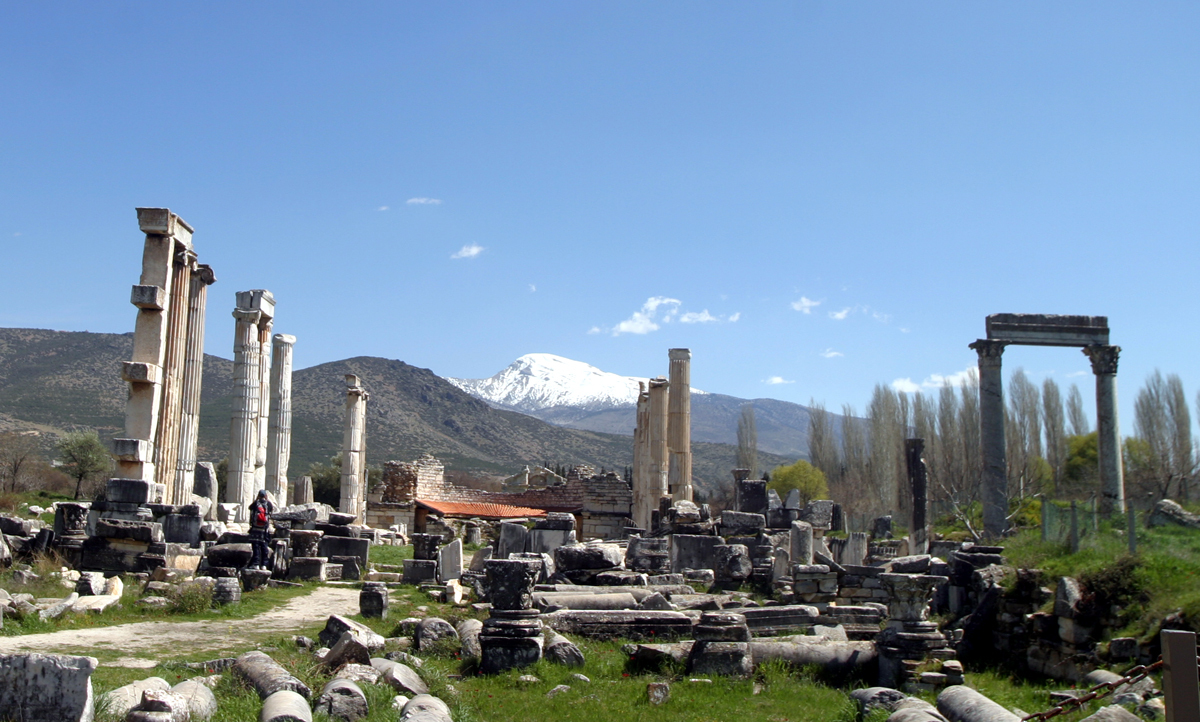
© Brocken Inaglory, CC BY-SA 4.0 Resized from original. (This derivative is under the same CC BY-SA license.)
World Heritage Research
Discover scientific research and academic studies that deepen our understanding of Aphrodisias from its history and significance to its conservation, management, and contemporary challenges.
-
The design of the “archive wall” at Aphrodisias
Aphrodisias' 'archive wall,' traditionally thought to be chronologically ordered, is revealed through this study to have been designed centripetally, prioritizing documents of honorific significance over chronological sequence. The research identifies two distinct epigraphic phases: the original phase, likely dating from 224 CE and comprising inscriptions above the orthostate course, and a later phase from 243 CE or slightly after, extending the inscriptions to the orthostate course. Additionally, it suggests that document 4, the earliest in the dossier, may be a letter by Cornelius Sulla. This study challenges conventional assumptions about the wall's design, emphasizing the importance of rhetorical content and concrete privileges over chronology.
Kokkinia, C. (2016). The design of the “archive wall” at Aphrodisias. Tekmeria, 13, 9. https://doi.org/10.12681/tekmeria.8627
View Publication Record | Read Publication