World Heritage Identification Number: 485
World Heritage since: 1988
Category: Mixed Cultural Heritage and Natural Heritage
WHE Type: Archaeological Sites
Transboundary Heritage: No
Endangered Heritage: No
Country: 🇹🇷 Türkiye
Continent: Asia
UNESCO World Region: Europe and North America
Map
Exploring the Ancient City of Hierapolis and the Natural Wonder of Pamukkale
Hierapolis-Pamukkale is a remarkable UNESCO World Heritage Site located in southwestern Anatolia, Turkey. This unique destination offers a blend of ancient history and natural beauty that attracts visitors from around the world.
The origins of Hierapolis date back to the Phrygian era, where it served as a significant cult center dedicated to the Anatolian mother goddess Cybele. However, it was during the Hellenistic period that the city truly flourished under the rule of the Attalid dynasty, the kings of Pergamon. The remnants of Hierapolis today include extensive remains of bathhouses, temples, and other Greek structures.
One of the most striking features of Hierapolis is its hot springs, which were highly valued for their therapeutic properties. These mineral-rich waters continue to flow from the cliffs above the modern town of Pamukkale, creating an extraordinary landscape known as Cotton Castle or Pamukkale (Turkish for 'cotton' or 'wool').
The name Pamukkale derives from the white, cascading terraces formed by the accumulation of carbonate minerals deposited by the flowing water. Over time, these mineral-rich waters have created a surreal landscape featuring petrified waterfalls, mineral forests, and a series of terraced basins. The sight of these snow-like terraces against the clear blue sky is truly breathtaking.
In addition to its historical and geological significance, Hierapolis-Pamukkale holds great cultural importance. It is renowned as the birthplace of the Stoic philosopher Epictetus, whose teachings greatly influenced Roman society. Visitors can explore the ancient theater, necropolis, and agora, providing insights into the daily life and social structure of this ancient city.
Today, Hierapolis-Pamukkale stands as a testament to the rich history and natural wonders of Turkey. Whether you are drawn to the allure of the ancient city or captivated by the mesmerizing landscapes of Pamukkale, this UNESCO World Heritage Site offers an unforgettable experience for travelers seeking adventure, culture, and serenity.
UNESCO Description of the World Heritage Site
Deriving from springs in a cliff almost 200 m high overlooking the plain, calcite-laden waters have created at Pamukkale (Cotton Palace) an unreal landscape, made up of mineral forests, petrified waterfalls and a series of terraced basins. At the end of the 2nd century B.C. the dynasty of the Attalids, the kings of Pergamon, established the thermal spa of Hierapolis. The ruins of the baths, temples and other Greek monuments can be seen at the site.
UNESCO Justification of the World Heritage Site
Criterion (iii): Hierapolis is an exceptional example of a Greco-Roman thermal installation established on an extraordinary natural site. The therapeutic virtues of the waters were exploited at the various thermal installations, which included immense hot basins and pools for swimming. Hydrotherapy was accompanied by religious practices, which developed in relation to local cults. The Temple of Apollo, which includes several Chtonian divinities, was erected on a geological fault from which noxious vapours escaped. The theatre, which dates from the time of Severus, is decorated with an admirable frieze depicting a ritual procession and a sacrifice to the Ephesian Artemis. The necropolis, which extends over 2 kilometres, affords a vast panorama of the funerary practices of the Greco-Roman era.
Criterion (iv): The Christian monuments of Hierapolis, erected between the 4th and the 6th centuries, constitute an outstanding example of an Early Christian architectural group with a cathedral, baptistery and churches. The most important monument, situated outside the north-west wall of the city, is the Martyrium of St. Philip. At the top of a monumental stairway, the octagonal layout of the building is remarkable because of its ingenious spatial organization. Radiating from the central octagon are chapels, polygonal halls and triangular rooms, which combine to culminate in a square structure encircled by rectangular cells bordered with porticoes.
Criterion (vii): Calcite-laden waters from hot springs, emerging from a cliff almost 200 metres high overlooking the plain, have created a visually stunning landscape at Pamukkale. These mineralized waters have generated a series of petrified waterfalls, stalactites and pools with step-like terraces, some of which are less than a meter in height while others are as high as six meters. Fresh deposits of calcium carbonate give these formations a dazzling white coating. The Turkish name Pamukkale, meaning “cotton castle”, is derived from this striking landscape.
Encyclopedia Record: Hierapolis
Hierapolis was a Hellenistic Greek city in Phrygia, in southwestern Anatolia, Turkey. It was founded in the 3rd century BC, on the site of a Phrygian cult center of the Anatolian mother goddess Cybele, It was famous for its hot springs, its high quality wool fabrics and dyes, and as the birthplace of the Stoic philosopher Epictetus. Its extensive remains are adjacent to modern Pamukkale in Turkey.Additional Site Details
Area: 1,077 hectares
Number of Components: 1
(iv) — Outstanding example of a type of building or landscape
(vii) — Contains superlative natural phenomena or beauty
Coordinates: 37.92389 , 29.12333
IUCN World Heritage Outlook
The 2025 Conservation Outlook on Hierapolis-Pamukkale reports the following assessment:
Source: International Union for Conservation of Nature (IUCN) · View assessment
Image
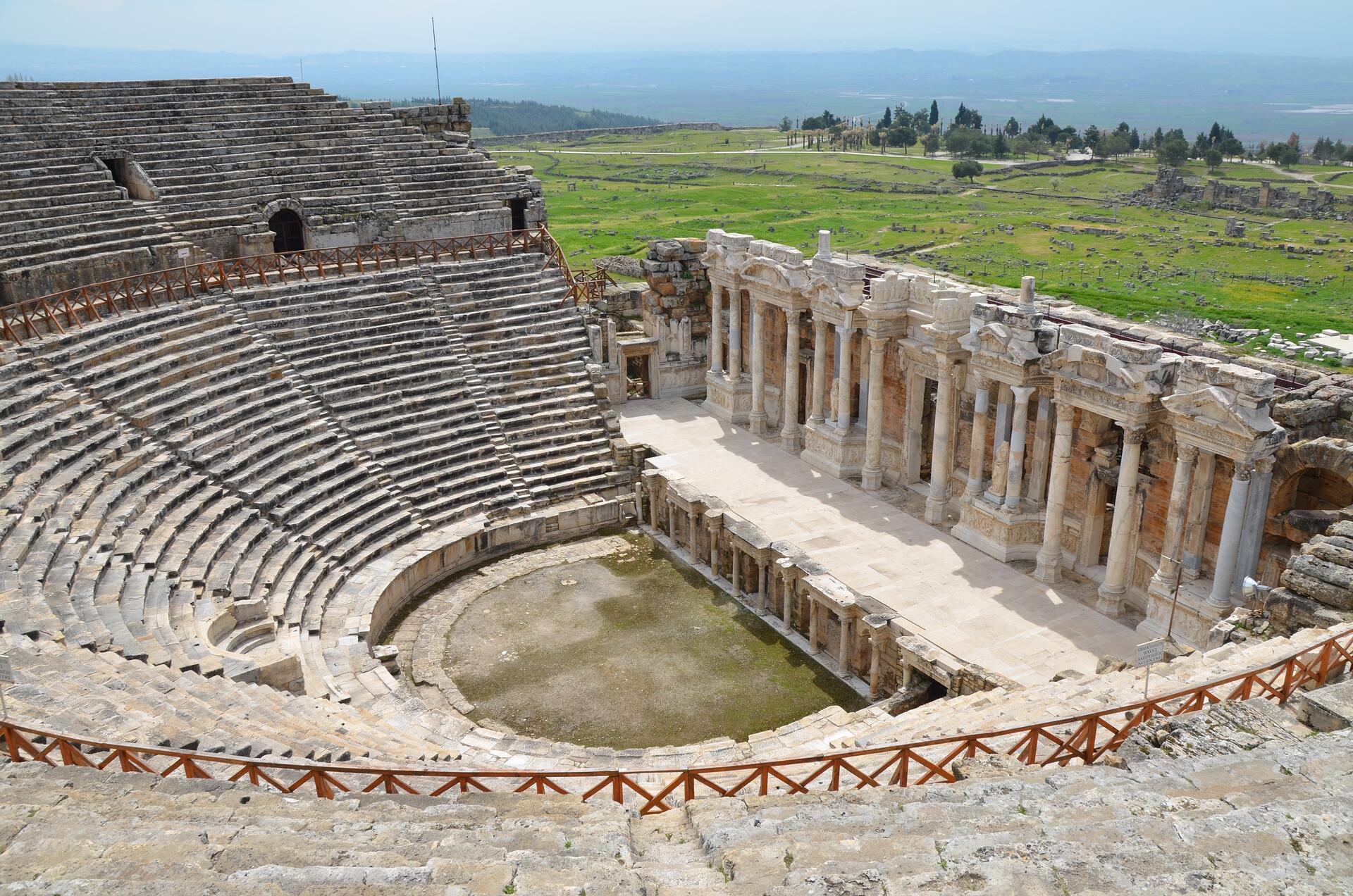
© Carole Raddato, CC BY-SA 2.0 Resized from original. (This derivative is under the same CC BY-SA license.)
World Heritage Research
Discover scientific research and academic studies that deepen our understanding of Hierapolis-Pamukkale from its history and significance to its conservation, management, and contemporary challenges.
-
Geophysical Characterization of Archaeological Sites in Active Seismic Zones: The Case of the “Basilica Bath” at Hierapolis (Turkey)
Geophysical surveys reveal the likely fault configuration responsible for the partial collapse of the Basilica Bath at Hierapolis, providing critical insights into the site's seismic vulnerability. Using electrical resistivity tomography (ERT) and seismic refraction tomography (SRT), researchers identified buried archaeological features and potential fault directions, offering new data to support studies on the building's reconstruction and reuse in ancient times. The findings contribute to understanding the impact of seismic activity on UNESCO-listed sites like Hierapolis-Pamukkale, located in an active tectonic zone with a history of destructive earthquakes.
Deiana, R., Semeraro, G., Cassiani, G., Barone, I., & Boaga, J. (2026). Geophysical Characterization of Archaeological Sites in Active Seismic Zones: The Case of the “Basilica Bath” at Hierapolis (Turkey). Applied Sciences, 16(6), 2795. https://doi.org/10.3390/app16062795
View Publication Record | Read Publication -
Hierapolis (Pamukkale) Saint Philip Kilisesi Mozaik Harcının Analizi ve Konservasyonu
A significant discovery of the conservation challenges facing ancient mosaics at Hierapolis-Pamukkale was revealed through the analysis and preservation efforts of Saint Philip Church's mosaic. The mosaic, severely damaged due to illegal excavations and earthquakes, underwent urgent removal in 2010 for protective storage. Extensive material analyses, including tuz tests (chloride, sulfate, nitrate, carbonate), oil and protein tests, thermal analysis, and petrografic examinations using SEM-EDX, XRD, stereo, and polarized microscopy, were conducted to assess its condition. Conservation efforts in 2011 and 2012 involved cleaning the mortar behind the tesserae and applying a compatible conservation mortar, followed by transfer onto Aerolam panels for long-term preservation. The study highlights the critical need for rapid intervention and scientific analysis in safeguarding vulnerable cultural heritage sites.
NOEI, S. (2023). Mortar Analysis and Conservation of the Saint Philip Church’s Mosaic in Hierapolis (Pamukkale). Journal of Mosaic Research, (16), 477–487. https://doi.org/10.26658/jmr.1377325
View Publication Record | Read Publication -
Detailed Documentation and In Situ Conservation According to Mortar Characterisation of Opus Sectile Uncovered in the Saint Philip Church of Hierapolis (Pamukkale-Turkey)
A detailed conservation approach for ancient stone-art (opus sectile) at Hierapolis-Pamukkale, Turkey, revealed that all materials used were locally sourced. The study combined archaeological excavation with advanced mortar analysis—including petrographic and SEM-EDX techniques—to replicate the original bedding mortar. Conservation efforts involved minimal intervention, mechanical/chemical cleaning, reinforcement, and precise documentation using 3D modeling (Agisoft) and CAD drawings. The opus sectile was preserved in situ with lime-based mortars and protected against plant intrusion. This interdisciplinary method ensures long-term monitoring and future conservation strategies for this UNESCO World Heritage Site.
Noei, S. (2022). DETAILED DOCUMENTATION AND IN SITU CONSERVATION ACCORDING TO MORTAR CHARACTERISATION OF OPUS SECTILE UNCOVERED IN THE SAINT PHILIP CHURCH OF HIERAPOLIS (PAMUKKALE-TURKEY). Zenodo. https://doi.org/10.5281/ZENODO.6815465
View Publication Record | Read Publication -
Orta Bizans Dönemi Kabartma Yüzlü Sütun Başlığı Örneğinde Bezeme Unsurlarının Tipolojik İşlevselliği
A study of three relief-faced column capitals from the Middle Byzantine period, housed in Pamukkale Archaeology Museum's Hierapolis stone collection, reveals a unique regional adaptation of classical Corinthian capital designs. These capitals feature distinctive relief faces extending downward from the abacus, blending various decorative motifs into a complex form. While their symbolic significance remains speculative, the study suggests these capitals represent a localized variation of Middle Byzantine capital typology, distinct from earlier Geç Antik-Erken Bizans period prototypes. The research highlights the challenge of attributing such capitals to specific architectural contexts due to uncertain provenance and missing structural associations.
ARMAĞAN, M. E. (2022). Orta Bizans Dönemi Kabartma Yüzlü Sütun Başlığı Örneğinde Bezeme Unsurlarının Tipolojik İşlevselliği. Süleyman Demirel Üniversitesi Fen-Edebiyat Fakültesi Sosyal Bilimler Dergisi, (56), 83–92. https://doi.org/10.35237/sufesosbil.1135490
View Publication Record | Read Publication -
A Lydian inscription from Denizli
A rare and well-preserved Lydian funerary inscription, dating back to the 4th century BCE, was discovered in Denizli, Turkey. The marble stele, adorned with an anthemion relief, is now housed in the Hierapolis Museum in Pamukkale. This find, unearthed during excavations led by Professor Kadir Pektaş, provides valuable insights into Lydian language and culture. The inscription's length and good condition make it significant for both Anatolianists and Indo-Europeanists. Researchers present a detailed description of the stone, an edited transcription of the text with commentary, a partial translation, and historical context, shedding light on ancient Lydian society.
Rojas, F., & Öztürk, E. A. (2022). A Lydian inscription from Denizli. Kadmos, 61(1-2), 155–164. https://doi.org/10.1515/kadmos-2022-0009
View Publication Record | Read Publication -
Hierapolis Adını Pamukkale’ye Dönüştüren Mekân: Selçuklu Kalesi
The name 'Pamukkale' emerged from the Seljuk era, replacing the ancient Greek name 'Hierapolis,' due to the construction of a Seljuk fortress in the region. This shift reflects both natural and human factors influencing toponymy. The study used geographic research methods, field observations, historical sources, and toponomy principles to trace the origin of Pamukkale's name. Archaeological findings, including Seljuk coins from excavations around the fortress, support this transition, shedding light on the cultural and historical evolution of one of Turkey's most significant tourism destinations.
KARA, H., BALIK, İ., & GÖKBURUN, İ. (2021). HİERAPOLİS ADINI PAMUKKALE’YE DÖNÜŞTÜREN MEKÂN: SELÇUKLU KALESİ. Journal of History School, LV(LV), 4089–4113. https://doi.org/10.29228/joh.52612
View Publication Record | Read Publication -
Destination Personality Impacts on the Satisfaction and Behavioral Intentions: A Case of Pamukkale – Hierapolis Site
A study on Hierapolis-Pamukkale reveals that destination personality significantly influences visitor satisfaction and behavioral intentions, such as repeat visits or positive word-of-mouth. The research employs a quantitative approach, analyzing survey data from tourists to assess how traits like authenticity, uniqueness, and natural beauty shape their experiences. Findings suggest that enhancing these perceived attributes could boost long-term engagement with the site, offering valuable insights for sustainable tourism management at UNESCO World Heritage Sites.
Atay, L., Türkmen, S., & Carus, M. (2020). DESTINATION PERSONALITY IMPACTS ON THE SATISFACTION AND BEHAVIORAL INTENTIONS: A CASE OF PAMUKKALE – HIERAPOLIS SITE. Acta Turistica, 32(1), 75–102. https://doi.org/10.22598/at/2020.32.1.75
View Publication Record | Read Publication