World Heritage Identification Number: 1495
World Heritage since: 2018
Category: Cultural Heritage
WHE Type: Buildings & Architectural Ensembles
Transboundary Heritage: No
Endangered Heritage: No
Country: 🇯🇵 Japan
Continent: Asia
UNESCO World Region: Asia and the Pacific
Map
Unveiling the Hidden Christian Sites in the Nagasaki Region: A Testament to Resilience and Faith
The Hidden Christian Sites in the Nagasaki Region, inscribed as a UNESCO World Heritage Site in 2018, offers a captivating glimpse into the rich tapestry of Japanese history, culture, and religion. This collection of twelve sites, scattered across Nagasaki Prefecture and Kumamoto Prefecture, provides a poignant narrative of the resilience and enduring spirit of the Christian community in Japan, particularly during the period of religious persecution that lasted from the 17th to the 19th centuries.
More to come…UNESCO Description of the World Heritage Site
Located in the north-western part of Kyushu island, this serial property consists of ten villages, remains of the Hara Castle and a cathedral, dating from the 17th to the 19th centuries. They reflect the era of prohibition of the Christian faith, as well as the revitalization of Christian communities after the official lifting of prohibition in 1873. These sites bear unique testimony to a cultural tradition nurtured by hidden Christians in the Nagasaki region who secretly transmitted their faith during the period of prohibition from the 17th to the 19th century.
UNESCO Justification of the World Heritage Site
Criterion (iii): The Hidden Christian Sites in the Nagasaki Region bear unique testimony to a distinctive religious tradition nurtured by Hidden Christians who secretly transmitted their faith in Christianity during the time of prohibition spanning more than two centuries in Japan, from the 17th to the 19th century.
Encyclopedia Record: Hidden Christian Sites in the Nagasaki Region
Hidden Christian Sites in the Nagasaki Region is a group of twelve sites in Nagasaki Prefecture and Kumamoto Prefecture relating to the history of Christianity in Japan. The Nagasaki churches are unique in the sense that each tells a story about the revival of Christianity after a long period of official suppression.Additional Site Details
Area: 5,566.55 hectares
Number of Components: 12
Coordinates: 32.8022222222 , 128.9038888889
Image
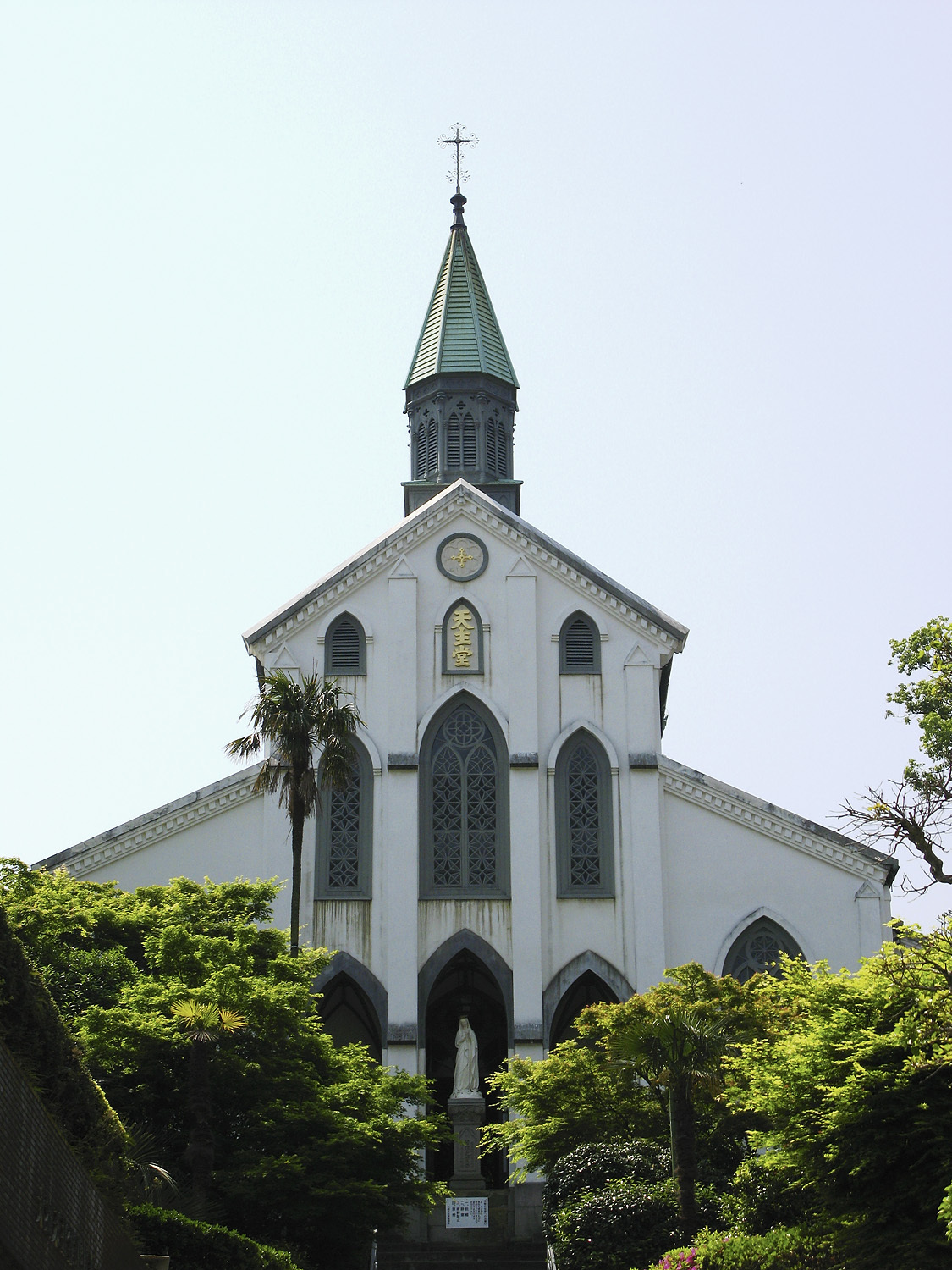
Fg2, Public domain
World Heritage Research
Discover scientific research and academic studies that deepen our understanding of Hidden Christian Sites in the Nagasaki Region from its history and significance to its conservation, management, and contemporary challenges.
-
Translating Catholic Heritage through Local Environment: Materiality of Japan’s World Heritage
Nagasaki's nomination for UNESCO World Heritage status, centered on its 'Hidden Christian Sites,' reveals a nuanced approach to heritage preservation. The study highlights how the narrative around these sites, primarily Catholic church buildings and materials, has been subtly secularized during the nomination process. This shift was strategic, aimed at navigating local sensitivities and aligning with national interests without provoking controversy. The research demonstrates that material culture—specifically religious architecture—serves as a bridge to mediate complex social relationships while maintaining historical authenticity. The findings underscore the delicate balance required in heritage conservation, where cultural diplomacy plays a pivotal role in shaping global recognition.
Yamada, T. (2025). Translating Catholic Heritage through Local Environment: Materiality of Japan’s World Heritage. International Journal of Asian Christianity, 8(2), 219–241. https://doi.org/10.1163/25424246-08020009
View Publication Record | Read Publication -
Hidden Christians Made Visible: An Ethnography of Tourism in a World Heritage Property of Japan
A decade-long nomination process for Japan's 'Hidden Christian Sites in the Nagasaki Region' as a UNESCO World Heritage Site has not only recognized the cultural significance of these sites but also transformed them into a prominent touristic destination. This transformation has given visibility to the Hidden Christians, who practiced their faith secretly for 250 years during a nationwide ban on Christianity. The study reveals that this process has created distinct 'borders of memory' among different stakeholders—including the Prefectural Government, Catholic Church, tourism agencies, and local guides—leading to collisions and fusions in their aims and perspectives. These borders highlight the tension between two logics in Japanese cultural management: the logic of actualization and the preservation of the present.
Mateoc, R. (2023). Hidden Christians Made Visible: An Ethnography of Tourism in a World Heritage Property of Japan. Heritage, Contested Sites, and Borders of Memory in the Asia Pacific, 107–135. https://doi.org/10.1163/9789004512986_006
View Publication Record | Read Publication -
Bending history into heritage at hidden Christian sites in Nagasaki, Japan: UNESCO World Heritage site designation and tourism
UNESCO World Heritage site designation, while intended to foster sustainable tourism and secure funding for preservation, often faces criticism for its rigid selection criteria and pressure for tangible evidence of authenticity. This study reveals how the intervention of ICOMOS significantly altered the application process for the Hidden Christian Sites in Nagasaki, Japan, leading applicants to stage their heritage to meet UNESCO's demands. The research highlights the challenges in balancing historical integrity with tourism-driven narratives, emphasizing the need for greater recognition of local voices and alternative narratives to ensure authenticity in an era dominated by heritage commercialization.
Hashimoto, A., & Telfer, D. J. (2023). Bending history into heritage at hidden Christian sites in Nagasaki, Japan: UNESCO World Heritage site designation and tourism. Journal of Heritage Tourism, 19(2), 221–242. https://doi.org/10.1080/1743873x.2023.2276869
View Publication Record | Read Publication -
Sustainable heritage through a sustainable community
A shift from public-sector-led participatory governance to active, community-driven heritage management enhances both cultural preservation and local sustainability. Using Japan's Hidden Christian Sites in Nagasaki—UNESCO-listed in 2018—as a case study, the research demonstrates how everyday practices by residents, rooted in community resilience, effectively conserve heritage while fostering social cohesion. This challenges traditional models where private or public sectors lead conservation efforts, instead highlighting the transformative potential of grassroots initiatives in sustainable heritage stewardship.
Suzuki, C. (2022). Sustainable heritage through a sustainable community. Routledge Handbook of Sustainable Heritage, 154–165. https://doi.org/10.4324/9781003038955-14
View Publication Record | Read Publication -
The Authenticity of the Hidden Christians’ Villages in Nagasaki: Issues in Evaluation of Cultural Landscapes
The global push for UNESCO World Heritage Site designation can inadvertently undermine the authenticity and sustainability of local cultural traditions, particularly when decisions prioritize tangible properties over living practices. A study analyzing the 'Hidden Christians Sites in the Nagasaki Region,' designated in 2018, reveals that while such recognition aims to preserve unique heritage, it often reduces complex cultural landscapes to tourist-ready attractions. Comparing UNESCO and Japanese policies, the research highlights how local stakeholders' input is sidelined in favor of predefined authenticity criteria, risking the erosion of living traditions. The findings underscore the need for heritage protection strategies grounded in scientific understanding and aligned with the interests of tradition bearers.
Delakorda Kawashima, T. (2021). The Authenticity of the Hidden Christians’ Villages in Nagasaki: Issues in Evaluation of Cultural Landscapes. Sustainability, 13(8), 4387. https://doi.org/10.3390/su13084387
View Publication Record | Read Publication -
From Pure Land to Hell: Introducing four culturally hybrid UNESCO World Heritage sites in the Gotō Archipelago
Four UNESCO World Heritage Sites in Japan's Gotō Archipelago, inscribed in 2018, reveal a complex cultural hybridity shaped by the interplay of Hidden Christian (HC) refugees and their environment during the 18th and 19th centuries. Despite economic and tourist-driven motivations behind the World Heritage campaign, these sites offer a deeper understanding of HC identity through oral history and historical documents, challenging simplistic narratives. The study demonstrates that HC communities, often marginalized in broader Japanese history, integrated religious practices with local ecological conditions, including harsh winters and coastal resources. By analyzing four key sites—supported by new oral histories—the research reorients East Asian historical narratives to include these interstitial, marginal spaces, emphasizing the significance of human-environmental interactions in shaping cultural heritage.
McClelland, G. (2022). From Pure Land to Hell: Introducing four culturally hybrid UNESCO World Heritage sites in the Gotō Archipelago. Shima: The International Journal of Research into Island Cultures, 16(1). https://doi.org/10.21463/shima.130
View Publication Record | Read Publication -
A Christian Samurai: The Trials of Baba Bunkō by William J. Farge
A groundbreaking study challenges the long-held assumption that Christian writings were nonexistent in 18th-century Japan due to Tokugawa persecution, by identifying Baba Bunkō (1718–59), a former samurai and critic of the shogunate, as a hidden Christian. William J. Farge's work reveals Bunkō’s 'Christian' nature through subtle but unmistakable references in his writings—such as critiques of imperial and shogunal crests linked to the Shimabara rebellion’s Eucharistic symbolism—to argue that his works must be interpreted within a Christian context. This study employs innovative methods, including close textual analysis of ambiguous language and historical contextualization, to shed new light on early modern Japanese Christianity and its enduring influence.
Higashibaba, I. (2020). A Christian Samurai: The Trials of Baba Bunkō by William J. Farge. The Catholic Historical Review, 106(1), 148–150. https://doi.org/10.1353/cat.2020.0032
View Publication Record | Read Publication