World Heritage Identification Number: 1023
World Heritage since: 2004
Category: Natural Heritage
WHE Type: Natural Landscapes & Geographic Features
Transboundary Heritage: No
Endangered Heritage: No
Country: 🇷🇺 Russian Federation
Continent: Europe
UNESCO World Region: Europe and North America
Map
Wrangel Island Reserve: A Biodiverse Arctic Treasure
The **Natural System of Wrangel Island Reserve**, inscribed as a UNESCO World Heritage Site in 2004, is a unique and significant ecological haven situated within the Arctic Circle. Comprising the 7,608 square kilometer Wrangel Island, the smaller Herald Island (11 km²), and surrounding waters, it offers an exceptional display of biodiversity seldom found in such a remote and extreme climate.
More to come…UNESCO Description of the World Heritage Site
Located well above the Arctic Circle, the site includes the mountainous Wrangel Island (7,608 km2), Herald Island (11 km2) and surrounding waters. Wrangel was not glaciated during the Quaternary Ice Age, resulting in exceptionally high levels of biodiversity for this region. The island boasts the world’s largest population of Pacific walrus and the highest density of ancestral polar bear dens. It is a major feeding ground for the grey whale migrating from Mexico and the northernmost nesting ground for 100 migratory bird species, many endangered. Currently, 417 species and subspecies of vascular plants have been identified on the island, double that of any other Arctic tundra territory of comparable size and more than any other Arctic island. Some species are derivative of widespread continental forms, others are the result of recent hybridization, and 23 are endemic.
UNESCO Justification of the World Heritage Site
Criterion (ix): The Wrangel Island Reserve is a self-contained island ecosystem and there is ample evidence that it has undergone a long evolutionary process uninterrupted by the glaciation that swept most other parts of the Arctic during the Quaternary period. The number and type of endemic plant species, the diversity within plant communities, the rapid succession and mosaic of tundra types, the presence of relatively recent mammoth tusks and skulls, the range of terrain types and geological formations in the small geographic space are all visible evidence of Wrangel’s rich natural history and its unique evolutionary status within the Arctic. Furthermore, the process is continuing as can be observed in, for example, the unusually high densities and distinct behaviours of the Wrangel lemming populations in comparison with other Arctic populations or in the physical adaptations of the Wrangel Island reindeers, where they may now have evolved into a separate population from their mainland cousins. Species interaction strategies are highly-honed and on display throughout the island, especially near Snowy owl nests which act as protectorates for other species and beacons for migratory species and around fox dens.
Criterion (x): The Wrangel Island Reserve has the highest level of biodiversity in the high Arctic. The island is the breeding habitat of Asia’s only Snow goose population which is slowly making a recovery from catastrophically low levels. The marine environment is an increasingly important feeding ground for the Gray whale migrating from Mexico (some from another World Heritage site, the Whale Sanctuary of El Vizcaino). The islands have the largest sea-bird colonies on the Chukchi Sea, are the northernmost nesting grounds for over 100 migratory bird species including several that are endangered such as the Peregrine falcon, have significant populations of resident tundra bird species interspersed with migratory Arctic and non-Arctic species and have the world’s highest density of ancestral polar bear dens. Wrangel Island boasts the largest population of Pacific walrus with up to 100,000 animals congregating at any given time at one of the island’s important coastal rookeries. Since Wrangel Island contains a high diversity of habitats and climates and conditions vary considerably from one location to another, total reproductive failure of a species in any given year is practically unheard of. Given the relatively small size of the area, this is very unusual in the high Arctic.
Encyclopedia Record: Wrangel Island
Wrangel Island is an island of the Chukotka Autonomous Okrug, Russia. It is the 92nd-largest island in the world and roughly the size of Crete. Located in the Arctic Ocean between the Chukchi Sea and East Siberian Sea, the island lies astride the 180th meridian. The International Date Line is therefore displaced eastwards at this latitude to keep the island, as well as the Chukchi Peninsula on the Russian mainland, on the same day as the rest of Russia. The closest land to Wrangel Island is the tiny and rocky Herald Island located 60 kilometres (32 nmi) to the east. Its straddling the 180th meridian makes its north shore at that point both the northeasternmost and northwesternmost point of land in the world by strict longitude; using the International Date Line instead, those respective points become Herald Island and Alaska's Cape Lisburne.Additional Site Details
Area: 1,916,300 hectares
Number of Components: 1
(x) — Contains most important habitats for biodiversity
Coordinates: 71.18888889 , -179.7152778
IUCN World Heritage Outlook
The 2025 Conservation Outlook on Natural System of Wrangel Island Reserve reports the following assessment:
Source: International Union for Conservation of Nature (IUCN) · View assessment
Image
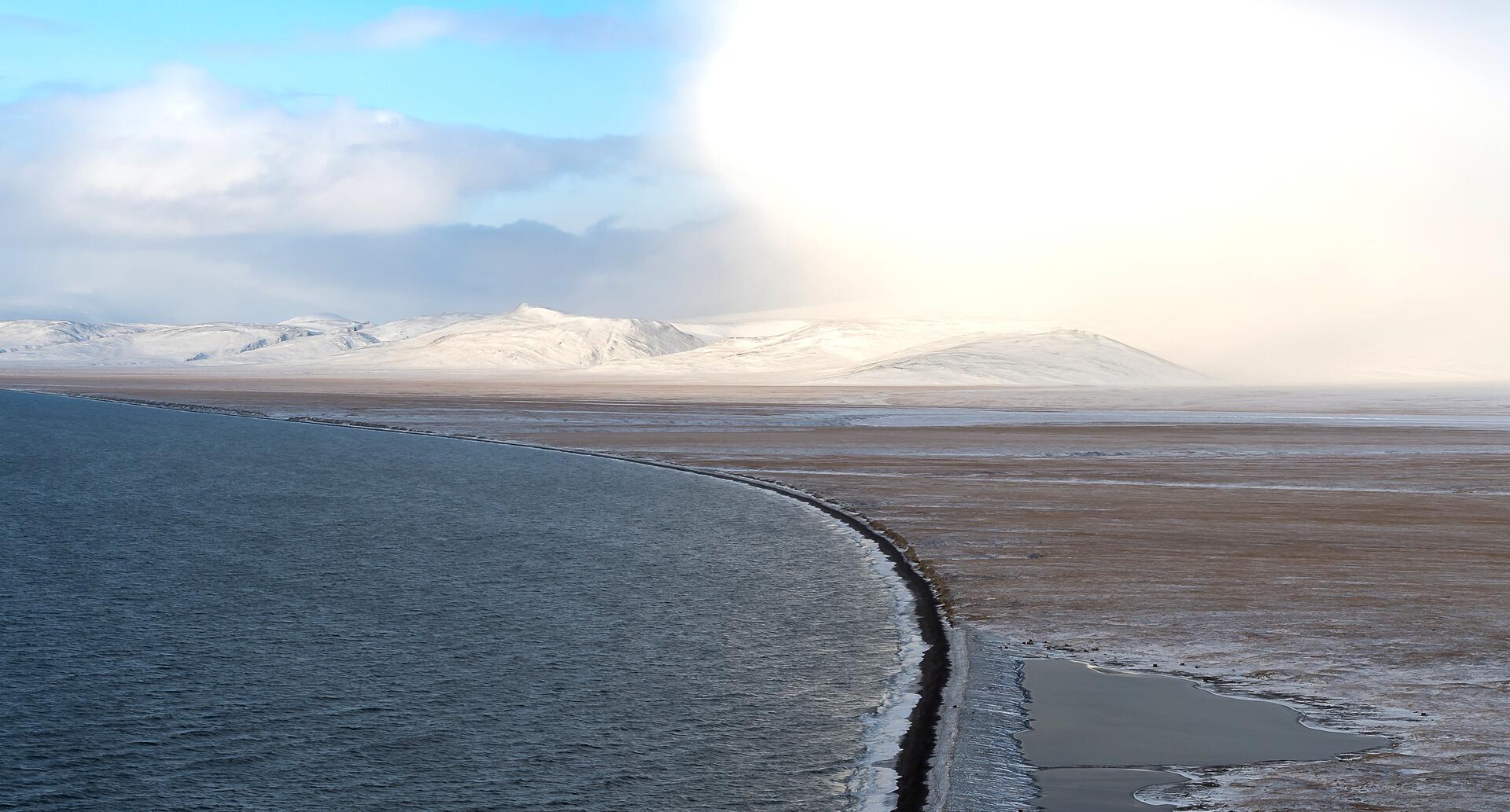
© Виталий Дворяченко, CC BY-SA 4.0 Resized from original. (This derivative is under the same CC BY-SA license.)
World Heritage Research
Discover scientific research and academic studies that deepen our understanding of Natural System of Wrangel Island Reserve from its history and significance to its conservation, management, and contemporary challenges.
-
New Data on Late Paleozoic Conglomerates of Wrangel Island and Their Geological Interpretation
A new geological interpretation of conglomerates on Wrangel Island reveals distinct age differences between two types found in the Central tectonic zone. The first type, dominated by metamorphic schists and mafic volcanics, likely predates the second type, which contains rounded quartz, limestone fragments, and faunal remains—similar to intraformational conglomerates from the Northern zone. Faunal analysis confirms the Guadalupian–Lopingian (Middle–Late Permian) age of the latter, suggesting local tectonic or sedimentary rearrangements during the Pennsylvanian Bashkirian Age and Middle–Late Permian periods. These findings mirror patterns observed in Canada’s Sverdrup basin, offering insights into Paleozoic geological dynamics.
Tuchkova, M. I., Filimonova, T. V., Isakova, T. N., Zagoskina-Beloshei, V. E., Sokolov, S. D., & Dubenskiy, A. S. (2025). New Data on Late Paleozoic Conglomerates of Wrangel Island and Their Geological Interpretation. Stratigraphy and Geological Correlation, 33(2), 195–214. https://doi.org/10.1134/s0869593824700333
View Publication Record | Read Publication -
(A review) O. I. Sumina. Tundra science studies. Terrestrial ecosystems of the Arctic. Textbook. 2024. Saint-Petersburg. Lan. 400 p.
A comprehensive review of Dr. Olga I. Sumina's textbook, 'Tundra Science Studies: Terrestrial Ecosystems of the Arctic,' highlights its dual role as a scientific monograph and educational resource. The book synthesizes decades of geobotanical research across the Russian Arctic, including Wrangel Island Reserve, Alaska, and Scandinavia, offering detailed insights into the biome's living and nonliving components. It emphasizes the necessity of long-term ecosystem monitoring to accurately assess ongoing changes and predict future trajectories, a critical insight for Arctic conservation efforts. The textbook integrates climate, geology, flora, and vegetation dynamics while providing structured learning tools such as questions, assignments, and essay topics. Its circumpolar perspective, including the Circumpolar Arctic Vegetation Map (CAVM), underscores its value for both students and seasoned researchers.
Matveyeva, N. V. (2025). (A review) O. I. Sumina. Tundra science studies. Terrestrial ecosystems of the Arctic. Textbook. 2024. Saint-Petersburg. Lan. 400 p. Vegetation of Russia, (50), 161–166. https://doi.org/10.31111/vegrus/2025.50.161
View Publication Record | Read Publication -
Crane flies (Diptera, Tipuloidea: Tipulidae, Limoniidae) of Wrangel Island (Chukotka AO, Russia). 2. Features of the faunal composition and spatial distribution
Wrangel Island's crane fly (Diptera, Tipuloidea) fauna exhibits distinct faunal composition and spatial distribution patterns, with notable endemism and species richness. The study identified 45 species, including several rare or endemic taxa, highlighting the island's ecological significance as a UNESCO World Heritage Site. Researchers employed field sampling across diverse habitats—tundra, coastal zones, and river valleys—to assess species diversity, abundance, and distribution. The findings underscore Wrangel Island's role as a biodiversity hotspot, with crane flies serving as indicator taxa for monitoring environmental changes in the Arctic.
Khruleva, О. А., Lantsov, V. I., Devyatkov, V. I., & Paramonov, N. M. (2025). Crane flies (Diptera, Tipuloidea: Tipulidae, Limoniidae) of Wrangel Island (Chukotka AO, Russia). 2. Features of the faunal composition and spatial distribution. Euroasian Entomological Journal, 24(3), 153–168. https://doi.org/10.15298/euroasentj.24.03.05
View Publication Record | Read Publication -
The 40Ar–39Ar Age of Folding in the Sedimentary Complexes of Chukotka and Wrangel Island (Northeastern Russia)
A groundbreaking study reveals that the sedimentary complexes of Chukotka and Wrangel Island, including UNESCO World Heritage Site components, experienced significant folding during the Tithonian period (150 million years ago). Using 40Ar–39Ar isotope dating on newly formed micas and chlorites from thrust zones, researchers identified two distinct deformation stages: one in the Late Permian (257 million years ago) affecting Silurian rocks on Wrangel Island's Dream-Head Mountains, and another involving Devonian to Triassic sedimentary rocks. The study also found that thrust formation was accompanied by substantial heating of sedimentary sequences to temperatures between 250–380°C, with minimal temperature variation within the thrust zone itself. This research provides critical insights into the tectonic history of this remote Arctic region.
Tuchkova, M. I., Sokolov, S. D., Moiseev, A. V., & Vatrushkina, E. V. (2024). The 40Ar–39Ar Age of Folding in the Sedimentary Complexes of Chukotka and Wrangel Island (Northeastern Russia). Doklady Earth Sciences, 514(2), 255–263. https://doi.org/10.1134/s1028334x2360295x
View Publication Record | Read Publication -
An Examination of the Wrangel Island Sea Ice Thickness Dipole
A distinct sea ice thickness dipole is observed around Wrangel Island, with thicker ice accumulating on its eastern side and thinner ice persisting to the west due to the Beaufort Gyre's influence. This phenomenon, present year-round but most pronounced in January (with a ~1 m difference), reverses during atmospheric circulation shifts. The dipole is linked to opposing ice divergence and convergence across the western Arctic, potentially affecting ocean circulation and ecosystems in the Chukchi Sea. Additionally, it contributes to the transient opening of a polynya west of the island during spring.
Ross, S., Moore, G. W. K., & Laidre, K. L. (2024). An Examination of the Wrangel Island Sea Ice Thickness Dipole. Journal of Geophysical Research: Oceans, 129(6). Portico. https://doi.org/10.1029/2023jc020425
View Publication Record | Read Publication -
Assessing past and future climatic influences on the availability of polar bear maternal denning habitat on Wrangel Island
Despite rising temperatures and sea ice loss, Wrangel Island's climate remains cold enough that the availability of polar bear maternal denning habitat is not yet an immediate limiting factor for the Chukchi Sea subpopulation. A retrospective analysis (1980–2020) found no significant trends in the spatial or temporal availability of snowdrift habitat suitable for denning over 41 years. However, sensitivity simulations predict that a projected 7.6 °C temperature increase could reduce denning habitat by approximately 50%, while a rise of ≥13.6 °C could eliminate it entirely. The study used spatial modeling to evaluate potential denning habitat from September to December and assessed future climate change impacts on this critical habitat for polar bear reproduction.
Chinn, S. M., Liston, G. E., & Wilson, R. R. (2023). Assessing past and future climatic influences on the availability of polar bear maternal denning habitat on Wrangel Island. Ecological Modelling, 484, 110479. https://doi.org/10.1016/j.ecolmodel.2023.110479
View Publication Record | Read Publication -
A territorial behaviour of the greenlandic lemming (Dicrostonyx groenlandicus Trail, 1823) in the Wrangel Island
Research on the Greenlandic lemming (Dicrostonyx groenlandicus) on Wrangel Island revealed key insights into their territorial behavior, including daily activity patterns and rest-activity phases during juvenile maturation. The study employed visual monitoring to track adult and juvenile lemmings, capturing data on habitat use, food storage, and surface emergence of young animals. Findings highlighted the dynamic nature of lemming territories, particularly in relation to seasonal changes and reproductive cycles. This approach provided a comprehensive understanding of their ecological behavior within the unique Arctic environment of Wrangel Island, contributing valuable data for conservation efforts.
Strelkov, A. P., Strelkova, N. A., Mironov, A. D., & Natsvaladze, N. Yu. (2023). A territorial behaviour of the greenlandic lemming (Dicrostonyx groenlandicus Trail, 1823) in the Wrangel Island. Amurian Zoological Journal, 15(3), 588–605. https://doi.org/10.33910/2686-9519-2023-15-3-588-605
View Publication Record | Read Publication