
World Heritage Identification Number: 602
World Heritage since: 1993
Category: Cultural Heritage
WHE Type: Historic Cities & Urban Areas
Transboundary Heritage: No
Endangered Heritage: No
Country: 🇺🇿 Uzbekistan
Continent: Asia
UNESCO World Region: Asia and the Pacific
Map
The Historic Centre of Bukhara: A Timeless Gem Along the Silk Road
The Historic Centre of Bukhara, located in modern-day Uzbekistan, stands as a testament to the rich cultural and architectural heritage of Central Asia. Inscribed as a UNESCO World Heritage Site in 1993, this ancient city offers a unique glimpse into the region's history spanning over two millennia.
More to come…UNESCO Description of the World Heritage Site
Bukhara, which is situated on the Silk Route, is more than 2,000 years old. It is the most complete example of a medieval city in Central Asia, with an urban fabric that has remained largely intact. Monuments of particular interest include the famous tomb of Ismail Samani, a masterpiece of 10th-century Muslim architecture, and a large number of 17th-century madrasas.
UNESCO Justification of the World Heritage Site
Criterion (ii): The example of Bukhara in terms of its urban layout and buildings had a profound influence on the evolution and planning of towns in a wide region of Central Asia.
Criterion (iv): Bukhara is the most complete and unspoiled example of a medieval Central Asian town which has preserved its urban fabric to the present day.
Criterion (vi): Between the 9th and 16th centuries, Bukhara was the largest centre for Muslim theology, particularly on Sufism, in the Near East, with over two hundred mosques and more than a hundred madrasahs.
Encyclopedia Record: Bukhara
Bukhara is the seventh-largest city in Uzbekistan by population, with 280,187 residents as of 1 January 2020. It is the capital of Bukhara Region.Additional Site Details
Area: 216 hectares
Number of Components: 1
(iv) — Outstanding example of a type of building or landscape
(vi) — Directly associated with events or living traditions
Coordinates: 39.77472 , 64.42861
Image
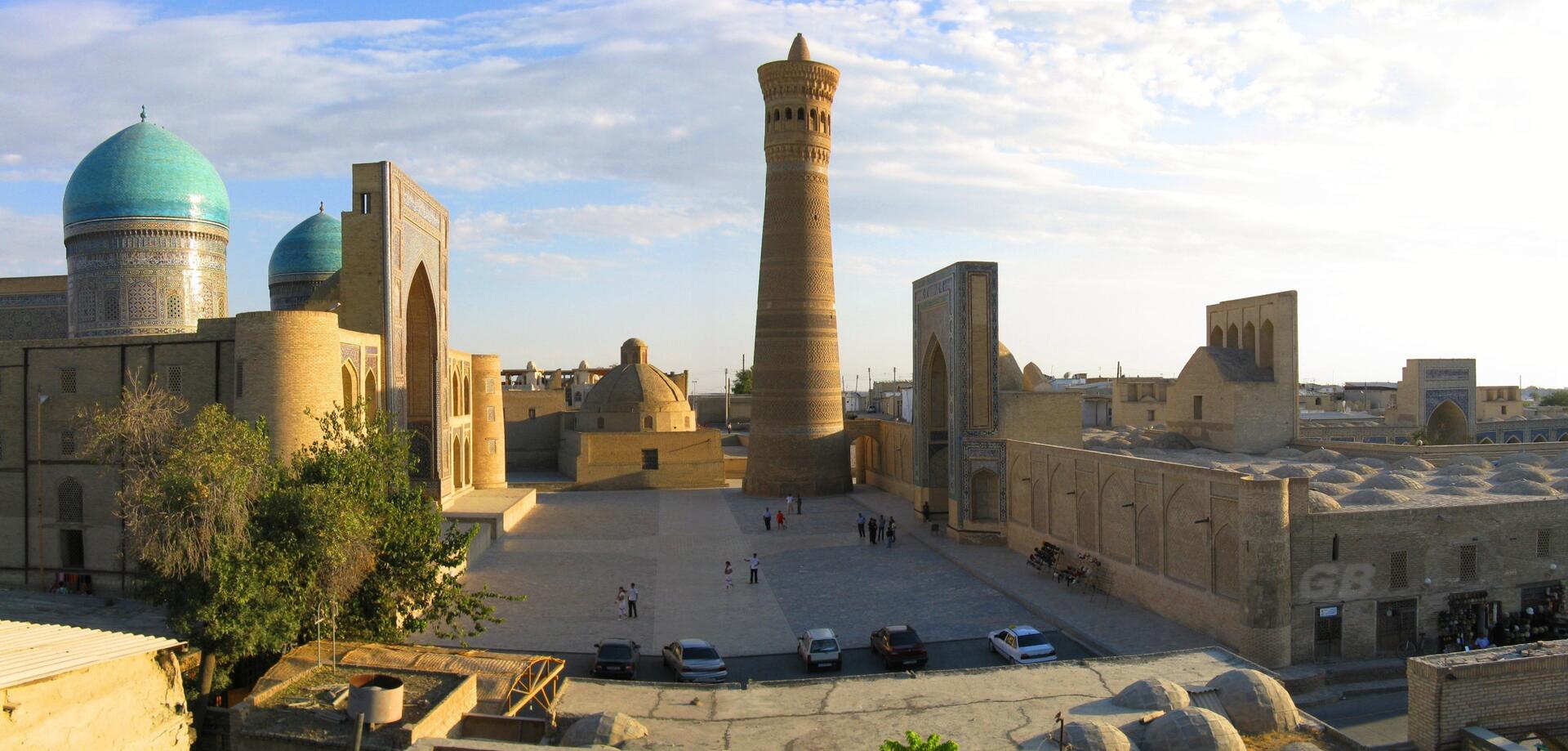
© Euyasik, CC BY-SA 3.0 Resized from original. (This derivative is under the same CC BY-SA license.)

World Heritage Research
Discover scientific research and academic studies that deepen our understanding of Historic Centre of Bukhara from its history and significance to its conservation, management, and contemporary challenges.
-
Ethnotourism In The Bukhara Oasis: Opportunities, Achievements and Problems
Bukhara's ethnotourism potential is highlighted as a key driver for global tourism, leveraging its rich historical and ethnographic heritage. The study reveals that the oasis, centered around the Zarafshan River, offers unique cultural experiences through its multiethnic communities, architecture, and culinary traditions. By analyzing Bukhara's aesthetic preferences and worldview, the research demonstrates how ethnotourism destinations such as Shirin, Sheykhon, Qorgon, and Borontepa actively promote national customs and folk arts. Challenges to ethnotourism growth are also identified, along with recommendations for sustainable development. The study positions Bukhara as an outdoor ethnographic museum, crucial for the expansion of global travel.
Ulugbekovich, B. (2025). Ethnotourism In The Bukhara Oasis: Opportunities, Achievements and Problems. Buletin Antropologi Indonesia, 2(3), 9. https://doi.org/10.47134/bai.v2i3.4364
View Publication Record | Read Publication -
Uzbekistan- A Land of Rich Cultural Heritage
Uzbekistan's rich cultural heritage, shaped by its strategic location along ancient trade routes and its prominence on the Silk Road, is highlighted through its architectural marvels like Samarkand’s Registan Square and Bukhara’s Historic Centre. The study reveals how traditional craftsmanship, music, dance, oral storytelling, and cuisine continue to influence national identity, underscoring their enduring significance in modern times. Modern preservation efforts, including restoration projects, educational programs, and sustainable tourism strategies, are also emphasized as key initiatives ensuring the long-term safeguarding of this legacy. These findings underscore Uzbekistan’s proactive role in maintaining its historical narrative for global appreciation.
Jizzakh branch of the National University of Uzbekistan named after Mirzo Ulugbek The Faculty of Psychology, the department of Foreign languages Philology and teaching languages Teshaboyeva Nafisa Zubaydulla qizi nafisateshaboyeva@gmail.com Student of group 203-24: Rustamova Sarvinoz O'ktamjonovna. (2025). UZBEKISTAN- A LAND OF RICH CULTURAL HERITAGE. Zenodo. https://doi.org/10.5281/ZENODO.17858707
View Publication Record | Read Publication -
A Strategy Using Heritage Documentation for Managing Change of the Historic Centre of Bukhara
A comprehensive strategy for managing change in Bukhara's historic center, recognized as a UNESCO World Heritage Site since 1993, has been developed using heritage documentation. This approach addresses the vulnerability of traditional Bukharian houses, primarily built with earthen materials and privately owned, which are at risk due to ongoing urban transformation. Two major international projects—CAAL funded by Arcadia and WMF's Traditional Bukharian Houses Documentation—collaborate with local institutions to create a digital database of neighborhoods (mahallas) and their traditional houses, documenting heritage attributes. The goal is to produce guidelines for conservation, maintenance, and adaptive reuse, emphasizing heritage regeneration and its role in achieving the UN 2030 Agenda's Sustainable Development Goals (SDGs).
Vileikis, O. (2023). A STRATEGY USING HERITAGE DOCUMENTATION FOR MANAGING CHANGE OF THE HISTORIC CENTRE OF BUKHARA. ISPRS Annals of the Photogrammetry, Remote Sensing and Spatial Information Sciences, X-M-1-2023, 269–276. https://doi.org/10.5194/isprs-annals-x-m-1-2023-269-2023
View Publication Record | Read Publication -
World Heritage Site Tourism and Destination Loyalty along the Silk Road: A Study of U.S. Travelers in Uzbekistan
Tourists visiting the Historic Centre of Bukhara and Western Tien-Shan in Uzbekistan for 7–13 days exhibit significantly higher destination loyalty, particularly those traveling independently to cultural heritage sites. This study, based on an online survey of 419 U.S. travelers, identifies key determinants of loyalty along Silk Road tourism routes, providing empirical evidence that can inform sustainable destination management and contribute to achieving the UN Sustainable Development Goals (SDGs). The research highlights the importance of travel duration, independence in exploration, and specific WHS destinations in fostering long-term visitor commitment.
Juraturgunov, H., Raimkulov, M., Ahn, Y.-j., & Kang, E. M. (2023). World Heritage Site Tourism and Destination Loyalty along the Silk Road: A Study of U.S. Travelers in Uzbekistan. Sustainability, 15(13), 10337. https://doi.org/10.3390/su151310337
View Publication Record | Read Publication