World Heritage Identification Number: 543
World Heritage since: 1990
Category: Cultural Heritage
WHE Type: Historic Cities & Urban Areas
Transboundary Heritage: No
Endangered Heritage: No
Country: 🇺🇿 Uzbekistan
Continent: Asia
UNESCO World Region: Asia and the Pacific
Map
Exploring the Ancient Walls of Itchan Kala: A Journey Through the Heart of Khiva, Uzbekistan
Itchan Kala, meaning 'inner town' in Uzbek, is the heart of the ancient city of Khiva, located in modern-day Uzbekistan. This fortified citadel, enclosed within towering brick walls up to 10 meters high, serves as a testament to the rich history and architectural prowess of Central Asia. In 1990, UNESCO recognized Itchan Kala as a World Heritage Site, acknowledging its significance as a well-preserved example of Islamic architecture in the region.
The origins of Itchan Kala date back more than 2,500 years, when nomadic tribes settled in the Khiva oasis. However, the city as it appears today took shape during the reign of the Khanate of Khiva, which flourished from the 16th to the 20th centuries. The city's strategic location along the Silk Road made it a crucial stopover for traders traveling between China, India, Persia, and Europe.
One of the most striking features of Itchan Kala is its imposing defensive walls. These walls, constructed from mud bricks and gypsum, were designed to protect the city from invaders. They encircle the entire old town, creating a labyrinthine network of narrow streets and courtyards that reveal a wealth of historical and cultural treasures. Within these fortifications lies a collection of over 50 historic monuments and 250 old houses.
Within these walls lies a collection of remarkable buildings, including the Djuma Mosque, one of the oldest and most significant religious sites in the city. Originally founded in the 10th century and largely reconstructed in the late 18th century, this mosque is famous for its flat roof supported by 213 carved wooden columns. Standing over 56 meters, the Islam Khodja Minaret, the tallest minaret in Khiva offers breathtaking panoramic views of the citadel upon climbing its spiral staircase. Its alternating bands of dark green and blue tiles make it the most recognizable landmark in the city.
Itchan Kala is also home to numerous mausoleums, madrasas, and palaces. Among them, the mausoleums of Pahlavan Mahmud and Muhammad Amin Khan stand out. The former houses the remains of Pahlavan Mahmud, a legendary hero known for his extraordinary strength and bravery, while the latter is the final resting place of Muhammad Amin Khan, who ruled Khiva from 1845 to 1855. His reign was cut short in battle, leaving the iconic, turquoise-tiled Kalta Minor Minaret famously unfinished.
Among the palaces, Tash-Khauli (the Stone House), built in the 1830s by Alla-Kulli-Khan, showcases the peak of Khivan decorative art. Its courtyards are adorned with elaborate blue-and-white majolica tiles, intricate wood carvings, and delicate stucco.
Overall, Itchan Kala provides visitors a captivating glimpse into the past and unparalleled insight into the culture, history, and architecture of Central Asia. Its designation as a UNESCO World Heritage Site is well-deserved, ensuring the preservation of this unique and enchanting destination for generations to come.
UNESCO Description of the World Heritage Site
Itchan Kala is the inner town (protected by brick walls some 10 m high) of the old Khiva oasis, which was the last resting-place of caravans before crossing the desert to Iran. Although few very old monuments still remain, it is a coherent and well-preserved example of the Muslim architecture of Central Asia. There are several outstanding structures such as the Djuma Mosque, the mausoleums and the madrasas and the two magnificent palaces built at the beginning of the 19th century by Alla-Kulli-Khan.
UNESCO Justification of the World Heritage Site
Criterion (iii) : Withthe coherent and well preserved urban ensemble of the inner town of Khiva, Itchan Kala bears exceptional testimony to the lost civilizations of Khorezm.
Criterion (iv) : Several monuments of Itchan Kala constitute remarkable and unique types of architectural ensembles, built according to the ancient traditions of Central Asia, which illustrate the development of Islamic architecture between the 14th to the 19th century.
Criterion (v) : The domestic architecture of Khiva, with traditional architectural style, represents an important example of human settlements in Central Asia by virtue of its design and construction.
Encyclopedia Record: Itchan Kala
Itchan Kala is the walled inner town of the city of Khiva, Uzbekistan. Since 1990, it has been protected as a World Heritage Site.Additional Site Details
Area: 37.5 hectares
Number of Components: 1
(iv) — Outstanding example of a type of building or landscape
(v) — Outstanding example of traditional human settlement
Coordinates: 41.378088 , 60.360253
Image
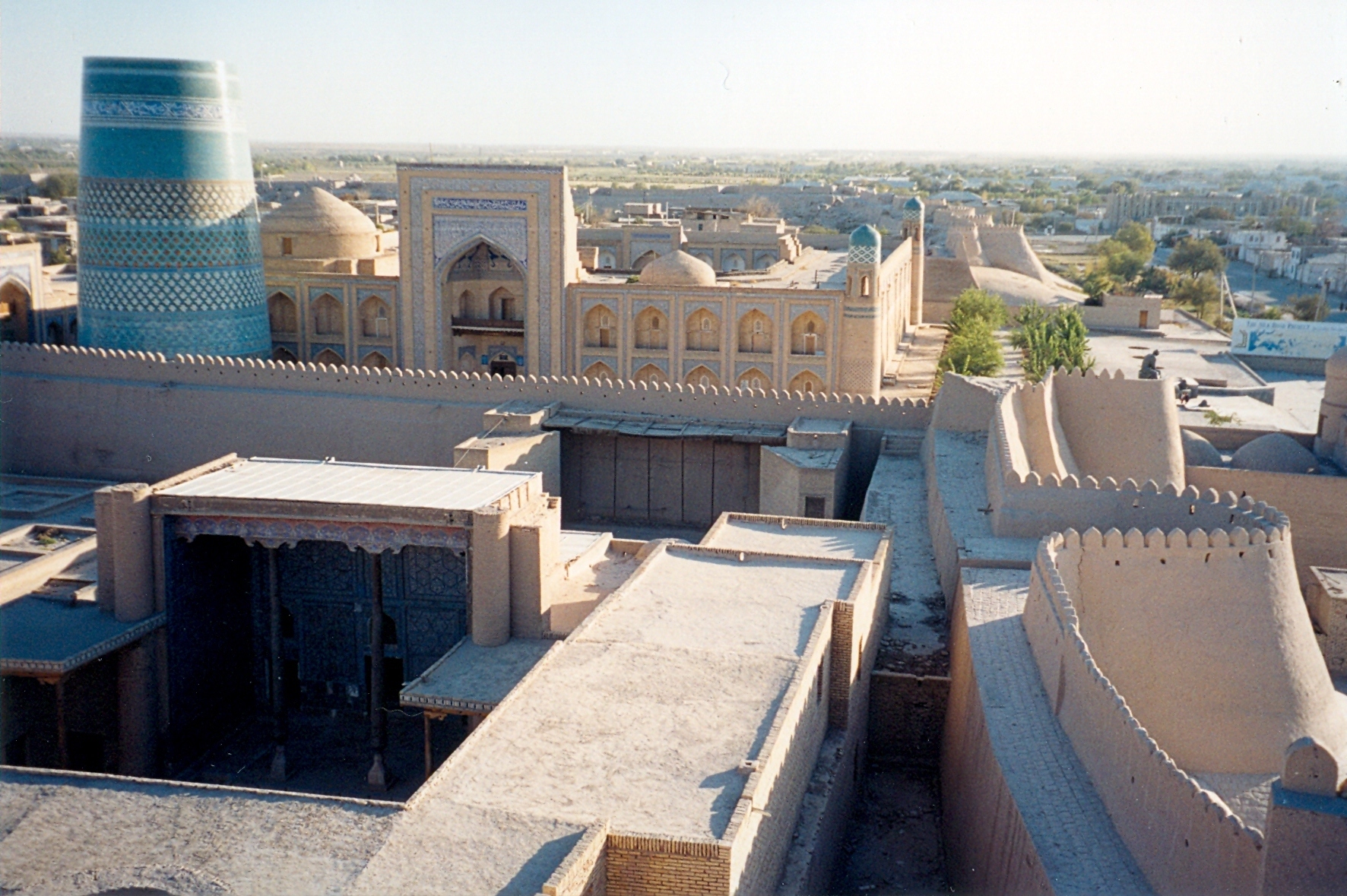
© Doron, CC BY-SA 3.0 Resized from original. (This derivative is under the same CC BY-SA license.)
World Heritage Research
Discover scientific research and academic studies that deepen our understanding of Itchan Kala from its history and significance to its conservation, management, and contemporary challenges.
-
Comparative Analysis of Icherisheher and Itchan Kala: Preservation of the Historic Urban Environment and Tourism Potential
A comparative analysis of Icherisheher (Azerbaijan) and Itchan Kala (Uzbekistan), two UNESCO World Heritage Sites, reveals their significance as rare examples of preserved ancient Eastern urban planning traditions. Both complexes, characterized by fortress walls, palaces, mosques, madrasahs, caravanserais, baths, and residential buildings, serve as Open-Air Museums that safeguard national cultural heritage while fostering international tourism and intercultural communication. Despite architectural differences in style, building materials, layout, and religious/cultural diversity, both sites demonstrate effective preservation practices. The study employed comparative-historical, comparative, descriptive, and content analysis methods to highlight their distinct yet complementary roles in cultural conservation and tourism development.
Gulnar Nazarova. (2026). COMPARATIVE ANALYSIS OF ICHERISHEHER AND ITCHAN KALA: PRESERVATION OF THE HISTORIC URBAN ENVIRONMENT AND TOURISM POTENTIAL. Zenodo. https://doi.org/10.5281/ZENODO.20733223
View Publication Record | Read Publication -
Termite Control Strategies in Khiva and Khorezm: Traditional Practices vs. Modern Approaches
Research in Khiva and Khorezm reveals that traditional termite control strategies, rooted in vernacular architecture, have effectively reduced infestation risks for centuries. Historic buildings like those in Itchan Kala utilize baked bricks, treated timber, and moisture-control techniques, which inherently deter termites without relying on explicit ancient termiticides. Modern Uzbek research has built upon this local knowledge by developing 'toxic bait' capsules using poplar sawdust and locally-sourced cellulose feed, as well as biologic traps derived from over 40 native plants, both showing promising results in field tests. This study bridges traditional practices with modern approaches, offering sustainable solutions for heritage conservation while leveraging indigenous materials.
Zafar, M. S., & Abdullaev, I. I. (2025). TERMITE CONTROL STRATEGIES IN KHIVA AND KHOREZM: TRADITIONAL PRACTICES VS. MODERN APPROACHES. Zenodo. https://doi.org/10.5281/ZENODO.17588151
View Publication Record | Read Publication -
The Historical Monuments, Ancient Places, Great Figures and Museums of the Country
Uzbekistan stands as a cultural treasure trove, particularly along the Great Silk Road, with its historical monuments and ancient sites reflecting a profound legacy. Key landmarks include Registan Square in Samarkand, the Ark Fortress in Bukhara, and Itchan Kala's inner city in Khiva, while Termez showcases Buddhist temples and Khorezm fortresses. The country's contributions to scholarship are equally significant, with figures like Amir Timur (Tamerlane), Ulugh Beg, Al-Khwarizmi, Ibn Sina (Avicenna), Al-Biruni, and poet Alisher Navoi shaping its intellectual history. Notable museums, such as the Amir Timur Museum in Tashkent, the Savitsky Art Museum in Nukus, and the State Museum of History, further enrich this heritage. This legacy positions Uzbekistan as a pivotal node in global cultural exchange.
Teshaboyeva, N., & Quvvatova, S. (2025). THE HISTORICAL MONUMENTS, ANCIENT PLACES, GREAT FIGURES AND MUSEUMS OF THE COUNTRY. Zenodo. https://doi.org/10.5281/ZENODO.17920677
View Publication Record | Read Publication -
Human-Centric Planning of Traditional Islamic Settlements: A Space Syntax Study of Itchan Kala, Khiva
Itchan Kala, a UNESCO World Heritage Site in Uzbekistan, exemplifies the enduring effectiveness of Islamic urban planning principles. The study reveals that its spatial organization harmoniously balances communal interaction and seclusion through a compact yet hierarchically layered structure. Key findings include a highly integrated main market street anchored by the Juma Masjid, promoting commerce and worship, while residential quarters offer low visibility and high controllability for privacy. Madrasas, now museums, serve as transitional zones between public and private realms. The research employed axial and visibility graph analysis (VGA) at global and local scales to assess visibility, integration, and controllability, demonstrating the city's resilience across generations and socio-political transitions. Itchan Kala serves as a timeless model for human-centered, sustainable urban development.
Asif, N., Yusof, Z. B., Azmin, A. K., Abdullah, F., & Sanusi, A. N. Z. (2025). HUMAN-CENTRIC PLANNING OF TRADITIONAL ISLAMIC SETTLEMENTS: A SPACE SYNTAX STUDY OF ITCHAN KALA, KHIVA. Planning Malaysia, 23. https://doi.org/10.21837/pm.v23i39.1951
View Publication Record | Read Publication -
The colonialism of the Modern Movement and the
post‐USSR reaction in Central AsiaThis study reveals how modernist architectural language, originally rooted in socialist ideals, was repurposed as a tool of colonial control in Central Asia. It demonstrates that the Soviet Union's nomination of Itchan Kala as an 'open-air city museum' for UNESCO World Heritage status in 1990 reflected a broader strategy to displace local identities tied to empire and religion, while simultaneously preserving a sanitized version of history. Post-Soviet reactions in Central Asia, particularly in Uzbekistan, have shifted toward reclaiming narratives through the inscription of properties like Shakhrisyabz, Bukhara, and Samarkand, emphasizing social, cultural, and economic processes over mere architectural monuments. The research combines political science and historical analysis to explore how urban fabric and language were manipulated to serve colonial agendas, while also examining the challenges and opportunities in postcolonial conservation efforts.
Turner, M., & Gak‐Vassallo, D. (2024). The colonialism of the Modern Movement and the
View Publication Record | Read Publicationpost‐USSR reaction in Central Asia. Curator: The Museum Journal, 67(1), 183–193. Portico. https://doi.org/10.1111/cura.12605 -
3D scanning and modeling of highly detailed and geometrically complex historical architectural objects: the example of the Juma Mosque in Khiva (Uzbekistan)
A groundbreaking 3D laser scanning and modeling of the Juma Mosque in Khiva, Uzbekistan—a UNESCO-listed site—reveals unprecedented insights into its intricate architecture. This study marks a first-of-its-kind high-resolution digital reconstruction of the mosque's interior, featuring 213 intricately carved wooden columns supporting its roof. The research highlights technical challenges and solutions for scanning such complex structures in active tourist settings, including optimizing scan positions and processing vast datasets. The resulting 3D model not only aids in studying the mosque's geometry and historical appearance but also serves as a tool for digital preservation and public engagement. This innovative approach sets a new benchmark for documenting highly detailed heritage sites.
Milosz, M., Kęsik, J., & Abdullaev, U. (2024). 3D scanning and modeling of highly detailed and geometrically complex historical architectural objects: the example of the Juma Mosque in Khiva (Uzbekistan). Heritage Science, 12(1). https://doi.org/10.1186/s40494-024-01207-3
View Publication Record | Read Publication -
Laser Scanning and Ambient Vibration Study of Juma Mosque in Khiva (Uzbekistan) with Subsequent Finite Element Modeling of Its Minaret
A collaborative research effort has successfully generated a highly accurate digital twin of the Juma Mosque's minaret in Itchan Kala, Uzbekistan, with millimeter-level precision. This achievement was accomplished through advanced laser scanning and ambient vibration studies, which captured the structural dynamics of the historic monument. The digital twin's physical properties and structural response were closely correlated to the actual minaret, validated by sophisticated finite element modeling. This innovative approach enables precise structural health monitoring, numerical predictions of performance, and the development of targeted restoration strategies for UNESCO World Heritage Sites.
Takhirov, S., Rakhmonov, B., Nafasov, R., Samandarov, A., & Sultanova, S. (2023). Laser Scanning and Ambient Vibration Study of Juma Mosque in Khiva (Uzbekistan) with Subsequent Finite Element Modeling of Its Minaret. Remote Sensing, 15(6), 1632. https://doi.org/10.3390/rs15061632
View Publication Record | Read Publication