World Heritage Identification Number: 776
World Heritage since: 1996
Category: Cultural Heritage
WHE Type: Religious Sites & Sacred Architecture
Transboundary Heritage: No
Endangered Heritage: No
Country: 🇯🇵 Japan
Continent: Asia
UNESCO World Region: Asia and the Pacific
Map
Itsukushima Shinto Shrine: A Floating Testament to Japanese Scenic Beauty
The Itsukushima Shinto Shrine, nestled on the picturesque island of Itsukushima within the Seto Inland Sea, stands as a testament to the rich history and cultural significance of Shintoism in Japan. This sacred site, inscribed as a UNESCO World Heritage Site in 1996, offers a unique blend of natural beauty and architectural mastery that encapsulates the essence of the Japanese concept of scenic beauty, or wabi-sabi.
More to come…UNESCO Description of the World Heritage Site
The island of Itsukushima, in the Seto inland sea, has been a holy place of Shintoism since the earliest times. The first shrine buildings here were probably erected in the 6th century. The present shrine dates from the 12th century and the harmoniously arranged buildings reveal great artistic and technical skill. The shrine plays on the contrasts in colour and form between mountains and sea and illustrates the Japanese concept of scenic beauty, which combines nature and human creativity.
UNESCO Justification of the World Heritage Site
Criterion (i): The configuration of the shrine buildings of ltsukushima-jinja presents an excellent architectural scene on the lines of the aristocratic residential style of this period. It is an outstanding work combining manmade and natural elements. The buildings exhibit great artistic and technical merit and are sited on the sea with a backdrop of impressive mountains.
Criterion (ii): The shrine buildings of Itsukushima-jinja are in the general tradition of Shinto shrine architecture in Japan and provide invaluable information for the understanding of the evolving spiritual culture of the Japanese people, namely the Japanese concept of scenic beauty. The most important aspect of Itsukushima-jinja is the setting of the shrine buildings as the central part of a trinity with the sea in the foreground and mountains in the background, recognized as a standard of beauty against which other examples of scenic beauty have come to be understood.
Criterion (iv): The buildings of Itsukushima-jinja, which through scrupulously accurate reconstructions have preserved styles from the late 12th and early 13th centuries, are outstanding examples of the ancient type of shrine architecture integrated with the surrounding landscape, the physical manifestation of humankind’s worship of nature.
Criterion (vi): Japanese spiritual life is deeply rooted in ancient shintoism which is centred on polytheistic nature worship. ltsukushima-jinja provides important clues understanding this aspect of Japanese religious expression.
Encyclopedia Record: Itsukushima Shrine
Itsukushima Shrine is a Shinto shrine on the island of Itsukushima, best known for its "floating" torii. It is in the city of Hatsukaichi, in Hiroshima Prefecture in Japan, accessible from the mainland by ferry at Miyajimaguchi Station. The shrine complex is listed as a UNESCO World Heritage Site, and the Japanese government has designated several buildings and possessions as National Treasures.Additional Site Details
Area: 431.2 hectares
Number of Components: 1
(ii) — Significant interchange of human values
(iv) — Outstanding example of a type of building or landscape
(vi) — Directly associated with events or living traditions
Coordinates: 34.29441667 , 132.3246389
Image
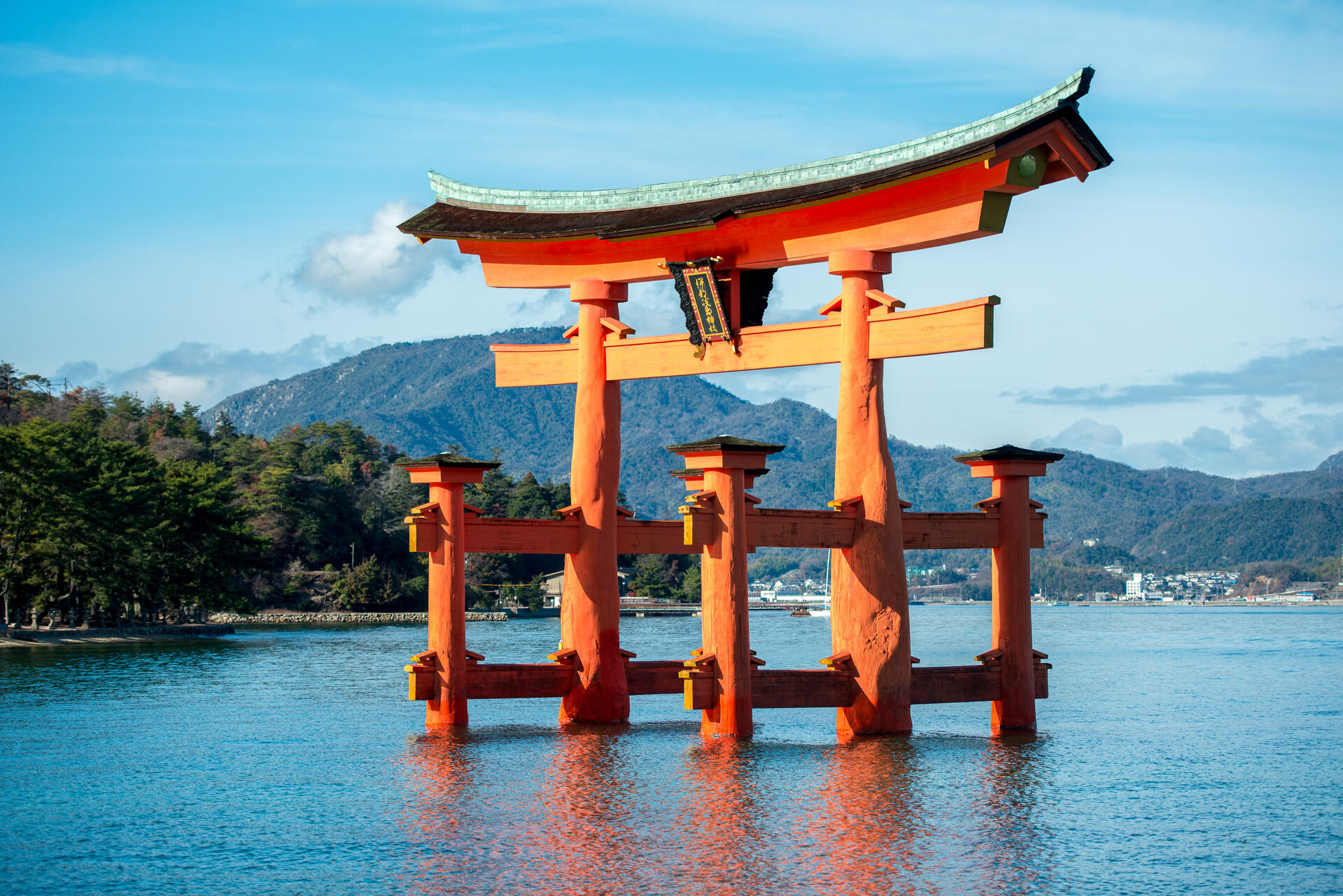
© JordyMeow, CC BY-SA 3.0 Resized from original. (This derivative is under the same CC BY-SA license.)
World Heritage Research
Discover scientific research and academic studies that deepen our understanding of Itsukushima Shinto Shrine from its history and significance to its conservation, management, and contemporary challenges.
-
Managing “Buffer”
Itsukushima Shinto Shrine, a UNESCO World Heritage Site since 1996, faces increasing threats from urban encroachment and natural disasters due to global warming. Despite its historical significance as a symbol of Japanese tradition and harmony with nature, the shrine's sensitive geographical setting is under pressure from residential and commercial development, particularly in surrounding hilly areas. The study highlights the need for integrated management strategies that balance tourism growth, cultural preservation, and environmental sustainability. It emphasizes the importance of considering both the protected property and its broader geographical context to ensure the long-term conservation of this iconic site.
Utaka, Y. (2015). Managing “Buffer”. International Review for Spatial Planning and Sustainable Development, 3(2), 79–95. https://doi.org/10.14246/irspsd.3.2_79
View Publication Record | Read Publication