World Heritage Identification Number: 603
World Heritage since: 2001
Category: Cultural Heritage
WHE Type: Historic Cities & Urban Areas
Transboundary Heritage: No
Endangered Heritage: No
Country: 🇺🇿 Uzbekistan
Continent: Asia
UNESCO World Region: Asia and the Pacific
Map
Samarkand: A Historical and Cultural Melting Pot
Samarkand, located in southeastern Uzbekistan, stands as one of the oldest continually inhabited cities in Central Asia. Known as the 'Crossroad of Cultures,' this ancient city has been a center of trade, religion, and learning for over two millennia. Inscribed as a UNESCO World Heritage Site in 2001, Samarkand boasts a rich history dating back to the 7th century BC, with its most significant development occurring during the Timurid period from the 14th to the 15th centuries.
More to come…UNESCO Description of the World Heritage Site
The historic town of Samarkand is a crossroad and melting pot of the world's cultures. Founded in the 7th century B.C. as ancient Afrasiab, Samarkand had its most significant development in the Timurid period from the 14th to the 15th centuries. The major monuments include the Registan Mosque and madrasas, Bibi-Khanum Mosque, the Shakhi-Zinda compound and the Gur-Emir ensemble, as well as Ulugh-Beg's Observatory.
UNESCO Justification of the World Heritage Site
Criterion (i): The architecture and townscape of Samarkand, situated at the crossroads of ancient cultures, are masterpieces of Islamic cultural creativity.
Criterion (ii): Ensembles in Samarkand such as the Bibi Khanum Mosque and Registan Square played a seminal role in the development of Islamic architecture over the entire region, from the Mediterranean to the Indian subcontinent.
Criterion (iv): The historic town of Samarkand illustrates in its art, architecture, and urban structure the most important stages of Central Asian cultural and political history from the 13th century to the present day.
Encyclopedia Record: Samarkand
Samarkand is a city in southeastern Uzbekistan and among the oldest continuously inhabited cities in Central Asia. Samarkand is the capital of the Samarkand Region and a district-level city, that includes the urban-type settlements Kimyogarlar, Farhod and Khishrav. With 551,700 inhabitants (2021), it is the third-largest city in Uzbekistan.Additional Site Details
Area: 1,123 hectares
Number of Components: 5
(ii) — Significant interchange of human values
(iv) — Outstanding example of a type of building or landscape
Coordinates: 39.66861 , 67
Image
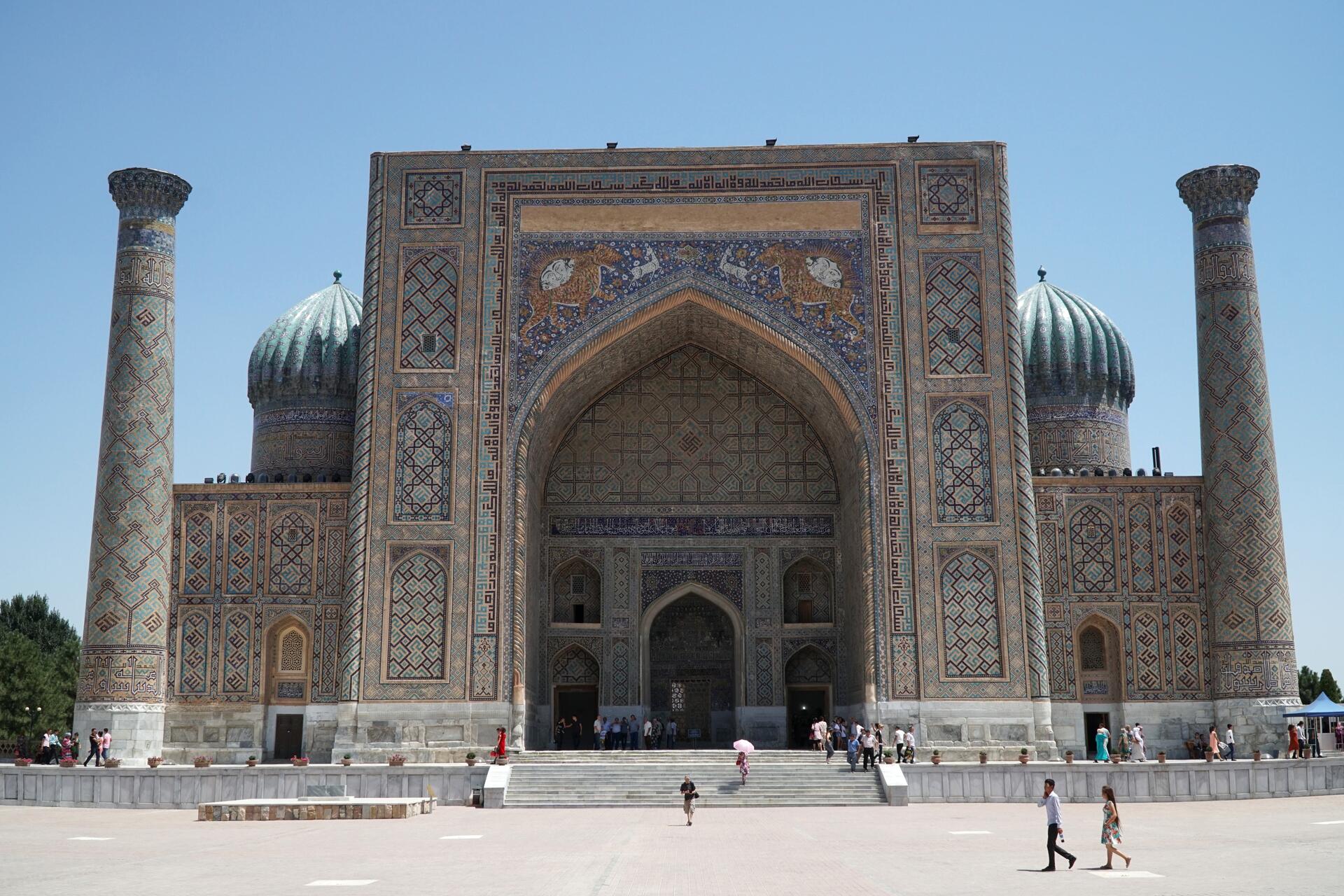
© Adam Harangozó, CC BY-SA 4.0 Resized from original. (This derivative is under the same CC BY-SA license.)
World Heritage Research
Discover scientific research and academic studies that deepen our understanding of Samarkand – Crossroad of Cultures from its history and significance to its conservation, management, and contemporary challenges.
-
Proximity to the Prophet Muhammad in Fifteenth-Century Samarkand
Fifteenth-century Samarkand saw the emergence of a nuanced understanding of 'sayyid' and 'sharif' status, where genealogical claims of descent from or proximity to the Prophet Muhammad were strategically used to legitimize sacred figures. This study compares two texts—an anonymous shrine visitation guide (Qandiyya-yi Khurd) and a scholarly work (Muhammad Parsa's Fasl al-Khitab)—to reveal how such claims expanded beyond traditional Sufi lineages, reflecting broader religious and political dynamics of the late medieval period. The research demonstrates that popular and scholarly narratives converged to validate the sacred status of two early Islamic-era saints, Qutham ibn ‘Abbas and ‘Abdi Darun, offering new insights into the cultural and political landscape of Samarkand during this era.
Salikuddin, R. (2026). Proximity to the Prophet Muhammad in Fifteenth-Century Samarkand. Comparative Studies of South Asia, Africa and the Middle East, 46(1), 165–178. https://doi.org/10.1215/1089201x-12354713
View Publication Record | Read Publication -
Microplastic pollution of the Zrafshan river tributary in Samarkand and Navoi regions of the Republic of Uzbekistan
A recent study reveals significant microplastic pollution in the Zarafshan River, flowing through Samarkand and Navoi regions of Uzbekistan. The research found concentrations of 3.22±1.64 and 2.96±0.78 microplastic particles per cubic meter in the Navoi and Samarkand regions, respectively, with particle sizes ranging from 0.15 to 3.00 mm. This pollution is attributed to environmental factors but poses a serious threat due to its potential to accumulate toxic substances, which could disrupt aquatic ecosystems. The study employed advanced techniques such as hydrogen peroxide oxidation for organic matter removal, density separation, and Raman spectroscopy for polymer identification. However, the limited data on microplastic pollution in Central Asia hinders comprehensive risk assessment and mitigation strategy development. Regular monitoring and targeted measures are urgently needed to address this growing environmental concern.
Khusanov, A., Sabirov, O., Frank, Y., Vorobev, D., Vorobev, E., Rakhmatullina, S., Tashbaev, S., Mamatkarimova, S., Yakhyoyev, A., Juraev, M., Isakov, I., Karimjonov, D., Zokirov, I., & Abdullaev, I. (2025). Microplastic pollution of the Zrafshan river tributary in Samarkand and Navoi regions of the Republic of Uzbekistan. Green Analytical Chemistry, 12, 100200. https://doi.org/10.1016/j.greeac.2024.100200
View Publication Record | Read Publication -
Representation of the Samarkand text in the linguocognitive aspect
The toponym 'Samarkand' functions as a special type of linguistic organization of knowledge, encapsulating universal human understanding of the city's cultural significance. Through analysis of poetic material using continuous sampling and cognitive matrix methods, researchers identified conceptual thematic areas that structure meanings associated with Samarkand. These areas reveal how the toponym reflects broader cognitive contexts, providing insight into how language organizes information about reality. The study highlights Samarkand's role as a crossroad of cultures, demonstrating its linguistic representation of historical and cultural phenomena.
Lipatova, Y. V. (2024). Representation of the Samarkand text in the linguocognitive aspect. Neophilology, 10(1), 67–75. https://doi.org/10.20310/2587-6953-2024-10-1-67-75
View Publication Record | Read Publication -
AI and Big Data Analytics in Uzbekistan’s Tourism: Enhancing Operational Efficiency and Visitor Satisfaction – A Case Study of Samarkand
AI and big data analytics significantly enhance operational efficiency and visitor satisfaction in Samarkand's tourism sector, particularly benefiting younger and international tourists. The study, conducted through qualitative case analysis involving interviews, surveys, and observations with tourism operators, technology experts, and visitors, demonstrates substantial improvements in booking systems, guest services, and personalized offerings. These findings underscore the transformative potential of digital technologies in modernizing Uzbekistan's tourism industry while preserving its cultural heritage. Continued investment in digital infrastructure is emphasized to sustain these advancements.
Ibrokhimov, N., & Khusanovich, I. S. (2024). AI and Big Data Analytics in Uzbekistan’s Tourism: Enhancing Operational Efficiency and Visitor Satisfaction – A Case Study of Samarkand. Academic Journal of Digital Economics and Stability, 37(4), 58–66. https://doi.org/10.51699/economics.v37i4.132
View Publication Record | Read Publication -
Assessment of the Potential of Agrotourism in Samarkand to Attract Foreign Tourists
Agrotourism in Samarkand, despite its rich agricultural heritage and cultural significance, remains underdeveloped but holds substantial potential to diversify tourism and boost rural economies. A mixed-methods study—combining statistical analysis, surveys of foreign tourists and local residents, and expert interviews—revealed key preferences and challenges that hinder growth. Strategic recommendations are proposed to enhance agrotourism offerings, aiming for sustainable economic development in the region.
Allayorovich, A. N. (2024). Assessment of the Potential of Agrotourism in Samarkand to Attract Foreign Tourists. American Journal of Economics and Business Management, 7(10), 904–913. https://doi.org/10.31150/ajebm.v7i10.3003
View Publication Record | Read Publication -
Hephyronyms in the structure of the Samarkand text
Research reveals that gephyronyms—proper names of bridges—serve as meaningful units within the urban text of Samarkand, encoding extralinguistic and cultural knowledge. These toponyms-texts form an intertextual network, reflecting properties of the city's spatial and cultural landscape while maintaining coherence through components like address, historical, and national-cultural significance. The study employs semiotic and semantic analysis alongside interpretation methods to dissect Samarkand's gephyronyms, demonstrating their role in constructing a readable urban narrative. This approach highlights how toponyms function iconically, embedding onomastic information into the broader city-text.
Lipatova, Ye. V. (2024). Hephyronyms in the structure of the Samarkand text. Neophilology, 10(4), 871–878. https://doi.org/10.20310/2587-6953-2024-10-4-871-878
View Publication Record | Read Publication -
Developing the Samarkand Region Urbanization, Infrastructure, and Modernization
Samarkand, a UNESCO World Heritage Site and historic Silk Road city, faces growing urban challenges due to tourism and population growth. A new study proposes a comprehensive development model inspired by Sejong City, focusing on advanced planning, sustainability, and smart technologies. Key findings emphasize the need for improved public transport, road maintenance, water supply, affordable housing, and strategic urban expansion while preserving historical landmarks like the Registan and Gur-e-Amir. This integrated approach aims to enhance Samarkand’s urban functionality and appeal, balancing modern needs with historical preservation.
Norimov, I. (2024). DEVELOPING THE SAMARKAND REGION URBANIZATION, INFRASTRUCTURE, AND MODERNIZATION. International Journal of Economic Integration and Regional Competitiveness, 1(7), 15–19. https://doi.org/10.61796/ijeirc.v1i7.160
View Publication Record | Read Publication