World Heritage Identification Number: 1028
World Heritage since: 2001
Category: Cultural Heritage
WHE Type: Historic Cities & Urban Areas
Transboundary Heritage: No
Endangered Heritage: No
Country: 🇬🇧 United Kingdom of Great Britain and Northern Ireland
Continent: Europe
UNESCO World Region: Europe and North America
Map
Saltaire: A Victorian Model Village and UNESCO World Heritage Site
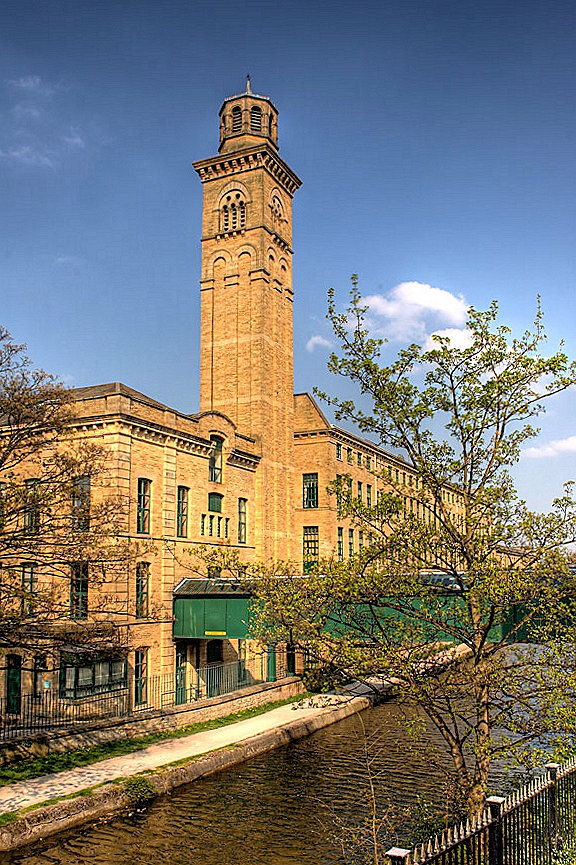
Saltaire, located near Shipley in West Yorkshire, England, is a remarkable example of a Victorian model village that has been preserved since its construction in the mid-19th century. This unique settlement, which serves as a testament to the philanthropic spirit of its founder, Titus Salt, was designated as a UNESCO World Heritage Site in 2001.
More to come…UNESCO Description of the World Heritage Site
Saltaire, West Yorkshire, is a complete and well-preserved industrial village of the second half of the 19th century. Its textile mills, public buildings and workers' housing are built in a harmonious style of high architectural standards and the urban plan survives intact, giving a vivid impression of Victorian philanthropic paternalism.
UNESCO Justification of the World Heritage Site
Criterion (ii): Saltaire is an outstanding and well preserved example of a mid 19th century industrial town, the concept of which was to exert a major influence on the development of the garden city movement.
Criterion (iv): The layout and architecture of Saltaire admirably reflect mid 19th century philanthropic paternalism, as well as the important role played by the textile industry in economic and social development.
Encyclopedia Record: Saltaire
Saltaire is a Victorian model village near Shipley, West Yorkshire, England, situated between the River Aire, the railway, and the Leeds and Liverpool Canal. Salts Mill and the houses were built by Titus Salt between 1851 and 1871 to allow his workers to live in better conditions than the slums of Bradford. The mill ceased production in 1986, and was converted into a multifunctional location with an art gallery, restaurants, and the headquarters of a technology company. It is a UNESCO World Heritage Site and on the European Route of Industrial Heritage.Additional Site Details
Area: 20 hectares
Number of Components: 1
(iv) — Outstanding example of a type of building or landscape
Coordinates: 53.83916667 , -1.788333333
World Heritage Research
Discover scientific research and academic studies that deepen our understanding of Saltaire from its history and significance to its conservation, management, and contemporary challenges.
-
The Sociology of New Communities
A core insight from this study is that the creation of new communities, such as Saltaire, reflects a pervasive societal belief in the virtue of small-scale living over large-scale or mass society. This belief has persisted across centuries, from 19th-century social reformers advocating urban improvements to contemporary 'communitarians' seeking simplicity and local community involvement. The research identifies two key traditions: one focused on urban reform through policy (e.g., garden cities) and another on more fundamental social reconstruction, often led by middle-class intellectuals with utopian ideals or pragmatic approaches like those seen in Saltaire. Modern advocacy for 'small communities' merges these traditions, emphasizing social planning over physical or economic planning to foster citizen participation. However, this philosophy is not universally accepted, highlighting the existence of alternative values regarding community design.
Thorns, D. C. (2026). The Sociology of New Communities. The Quest for Community, 136–149. https://doi.org/10.4324/9781003755418-7
View Publication Record | Read Publication -
Place, Identity and Wellbeing: Bradford and Beyond
Research demonstrates that digital heritage tools, combined with arts-based methods, significantly enhance community wellbeing, resilience, and identity formation. The study highlights how 3D reconstructions of heritage sites, such as those developed through the Fragmented Heritage project, facilitate the preservation and reinterpretation of intangible cultural heritage, particularly in post-disaster or conflict scenarios. Creative workshops, including those involving school learners, reveal deepened connections to place, routes, and narratives, with applications extending globally—such as in Tanzania's Bagamoyo Festival and Jordan's BReaTHe festivals. Additionally, the integration of funerary archaeology with creative methods normalizes discussions around death and loss, fostering resilience across diverse audiences, from health professionals to young people. These approaches collectively enrich social cohesion and wellbeing by valuing origins and intangible heritage, offering scalable models for heritage-led community development.
Croucher, K., Bates, C. R., Booker, O., Evans, A., Gaffney, C., Ichumbaki, E., Jennings, B., Moore, J., Ogden, J., Ritchings, J., Simpson, S., Sparrow, T., Snaylam, S., Sutton-Butler, A., Walker, A., & Wilson, A. S. (2026). Place, Identity and Wellbeing: Bradford and Beyond. Internet Archaeology, (73). https://doi.org/10.11141/ia.73.4
View Publication Record | Read Publication -
Digital Twins at the City and Town Scale: Europe and Beyond
A scalable digital twin approach, integrating mobile mapping and high-resolution 3D modeling, has successfully created seamless, data-rich representations of urban heritage at risk, including UNESCO World Heritage Sites like Saltaire. This methodology, pioneered by the Visualising Heritage team at the University of Bradford, enables proactive preservation efforts by anticipating heritage loss and supporting local authority decision-making. The 'Virtual Bradford' digital twin exemplifies this approach, offering an open-data Level-of-Detail 3 (LoD3) model that encompasses conservation areas and landmark buildings, including those designed by architects Lockwood & Mawson. The research also extends to global applications, such as the colonial city of Bagamoyo in Tanzania, addressing challenges faced by developing countries through UKRI's Global Challenges Research Fund (GCRF). This work bridges planning, regeneration, and public engagement, fostering topophilia while embedding heritage conservation at its core.
Gaffney, C., Croucher, K., Bates, C. R., Booker, O., Dunn, R., Evans, A., Ichumbaki, E. B., Moore, J., Ogden, J., Ritchings, J., et al. (2025). Digital Twins at the City and Town Scale: Europe and Beyond. Internet Archaeology, (70). https://doi.org/10.11141/ia.70.5
View Publication Record | Read Publication -
Optimising 3D point cloud semantic segmentation: ML and manual refinement in the UNESCO Saltaire Village
Researchers have demonstrated that combining machine learning (ML) algorithms with manual refinement significantly improves the semantic segmentation of 3D point clouds, particularly for mid-19th-century industrial housing architecture. This approach, tested at the UNESCO World Heritage Site Saltaire Village, addresses challenges posed by contemporary human activity altering the original fabric and spatial composition. The study compares standalone ML and multilayer ML classification methods, providing evidence of difficulties in transitioning from traditional human-led models to HBIM (History Building Information Modeling) in densely altered heritage environments. The findings lay the groundwork for a semi-automated AI-backed scan-to-BIM approach, offering deeper insights into 19th-century architecture and supporting sustainable heritage preservation.
Cotella, V. A., Neagu, C. D., Bavani, S. A., Trichard, M., Horcholle, F., Sangoï, R., Lacalle, C., Jeanvoine, A., Sparrow, T., & Wilson, A. S. (2025). Optimising 3D point cloud semantic segmentation: ML and manual refinement in the UNESCO Saltaire Village. Building Research & Information, 53(7), 846–870. https://doi.org/10.1080/09613218.2025.2521751
View Publication Record | Read Publication -
Entrepreneurial Philanthropy at Cromford, Quarry Bank, and Saltaire Mills during the Industrial Revolution
Entrepreneurial philanthropy during the Industrial Revolution at Cromford, Quarry Bank, and Saltaire Mills was shaped by market competition and wealth creation, with site-specific factors influencing its extent and nature. This study introduces 'philanthropic space' to analyze how these communities addressed working-class discontent while balancing discipline and self-improvement opportunities, particularly through education. It reveals that active welfare provision was contingent on profitable enterprise, offering a nuanced perspective on the interplay between capital and social welfare during this transformative period.
Yates, D. (2024). Entrepreneurial Philanthropy at Cromford, Quarry Bank, and Saltaire Mills during the Industrial Revolution. The Historical Journal, 67(3), 463–492. https://doi.org/10.1017/s0018246x24000141
View Publication Record | Read Publication -
Blick zurück oder nach vorn? Städtebauliche Vorbilder, Visionen und Konzepte des frühen 20. Jahrhunderts
Early 20th-century urban planning in Saltaire, England, exemplifies the intersection of social reform and innovative infrastructure solutions. The study reveals how industrialist Titus Salt's vision for Saltaire addressed critical housing and infrastructural challenges faced by rapidly growing industrial cities. By integrating pre-designed worker housing with gardens, modern amenities, and efficient traffic management, Saltaire set a precedent that influenced urban development across Europe well into the mid-20th century. The research approach analyzes historical records, architectural plans, and social dynamics to dissect how visionary concepts translated into tangible urban solutions, highlighting the tension between idealism and practical implementation in early modern city planning.
Stephan, R. (2024). Blick zurück oder nach vorn? Städtebauliche Vorbilder, Visionen und Konzepte des frühen 20. Jahrhunderts. Stadtträume - Traumstädte, 191–202. https://doi.org/10.13109/9783666315480.191
View Publication Record | Read Publication -
Assessing Industrial Heritage Through Collaborative Counter-Mapping: A Case Study of Salts Mill, UK
A groundbreaking approach to industrial heritage revitalization through arts-led regeneration has been demonstrated at Salts Mill, UK. This study reveals that integrating community perspectives and intangible cultural elements into the conservation process can significantly enhance long-term sustainability and foster resilient local development. Unlike traditional preservation methods, which focus solely on physical structures, this research employs collaborative counter-mapping to capture embodied experiences, local essence, and everyday life interactions facilitated by arts-led initiatives. The findings underscore the importance of prioritizing community engagement over mere building or collection conservation in post-industrial settings, offering a pioneering framework for future heritage management strategies.
Jin, W., & Jin, J. (2024). Assessing Industrial Heritage Through Collaborative Counter-Mapping: A Case Study of Salts Mill, UK. Urban Planning, 9. https://doi.org/10.17645/up.7976
View Publication Record | Read Publication