World Heritage Identification Number: 1594
World Heritage since: 2019
Category: Cultural Heritage
WHE Type: Infrastructure & Industry
Transboundary Heritage: No
Endangered Heritage: No
Country: 🇬🇧 United Kingdom of Great Britain and Northern Ireland
Continent: Europe
UNESCO World Region: Europe and North America
Map
Jodrell Bank Observatory: A Pioneering Hub of Radio Astronomy
The Jodrell Bank Observatory, located in a tranquil rural setting in Cheshire, England, stands as a testament to human curiosity and ingenuity in the pursuit of understanding the cosmos. Inscribed as a UNESCO World Heritage Site in 2019, this remarkable observatory represents a significant milestone in the history of radio astronomy, bridging the gap between traditional optical astronomy and the modern era of radio observations.
More to come…UNESCO Description of the World Heritage Site
Located in a rural area of northwest England, free from radio interference, Jodrell Bank is one of the world's leading radio astronomy observatories. At the beginning of its use, in 1945, the property housed research on cosmic rays detected by radar echoes. This observatory, which is still in operation, includes several radio telescopes and working buildings, including engineering sheds and the Control Building. Jodrell Bank has had substantial scientific impact in fields such as the study of meteors and the moon, the discovery of quasars, quantum optics, and the tracking of spacecraft. This exceptional technological ensemble illustrates the transition from traditional optical astronomy to radio astronomy (1940s to 1960s), which led to radical changes in the understanding of the universe.
UNESCO Justification of the World Heritage Site
Criterion (i): Jodrell Bank Observatory is a masterpiece of human creative genius related to its scientific and technical achievements. The adaptation and development of radar and radio frequency reflectivity to develop radically new equipment, such as the Transit Telescope and Lovell Telescope, were a key part in the development of entirely new fields of scientific research and led to a dramatic change in the understanding of the Universe. The Observatory was important in the pioneering phase and later evolution of radio astronomy.
Criterion (ii): Jodrell Bank Observatory represents an important interchange of human values over a span of time and on a global scale on developments in technology related to radio astronomy. The scientific work at Jodrell Bank was at the heart of a global collaborative network. In particular, several important technological developments such as very large paraboloidal dish telescopes and interferometer were developed at the Observatory, and were later influential in scientific endeavours in many parts of the world.
Criterion (iv): Jodrell Bank Observatory represents an outstanding example of a technological ensemble which illustrates a significant stage in human history (1940s-1960s) – the transition from optical astronomy to radio astronomy and the associated consequence for the understanding of the Universe through multi-wavelength astrophysics. The property is also associated with the peacetime development of ‘Big Science’ as a major change in the way in which scientific research was supported and undertaken. The surviving evidence at the property related to the evolutionary development of radio astronomy from the post-war pioneering phase through to sophisticated, large scale research activity in the field makes Jodrell Bank an outstanding example of such a technological ensemble.
Criterion (vi): Jodrell Bank Observatory is directly and tangibly associated with events and ideas of outstanding universal significance. The development of the new field of radio astronomy at the property lead to a revolutionary understanding of the Universe which was only possible through research beyond the possibilities of optical astronomy to explore the electromagnetic spectrum beyond visible light. Understanding of the nature and scale of the Universe has been dramatically changed by research in radio astronomy at the Observatory.
Encyclopedia Record: Jodrell Bank Observatory
Jodrell Bank Observatory in Cheshire, England, hosts a number of radio telescopes as part of the Jodrell Bank Centre for Astrophysics at the University of Manchester. The observatory was established in 1945 by Bernard Lovell, a radio astronomer at the university, to investigate cosmic rays after his work on radar in the Second World War. It has since played an important role in the research of meteoroids, quasars, pulsars, masers, and gravitational lenses, and was heavily involved with the tracking of space probes at the start of the Space Age.Additional Site Details
Area: 17.38 hectares
Number of Components: 1
(ii) — Significant interchange of human values
(iv) — Outstanding example of a type of building or landscape
(vi) — Directly associated with events or living traditions
Coordinates: 53.2339166667 , -2.3038611111
Image
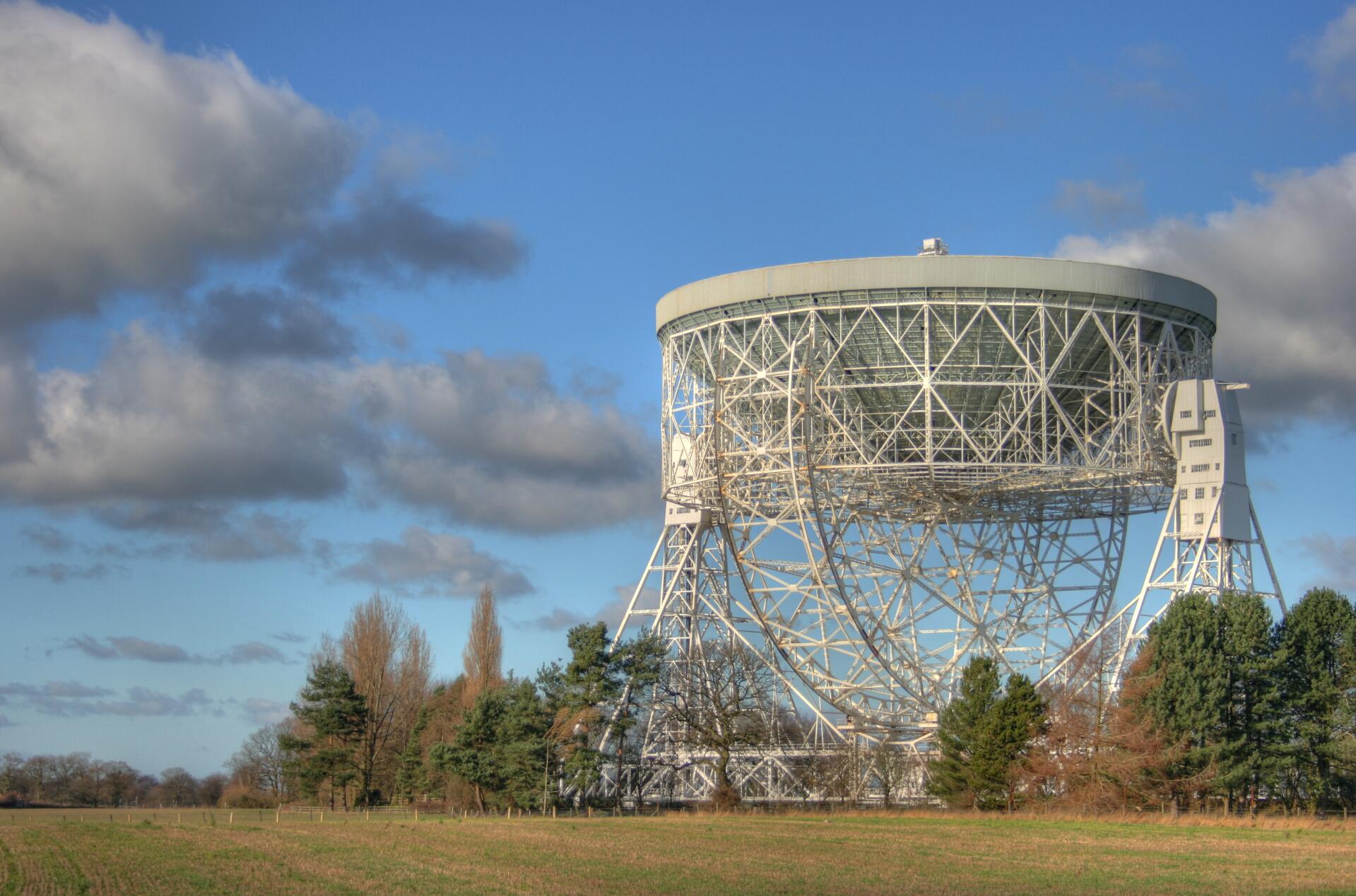
© Mike Peel; Jodrell Bank Centre for Astrophysics, University of Manchester, CC BY-SA 4.0 Resized from original. (This derivative is under the same CC BY-SA license.)
World Heritage Research
Discover scientific research and academic studies that deepen our understanding of Jodrell Bank Observatory from its history and significance to its conservation, management, and contemporary challenges.
-
Radio Surveys
Radio astronomy surveys since the 1950s have significantly advanced our understanding of celestial objects and cosmic phenomena. These surveys, conducted by observatories worldwide—including Jodrell Bank, Green Bank, Parkes, Arecibo, VLA, Molonglo, GMRT, LOFAR, and SKA—have cataloged vast numbers of radio sources, pulsars, and neutral hydrogen regions across the electromagnetic spectrum. Key contributions include the 3C survey from Cambridge, the Drift-Scan Survey for pulsars at Green Bank, and the extensive HI Parkes All-Sky Survey. Advanced projects like LOFAR's LoTSS, LOTAAS, and MSSS programs, along with SKA precursors (ASKAP, MWA, MeerKAT, HERA), have pushed boundaries in low-frequency radio observations, revealing new insights into radio galaxies, pulsars, and the structure of the universe. These surveys utilize cutting-edge telescopes and synthesis techniques to map the sky with unprecedented sensitivity and resolution.
Norton, r. (2026). Radio Surveys. A Multi-Wavelength History of Astronomical Surveys, 234–248. https://doi.org/10.1201/9781003768715-17
View Publication Record | Read Publication -
Observation of discontinuities in the periodic modulation of PSR B1828−11
Researchers at Jodrell Bank Observatory have identified discontinuities in the periodic modulation of PSR B1828−11, a radio pulsar, challenging previous explanations involving planetary companions or precession. The study, using a high-resolution dataset spanning over 500 days, found significant shifts in modulation amplitude, frequency, and phase occurring before a glitch—a sudden increase in rotation frequency. These changes are statistically supported with a Bayes factor of 1486, suggesting complex dynamics in the pulsar's magnetosphere or precession. The findings offer new insights into neutron star rotational behavior and rule out planetary companions as the sole cause of observed modulations.
Dias, A., Ashton, G., Ostrovska, J., Jones, D. I., & Keith, M. (2025). Observation of discontinuities in the periodic modulation of PSR B1828−11. Monthly Notices of the Royal Astronomical Society, 538(4), 2923–2936. https://doi.org/10.1093/mnras/staf468
View Publication Record | Read Publication -
Measuring pulsar profile variations with 2D Gaussian process regression
Researchers using advanced Gaussian process regression techniques have identified significant pulsar profile variations in 21 out of 26 observed pulsars, with 11 showing previously documented correlations to spin-down rates and seven exhibiting new evidence of such correlations. The study, conducted at Jodrell Bank Observatory, employed a computationally efficient 2D Gaussian process model to enhance sensitivity by simultaneously tracking time- and phase-correlated signals in pulsar magnetospheres. Notably, PSR B0740–28 displayed complex profile shape changes that switch between quasi-stable states, challenging current understanding of the underlying physical processes.
Keith, M. J., Spiewak, R., Lyne, A. G., Weltevrede, P., Antonopoulou, D., & Stappers, B. (2025). Measuring pulsar profile variations with 2D Gaussian process regression. Monthly Notices of the Royal Astronomical Society, 540(3), 2486–2505. https://doi.org/10.1093/mnras/staf886
View Publication Record | Read Publication -
RHINO: a large horn antenna for detecting the 21 cm global signal
RHINO, a novel experiment at Jodrell Bank Observatory, introduces a large horn antenna designed to detect the faint 21 cm global signal from neutral hydrogen, a critical probe of the intergalactic medium's thermal state during Cosmic Dawn and Reionization. The signal, measuring tens to hundreds of millikelvin, is spectrally smooth but challenging to isolate due to foreground radio emissions and instrumental noise. RHINO leverages the high characterizability and environmental shielding of horn antennas, alongside a continuous wave calibration source to monitor gain fluctuations without rapid switching. Initial simulations demonstrate its potential for recovering physical signal parameters despite bandwidth limitations. A scaled-down prototype is currently under construction, marking a significant step toward advancing our understanding of the early universe's thermal history.
Bull, P., El-Makadema, A., Garsden, H., Edgley, J., Roddis, N., Chluba, J., Conselice, C. J., Dutta, S., Glasscock, K. A., Nasirudin, A., Norris, J., Wilensky, M. J., Ye, I., & Zhang, Z. (2025). RHINO: a large horn antenna for detecting the 21 cm global signal. RAS Techniques and Instruments, 4. https://doi.org/10.1093/rasti/rzaf046
View Publication Record | Read Publication -
A Cacophony of Echoes from Daily Monitoring of the Crab Pulsar at Jodrell Bank
Researchers analyzing archival data from the Jodrell Bank Observatory's 42-foot telescope have discovered that echoes—delayed pulses caused by intervening material redirecting emission toward Earth—are significantly more common than previously thought. These echoes, observed in the Crab pulsar's giant pulses between 2012 and 2016, suggest highly anisotropic structures with specific dimensions (lengths >4 au, widths ~0.1 au, depths ~5 au) likely originating from substructures within the nebular filaments of the Crab nebula. The study implies that such echoes may arise from offshoot features of larger nebular filaments, providing new insights into the pulsar's emission mechanisms and the surrounding environment.
Serafin Nadeau, T., van Kerkwijk, M. H., Bassa, C. G., Stappers, B. W., Mickaliger, M. B., & Lyne, A. G. (2024). A Cacophony of Echoes from Daily Monitoring of the Crab Pulsar at Jodrell Bank. The Astrophysical Journal, 962(1), 57. https://doi.org/10.3847/1538-4357/ad18c5
View Publication Record | Read Publication -
Communications Satellites
A pioneering experiment in 1964 demonstrated the feasibility of using passive communications satellites to relay signals between distant locations, marking a significant milestone in global telecommunications. The study, conducted collaboratively by the U.S., USSR, and the University of Manchester's Jodrell Bank Observatory, involved transmitting signals from Jodrell Bank to Zimenki, Russia, via the Echo 2 satellite. Despite limitations such as the satellite's programmed altitude precluding simultaneous visibility between the U.S. and USSR, the experiment successfully established long-distance communication links, paving the way for future advancements in satellite-based telecommunications.
Behn, R. C. (2024). Communications Satellites. Handbook of Soviet Space-Science Research, 373–392. https://doi.org/10.4324/9781032674247-19
View Publication Record | Read Publication -
Measuring glitch recoveries and braking indices with Bayesian model selection
Pulsars with large spin-up glitches typically exhibit braking indices greater than 3, indicating that internal torques dominate their rotational evolution between glitches. Researchers analyzed 157 glitches from 35 pulsars monitored by the Jodrell Bank Observatory using Bayesian model selection to determine post-glitch recovery parameters. They found strong correlations between glitch-induced spin-down rate changes and pulsar spin parameters, including a notable link between interglitch braking indices and spin-down rates. The study also suggests that the ratio of glitch-induced spin-down rate change to the second frequency derivative can estimate glitch recurrence times for certain pulsars. For younger pulsars (less than 10,000 years), external torques, such as electromagnetic dipole radiation, may dominate the observed braking indices, which could approach 3.
Liu, Y., Keith, M. J., Antonopoulou, D., Weltevrede, P., Shaw, B., Stappers, B. W., Lyne, A. G., Mickaliger, M. B., & Basu, A. (2024). Measuring glitch recoveries and braking indices with Bayesian model selection. Monthly Notices of the Royal Astronomical Society, 532(1), 859–882. https://doi.org/10.1093/mnras/stae1499
View Publication Record | Read Publication