World Heritage Identification Number: 371
World Heritage since: 1986
Category: Cultural Heritage
WHE Type: Infrastructure & Industry
Transboundary Heritage: No
Endangered Heritage: No
Country: 🇬🇧 United Kingdom of Great Britain and Northern Ireland
Continent: Europe
UNESCO World Region: Europe and North America
Map
The Ironbridge Gorge: A Symbol of the Industrial Revolution
The Ironbridge Gorge, located in Shropshire, England, stands as a testament to the transformative power of the Industrial Revolution. Inscribed as a UNESCO World Heritage Site in 1986, it embodies the spirit of innovation, progress, and industrial growth that characterized the 18th century.
More to come…UNESCO Description of the World Heritage Site
Ironbridge is known throughout the world as the symbol of the Industrial Revolution. It contains all the elements of progress that contributed to the rapid development of this industrial region in the 18th century, from the mines themselves to the railway lines. Nearby, the blast furnace of Coalbrookdale, built in 1708, is a reminder of the discovery of coke. The bridge at Ironbridge, the world's first bridge constructed of iron, had a considerable influence on developments in the fields of technology and architecture.
UNESCO Justification of the World Heritage Site
Criterion (i): The Coalbrookdale blast furnace perpetuates in situ the creative effort of Abraham Darby I who discovered the production technique of smelting iron using coke instead of charcoal in 1709. It is a masterpiece of man's creative genius in the same way as the Iron Bridge, which is the first known metal bridge. It was built in 1779 by Abraham Darby III from the drawings of the architect Thomas Farnolls Pritchard.
Criterion (ii): The Coalbrookdale blast furnace and the Iron Bridge exerted great influence on the development of techniques and architecture.
Criterion (iv): Ironbridge Gorge provides a fascinating summary of the development of an industrial region in modern times. Mining centres, transformation industries, manufacturing plants, workers' quarters, and transport networks are sufficiently well preserved to make up a coherent ensemble whose educational potential is considerable.
Criterion (vi): Ironbridge Gorge, which opens its doors to in excess of 600,000 visitors yearly, is a world renowned symbol of the 18th century Industrial Revolution.
Encyclopedia Record: Ironbridge Gorge
The Ironbridge Gorge is a deep gorge, containing the River Severn in Shropshire, England. It was first formed by a glacial overflow from the long drained away Lake Lapworth, at the end of the last ice age. The deep exposure of the rocks cut through by the gorge exposed commercial deposits of coal, iron ore, limestone and fireclay, which enabled the rapid economic development of the area during the early Industrial Revolution.Additional Site Details
Area: 547.9 hectares
Number of Components: 1
(ii) — Significant interchange of human values
(iv) — Outstanding example of a type of building or landscape
(vi) — Directly associated with events or living traditions
Coordinates: 52.62638889 , -2.472777778
Image
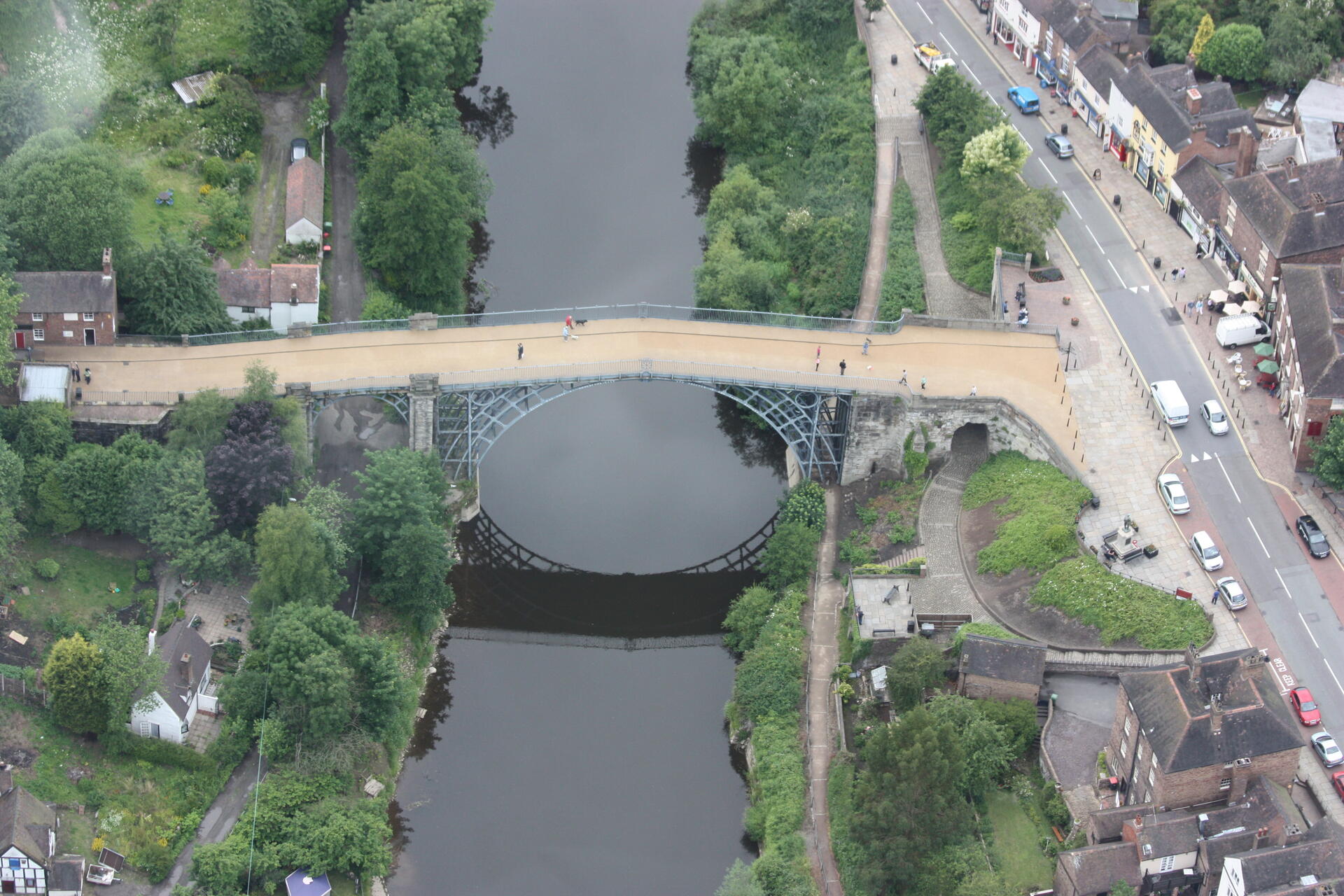
© Alice Humphreys - transatracurium, CC BY-SA 3.0 Resized from original. (This derivative is under the same CC BY-SA license.)
World Heritage Research
Discover scientific research and academic studies that deepen our understanding of Ironbridge Gorge from its history and significance to its conservation, management, and contemporary challenges.
-
Mining in the Ironbridge area of North Shropshire
A thematic and narrative analysis of oral histories from the Ironbridge Gorge reveals that coal mining was deeply embedded in the local landscape, with overlapping industrial processes as the norm. Male miners exhibited a striking lack of self-reflection on risk despite their empathy for women and pit ponies, highlighting a complex interplay between work culture and societal norms. The study, based on interviews conducted in the 1970s and 1980s, provides unique insights into the lived experiences of miners and the broader industrial dynamics of North Shropshire.
Asprey, E., & Galasińska, A. (2025). Mining in the Ironbridge area of North Shropshire. Embodied Labour, 79–95. https://doi.org/10.4324/9781003639879-6
View Publication Record | Read Publication -
The scientific ancestry and historiography of The Silurian System
Ironbridge Gorge, pivotal to the Industrial Revolution, represents a paradoxical intersection of geological innovation and industrial decline. While the region drove advancements in iron smelting and steam technology, its geological significance was overshadowed by later celebrations of shorter anniversary milestones, such as The Murchison Symposium's 150th-anniversary focus. This study reveals that by 1839, Shropshire's industrial output had shifted from pioneering coal-based iron smelting to mass-producing iron plates for the steamship Great Britain, marking a transition in both scale and innovation. The research employs historiographic analysis to trace the relationship between geological discovery and industrial demand, highlighting how mining exposures advanced geological investigation during the 'heroic age of geology.' This dual perspective underscores the complex interplay between scientific progress and industrial evolution.
Torrens, H. (2024). The scientific ancestry and historiography of The Silurian System. The Practice of British Geology, 1750-1850, X–1. https://doi.org/10.4324/9781003555841-10
View Publication Record | Read Publication -
The Archaeology of the Ironbridge Gorge in 20 Digs
Archaeological investigations at the UNESCO-listed Ironbridge Gorge have uncovered significant insights into its industrial heritage, revealing layers of historical activity from pre-industrial times to the peak of the Industrial Revolution. The study, presented in a series of 20 digs, highlights the gorge's pivotal role as a cradle of innovation, particularly in iron production and engineering. Researchers employed a combination of stratigraphic analysis, artifact recovery, and environmental sampling to reconstruct the timeline and context of human activity. Key discoveries include evidence of early industrial processes, such as charcoal burning and metalworking, alongside remnants of infrastructure that facilitated the growth of this iconic site. These findings not only deepen our understanding of the Ironbridge Gorge's significance but also underscore its importance as a global symbol of technological advancement.
West, I. (2024). The Archaeology of the Ironbridge Gorge in 20 Digs. Industrial Archaeology Review, 46(2), 136. https://doi.org/10.1080/03090728.2025.2465142
View Publication Record | Read Publication -
Changing economies, changing politics
Ironbridge Gorge, once defined by its industrial might and the allure of its 'sublime horrors,' exemplifies how cultural landscapes evolve with shifting economies and politics. The European Landscape Convention highlights that landscapes are shaped by human interaction with nature, often driven by food security needs and surplus production. This dynamic process leads to distinctive regional features, from cultivation patterns to settlement styles, which today attract tourists seeking the same aesthetic appeal as did Europe's grand tourists of the past. The study balances this historical perspective with an analysis of how contending groups have influenced landscape development through political processes, underscoring the interplay between economic change and governance in shaping cultural heritage.
Price, C. (2023). Changing economies, changing politics. Routledge Handbook of Cultural Landscape Practice, 500–514. https://doi.org/10.4324/9781315203119-57
View Publication Record | Read Publication -
Climate Change and the Museum
Museums, particularly industrial ones, face a critical opportunity to address climate change by reflecting on their role in climate injustice and contributing to sustainable decarbonization. A study focusing on Ironbridge Gorge (UK) and Heartlands (Cornwall, UK) reveals that while these institutions often celebrate human-induced climate alteration without critique, they can leverage the climate crisis as a catalyst for self-reflection and action. Drawing parallels with postcolonial theory, the research argues that museums must align their ambitions towards decolonization with efforts toward decarbonization to meaningfully engage with the climate challenge.
Harvey, D. C. (2023). Climate Change and the Museum. Museum Worlds, 11(1), 64–78. https://doi.org/10.3167/armw.2023.110106
View Publication Record | Read Publication -
George Perry (c.1718–1771): industrialist, cartographer and naturalist
George Perry (c.1718–1771) stands out as a multifaceted figure in the history of Coalbrookdale, Ironbridge Gorge, and Liverpool, contributing significantly to industrial development, cartography, and natural history. His 1758 work, A description of Coalbrookdale, featured two pioneering perspective views of industrial landscapes, created with Thomas Smith, offering rare visual documentation of early industrialization. Perry's correspondence with notable figures like Emanuel Mendes da Costa and Thomas Pennant highlights his role in fossil exchange and geological studies. Additionally, his unfinished history of Liverpool was later compiled by William Enfield (1773). This study reconstructs Perry's diverse career, emphasizing his interdisciplinary contributions to industry, mapping, and natural sciences.
Leach, S., & Torrens, H. S. (2022). George Perry (c.1718–1771): industrialist, cartographer and naturalist. Archives of Natural History, 49(1), 102–116. https://doi.org/10.3366/anh.2022.0761
View Publication Record | Read Publication -
‘The Cradle of the Industrial Revolution’ : The Museumification of the Ironbridge World Heritage
The Ironbridge Gorge, recognized as the 'cradle of the Industrial Revolution,' has undergone a significant transformation from its industrial past to a museumified heritage site. This process, driven by industrial archaeology and managed by the Ironbridge Gorge Museum Trust, has added new layers of meaning to the area's history. While initially focusing on elite innovators, recent attention has shifted towards the tension between elites and masses, as well as memory politics. The study highlights the authenticity debate surrounding Blists Hill Victorian Town, a reconstructed town that serves as an immersive public history space rather than a mere commercialization of nostalgia.
Yeom, W. (2022). ‘The Cradle of the Industrial Revolution’ : The Museumification of the Ironbridge World Heritage. Critical Review of History, 141, 104–136. https://doi.org/10.38080/crh.2022.11.141.104
View Publication Record | Read Publication