World Heritage Identification Number: 370
World Heritage since: 1986
Category: Cultural Heritage
WHE Type: Buildings & Architectural Ensembles
Transboundary Heritage: No
Endangered Heritage: No
Country: 🇬🇧 United Kingdom of Great Britain and Northern Ireland
Continent: Europe
UNESCO World Region: Europe and North America
Map
Durham Castle and Cathedral: A Medieval Marvel in North East England
The Durham Castle and Cathedral, located in the historic city of Durham, England, stand as a testament to the architectural prowess and religious significance of the Middle Ages. Inscribed as a UNESCO World Heritage Site in 1986, these structures have endured for nearly a millennium, offering visitors a glimpse into the past while still serving vital roles in modern society.
More to come…UNESCO Description of the World Heritage Site
Durham Cathedral was built in the late 11th and early 12th centuries to house the relics of St Cuthbert (evangelizer of Northumbria) and the Venerable Bede. It attests to the importance of the early Benedictine monastic community and is the largest and finest example of Norman architecture in England. The innovative audacity of its vaulting foreshadowed Gothic architecture. Behind the cathedral stands the castle, an ancient Norman fortress which was the residence of the prince-bishops of Durham.
UNESCO Justification of the World Heritage Site
Criterion (ii): Durham Cathedral is the largest and most perfect monument of ‘Norman’ style architecture in England. The small astral (castle) chapel for its part marks a turning point in the evolution of 11th century Romanesque sculpture.
Criterion (iv): Though some wrongly considered Durham Cathedral to be the first ‘Gothic’ monument (the relationship between it and the churches built in the Île-de-France region in the 12th century is not obvious), this building, owing to the innovative audacity of its vaulting, constitutes, as do Spire Speyer and Cluny, a type of experimental model which was far ahead of its time.
Criterion (vi): Around the relics of Cuthbert and Bede, Durham crystallized the memory of the evangelising of Northumbria and of primitive Benedictine monastic life.
Encyclopedia Record: Durham Castle
Durham Castle is a Norman castle in the city of Durham, England, which has been occupied since 1837 by University College, Durham after its previous role as the residence of the Bishops of Durham. Designated since 1986 as a cultural World Heritage Site in England, along with Durham Cathedral, the castle is open to the general public to visit, but only through guided tours, since it is in use as a working building and is home to over 100 students. The castle stands on top of a hill above the River Wear on Durham's peninsula, opposite Durham Cathedral.Additional Site Details
Area: 8.79 hectares
Number of Components: 1
(iv) — Outstanding example of a type of building or landscape
(vi) — Directly associated with events or living traditions
Coordinates: 54.77472222 , -1.576111111
Image
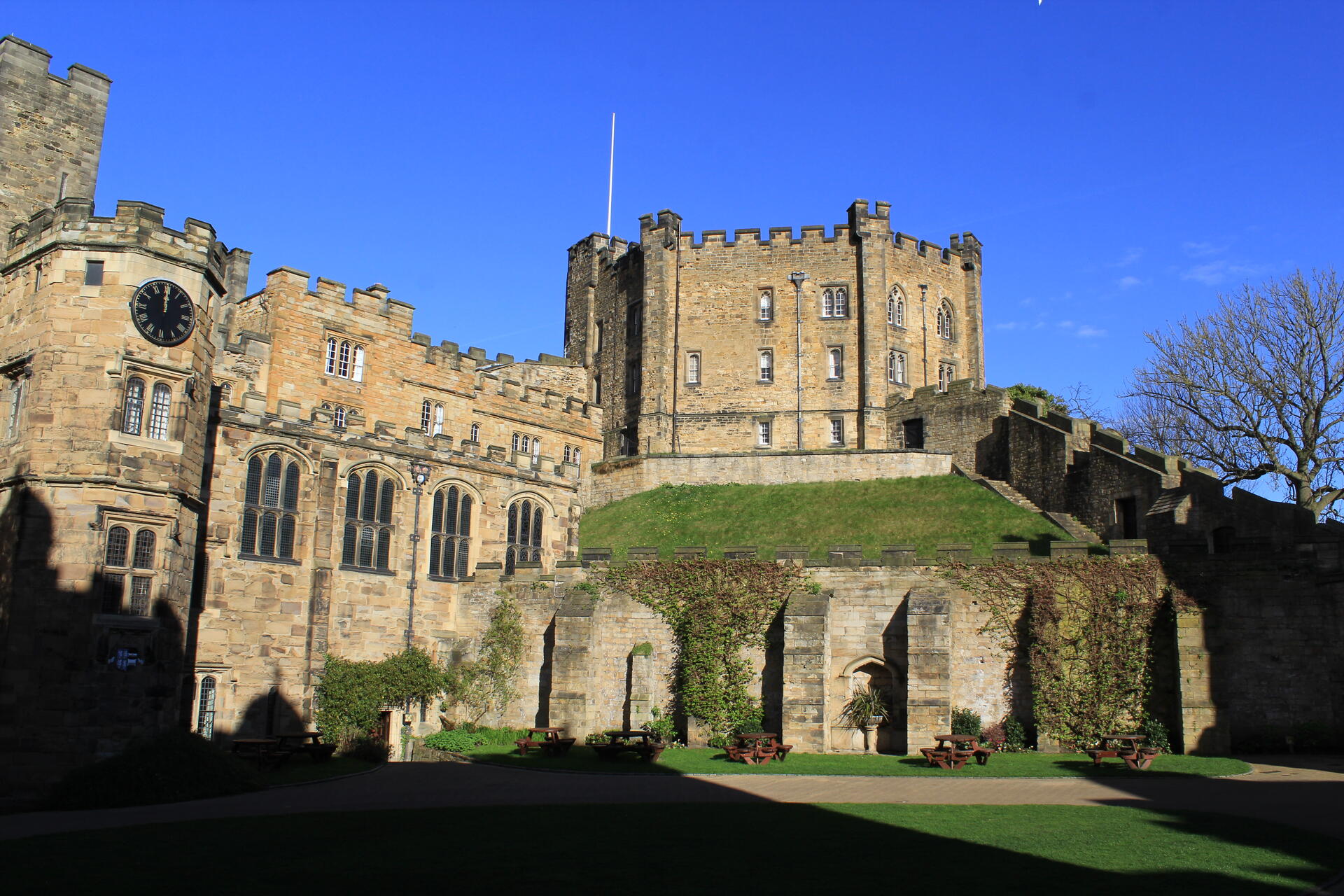
© Carla Brain, CC BY-SA 2.0 Resized from original. (This derivative is under the same CC BY-SA license.)
World Heritage Research
Discover scientific research and academic studies that deepen our understanding of Durham Castle and Cathedral from its history and significance to its conservation, management, and contemporary challenges.
-
Regional Performance as Intangible Cultural Heritage
The Anglo-Saxon Harrowing of Hell, possibly the oldest surviving play in the British Isles, and the Durham Song, a Tudor musical fragment, represent significant contributions to global dramatic heritage. These works, linked to Durham Castle and Cathedraloffer insights into early regional performance practices and their enduring appeal. The study explores how tangible elements like manuscripts and architecture reflect intangible cultural legacies, such as soundscapes and social contexts, while posing challenges in preservation and interpretation. By analyzing these fragments, researchers uncover connections between historical drama, landscape, and community traditions, highlighting Durham's role as a living heritage site with over a thousand years of continuous use.
RAVELHOFER, B. (2021). REGIONAL PERFORMANCE AS INTANGIBLE CULTURAL HERITAGE. Early Performers and Performance in the Northeast of England, 161–182. https://doi.org/10.2307/j.ctv1mvw99d.17
View Publication Record | Read Publication -
Bishop Tunstall’s Alterations to Durham Castle, 1536–48
A previously unnoted gunloop in Durham Castle's stair tower reveals that Bishop Cuthbert Tunstall's 1536–48 alterations included defensive enhancements, challenging the perception of his building program as purely domestic. Analysis of construction records also corrects the historical timeline of antiquarian John Leland's visit to 1543, not 1538. The study examines architectural modifications—such as a first-floor gallery, stair turret, and chapel—within the context of Durham Castle's evolving roles as a fortress, bishop's palace, and later university college, while considering their significance during turbulent political and religious events like the Pilgrimage of Grace.
Pears, R. (2019). BISHOP TUNSTALL’S ALTERATIONS TO DURHAM CASTLE, 1536–48. The Antiquaries Journal, 99, 161–185. https://doi.org/10.1017/s0003581519000064
View Publication Record | Read Publication -
Understanding Building Stones and Stone Buildings
A comprehensive exploration of the geological origins, properties, and lifecycle of building stones reveals critical insights into their durability and decay mechanisms. The study emphasizes recognizing diverse stone types—such as granites, limestones, and sandstones—through illustrated examples from Great Britain and beyond. It examines how these materials weather over time when used in structures like pillars, arches, and cathedrals, with a focus on Durham Cathedral's sandstone deterioration. Additionally, the research delves into historical architectural styles, showcasing contributions by architects like Vitruvius and Sir Christopher Wren, while also discussing the potential 'rebirth' of ruined buildings through digital recording. The book integrates over 450 diagrams and photographs to enhance understanding, supported by an extensive bibliography.
Hudson†, J. A., & Cosgrove, J. W. (2019). Understanding Building Stones and Stone Buildings (, Ed.). CRC Press. https://doi.org/10.1201/9781315100180
View Publication Record | Read Publication -
A Bishop of Two Peoples:
Durham Cathedral and the adjacent Norman Chapel, both commissioned by Bishop William of St. Calais, exhibit distinct architectural styles that reflect the political and cultural landscape following the Norman conquest of England in 1066. The cathedral's hybrid design blends Anglo-Saxon formal motifs with a Norman plan, symbolizing the bishop's strategic choices during this transitional period. In contrast, the chapel's stone capitals, likely crafted in Normandy and transported to Durham, embody the cultural influence of the duchy of Normandy. This study sheds light on the architectural hybridization of Durham Cathedral while providing insights into the commissioning context of the chapel within the broader narrative of Norman colonization.
Bernstein, M. (2018). A Bishop of Two Peoples: Journal of the Society of Architectural Historians, 77(3), 267–284. https://doi.org/10.1525/jsah.2018.77.3.267
View Publication Record | Read Publication -
Durham Cathedral Priory 1083–1539
Durham Cathedral, founded in 1093 and one of Western Europe's great Romanesque structures, stands as a monumental testament to medieval architecture, surpassing even the scale of Old St Peter's in Rome with its original length of 123 meters. This study reveals that the cathedral priory not only served as an architectural marvel but also left behind a rich administrative archive of over 4,500 financial and accounting records, providing unprecedented insight into medieval institutional management. The research examines the priory's origins, key events, and resource administration practices, highlighting its role in preserving St Cuthbert's mortal remains and functioning as a center of faith-driven monumental construction. Additionally, it identifies threats to the priory's resources during its 460-year existence, offering a comprehensive view of its significance in both architectural and administrative history.
Dobie, A. (2015). Durham Cathedral Priory 1083–1539. Accounting at Durham Cathedral Priory, 9–46. https://doi.org/10.1057/9781137479785_2
View Publication Record | Read Publication