World Heritage Identification Number: 276
World Heritage since: 2007
Category: Cultural Heritage
WHE Type: Archaeological Sites
Transboundary Heritage: No
Endangered Heritage: Yes
Country: 🇮🇶 Iraq
Continent: Asia
UNESCO World Region: Arab States
Map
Samarra Archaeological City: A Testament to the Architectural and Artistic Innovations of the Abbasid Empire
The Samarra Archaeological City, inscribed as a UNESCO World Heritage Site in 2007, offers a unique glimpse into the architectural and artistic achievements of the Abbasid Empire during the 9th century. Situated along the banks of the River Tigris, approximately 130 kilometers north of Baghdad, this expansive site stretches over 41.5 kilometers from north to south, with its width varying between 8 to 4 kilometers.
More to come…UNESCO Description of the World Heritage Site
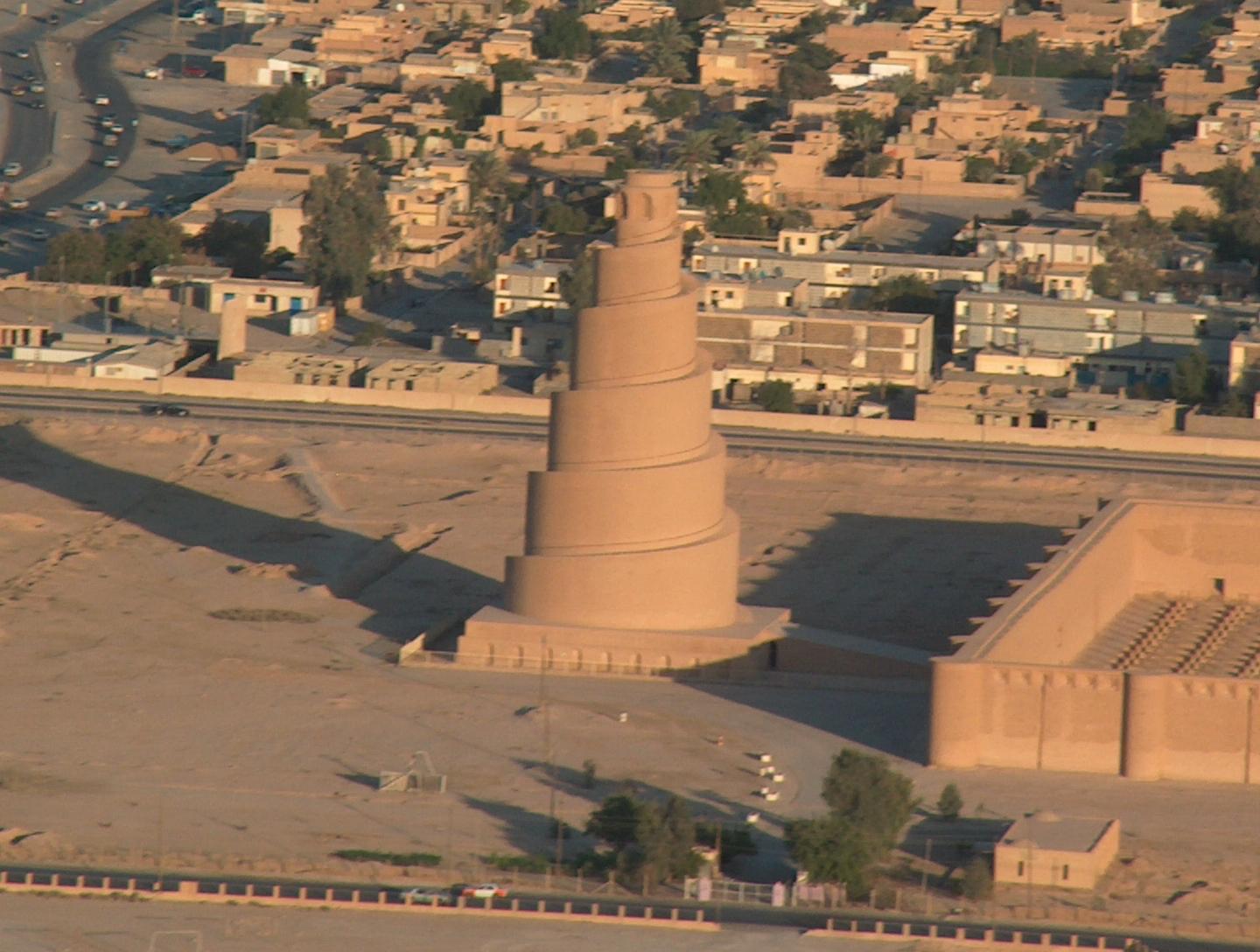
Samarra Archaeological City is the site of a powerful Islamic capital city that ruled over the provinces of the Abbasid Empire extending from Tunisia to Central Asia for a century. Located on both sides of the River Tigris 130 km north of Baghdad, the length of the site from north to south is 41.5 km; its width varying from 8 km to 4 km. It testifies to the architectural and artistic innovations that developed there and spread to the other regions of the Islamic world and beyond. The 9th-century Great Mosque and its spiral minaret are among the numerous remarkable architectural monuments of the site, 80% of which remain to be excavated.
UNESCO Justification of the World Heritage Site
Criterion (ii): Samarra represents a distinguished architectural stage in the Abbasid period by virtue of its mosques, its development, the planning of its streets and basins, its architectural decoration, and its ceramic industries.
Criterion (iii): Samarra is the finest preserved example of the architecture and city planning of the Abbasid Caliphate, extending from Tunisia to Central Asia, and one of the world's great powers of that period. The physical remains of this empire are usually poorly preserved since they are frequently built of unfired brick and reusable bricks.
Criterion (iv): The buildings of Samarra represent a new artistic concept in Islamic architecture in the Malwiya and Abu Dulaf mosques, in the form of a unique example in the planning, capacity and construction of Islamic mosques by comparison with those which preceded and succeeded it. In their large dimensions and unique minarets, these mosques demonstrate the pride and political and religious strength that correspond with the strength and pride of the empire at that time.
Encyclopedia Record: Samarra
Samarra is a city in Iraq. It stands on the east bank of the Tigris in the Saladin Governorate, 125 kilometers (78 mi) north of Baghdad. The modern city of Samarra was founded in 836 by the Abbasid caliph al-Mu'tasim as a new administrative capital and military base. In 2003 the city had an estimated population of 348,700. During the Iraqi Civil War (2006–08), Samarra was in the "Sunni Triangle" of resistance.Additional Site Details
Area: 15,058 hectares
Number of Components: 10
(iii) — Unique or exceptional testimony to a cultural tradition
(iv) — Outstanding example of a type of building or landscape
Coordinates: 34.3409894444 , 43.8235430555
World Heritage Research
Discover scientific research and academic studies that deepen our understanding of Samarra Archaeological City from its history and significance to its conservation, management, and contemporary challenges.
-
The Effect of Religious Monuments in the Plan of the ArabianIslamic city Samarra City – Case Study
Religious monuments play a significant regulatory role in the planning of Arabian Islamic cities, influencing urban fabric, spatial connections, and public space distribution. A study focusing on Samarra, one of the most important Arab Islamic cities, used GIS software (ArcView 3.3) to analyze its urban formation. The research found that religious monuments act as landmarks, shaping the city's layout by affecting axial connections, orientation, and permeability around their locations. This regulatory impact extends to both local and global levels, contributing to the city's architectural identity and spatial organization.
Taher, A. N., AL-Ataabi, M. S. A. H., & AL-Abbasi, Z. M. (2026). The Effect of Religious Monuments in the Plan of the ArabianIslamic city Samarra City – Case Study. Iraqi Journal of Architecture and Planning, 13(1). https://doi.org/10.36041/2617-9555.1185
View Publication Record | Read Publication -
Relations of Representatives of Transoxiana in Samarra during the Reigns of the Caliphs Al-Mutawakkil (847-861) and Al-Muntaṣir (861-862)
A critical stage in the decline of Abbasid central authority is revealed through the analysis of political dynamics in Samarra during the reigns of Caliphs al-Mutawakkil (847-861) and al-Muntaṣir (861-862). The study demonstrates that representatives from Transoxiana, including Turkic ghilman, Faraghina, and Ushrusanians, did not form a unified political group but operated within intricate patronage networks, military interests, and court rivalries. The research highlights the socio-spatial dimension of Samarra as a competitive settlement space among different military corps, drawing on archaeological and topographical studies alongside historical accounts from al-Ṭabarī, al-Yaʿqūbī, and al-Masʿūdī. This period marked the growing influence of Transoxianan elites in the caliphate's military-political system, contributing to the weakening of central authority.
Rakhmanova, O. R. (2026). RELATIONS OF REPRESENTATIVES OF TRANSOXIANA IN SAMARRA DURING THE REIGNS OF THE CALIPHS AL-MUTAWAKKIL (847-861) AND AL-MUNTAṢIR (861-862). Zenodo. https://doi.org/10.5281/ZENODO.20670816
View Publication Record | Read Publication -
Constructing Hydraulic Infrastructure in the ʿAbbāsid and Ṭūlūnid Capitals: Water Conduits in Baghdad, Samarra and Cairo between the Eighth and Ninth Centuries
Early Islamic hydraulic infrastructure, particularly water conduits in Baghdad, Samarra, and Cairo (al-Qaṭāʾiʿ), was primarily constructed to serve elite needs rather than the general populace. This study reveals that such projects required substantial financial and labor investments but often prioritized luxury for ruling classes over broader public utility. Using textual and material evidence, researchers analyzed three case studies—Baghdad under the ʿAbbāsid Caliphate, Samarra as a short-lived capital, and Cairo during the Ṭūlūnid dynasty—to explore construction motivations, maintenance challenges, and long-term usage patterns. The findings underscore the dual role of these systems: as symbols of power and as functional but elite-centric urban amenities.
van den Bent, J., & Brown, P. J. (2025). Constructing Hydraulic Infrastructure in the ʿAbbāsid and Ṭūlūnid Capitals: Water Conduits in Baghdad, Samarra and Cairo between the Eighth and Ninth Centuries. Al-Masāq, 37(1), 126–145. https://doi.org/10.1080/09503110.2024.2435086
View Publication Record | Read Publication -
Introduction — Managing and Understanding Water in the Abbasid Caliphate
Water management in the Abbasid Caliphate was not merely about resource scarcity but often hinged on governance and institutional organization. This special issue of the Journal of Abbasid Studies examines how urban centers like Basra, Baghdad, Samarra, and Red Sea harbor towns addressed water provision through diverse approaches, involving both central authorities and local practices. By integrating archaeological remains, geographies, legal texts, and scientific manuals, the study reveals that water scarcity was frequently mitigated through sophisticated governance strategies rather than solely by resource availability. The research underscores the multifaceted nature of water management in historical societies, offering new insights into urban planning, trade, and public health during this pivotal era.
van Berkel, M. (2025). Introduction — Managing and Understanding Water in the Abbasid Caliphate. Journal of Abbasid Studies, 12(1), 1–5. https://doi.org/10.1163/22142371-00802027
View Publication Record | Read Publication -
The Palace of Balkuwara, Samarra
The Palace of Balkuwara in Samarra, Iraq, stands as a testament to the monumental urban planning and architectural prowess of the early Abbasid caliphate. Built during the reign of Caliph al-Mutawakkil in the 9th century, this palatial complex offers unprecedented insights into the logistical challenges and resource management required for large-scale construction during this period. Archaeological analysis reveals that Balkuwara was part of a broader urban network, including 'cantonments' housing units primarily for the Turkish army, highlighting the caliphate's reliance on organized labor and military infrastructure. This study underscores the significance of Samarra as a model for urban foundations across the early Islamic world, demonstrating how the availability of labor and resources could determine the success or failure of such projects.
Milwright, M. (2025). The Palace of Balkuwara, Samarra. Encounters: Medieval Islamic History in 50 Objects, 66–71. https://doi.org/10.4324/9781003413240-10
View Publication Record | Read Publication -
Lost Cities in the Near East: Reassembling Knowledge through Archival Research and Excavation Documentation
Research on the 'lost cities' of Western Asia, such as Palmyra and Samarra, reveals that early explorations and archaeological practices have shaped narratives about their urban histories, often marginalizing certain periods. By analyzing archival research, historical literature, and excavation documentation, this study demonstrates how political regimes and scholarly traditions influence contemporary understandings of these cities. The findings highlight the need for a more inclusive approach to reconstructing knowledge about these significant heritage sites.
Bobou, O., Kühn, M., & Raja, R. (2025). Lost Cities in the Near East: Reassembling Knowledge through Archival Research and Excavation Documentation. Journal of Urban Archaeology, 12(1), 177–199. https://doi.org/10.1484/j.jua.5.151432
View Publication Record | Read Publication -
Paesaggi e capitali imperiali della Mesopotamia preclassica: ricognizioni di superficie nell’Iraq centro-meridionale e gli scavi di Ninive e Dur-Kurigalzu
A groundbreaking archaeological project, spanning from 2016 to 2024, has uncovered 120 previously unknown sites in Iraq, shedding light on the landscapes and urbanization cycles of Mesopotamia from the fourth millennium BC to modern times. The QADIS project, led by the University of Bologna in collaboration with the State Board of Antiquities and Heritage, employed a multifaceted approach combining surface surveys, remote sensing, geoarchaeology, and machine-learning algorithms for site detection. Excavations at the imperial capitals of Nineveh and Aqar Quf/Dur-Kurigalzu have revealed new monumental structures, city gates, administrative buildings, and cuneiform libraries. This research not only advances our understanding of the earliest Mesopotamian cities but also contributes to the protection and enhancement of Iraq's endangered archaeological heritage.
Marchetti, N. (2025). Paesaggi e capitali imperiali della Mesopotamia preclassica: ricognizioni di superficie nell’Iraq centro-meridionale e gli scavi di Ninive e Dur-Kurigalzu [JB]. OCNUS, 33, 265–278. https://doi.org/10.12876/OCNUS3329
View Publication Record | Read Publication