World Heritage Identification Number: 1437
World Heritage since: 2014
Category: Cultural Heritage
WHE Type: Archaeological Sites
Transboundary Heritage: No
Endangered Heritage: No
Country: 🇮🇶 Iraq
Continent: Asia
UNESCO World Region: Arab States
Map
Erbil Citadel: An Enduring Testament to Ancient Civilizations
The Erbil Citadel, nestled atop a towering ovoid-shaped tell in the heart of the Kurdistan region, serves as a captivating testament to the rich cultural heritage and enduring legacy of ancient civilizations. Inscribed as a UNESCO World Heritage Site in 2014, this fortified settlement offers a unique blend of history, architecture, and urban planning that has captivated visitors for millennia.
More to come…UNESCO Description of the World Heritage Site
Erbil Citadel is a fortified settlement on top of an imposing ovoid-shaped tell (a hill created by many generations of people living and rebuilding on the same spot) in the Kurdistan region, Erbil Governorate. A continuous wall of tall 19th-century façades still conveys the visual impression of an impregnable fortress, dominating the city of Erbil. The citadel features a peculiar fan-like pattern dating back to Erbil’s late Ottoman phase. Written and iconographic historical records document the antiquity of settlement on the site – Erbil corresponds to ancient Arbela, an important Assyrian political and religious centre – while archaeological finds and investigations suggest that the mound conceals the levels and remains of previous settlements.
UNESCO Justification of the World Heritage Site
Criterion (iv): Erbil Citadel is an imposing example of a multilayered archaeological mound still physically emerging from the surrounding landscape. The physical structure of the Citadel town is characterized by the permanence of the Ottoman period urban form and street pattern on top of the mound. Its shape with definite boundaries has in part dictated the transformations of the urban fabric which still exhibits the typical Ottoman period traditional articulation in functional districts and comprises some fine examples of residential buildings dating back to the 19th – 20th centuries, and, to a lesser degree, to the 18th century.
Encyclopedia Record: Citadel of Erbil
The Citadel of Erbil, locally called Qellat, is a tell or occupied mound, and the historical city centre of Erbil in the Kurdistan Region of Iraq. The citadel was added to the World Heritage List on 21 June 2014.Additional Site Details
Area: 15.6 hectares
Number of Components: 1
Coordinates: 36.1911111111 , 44.0091666667
Image
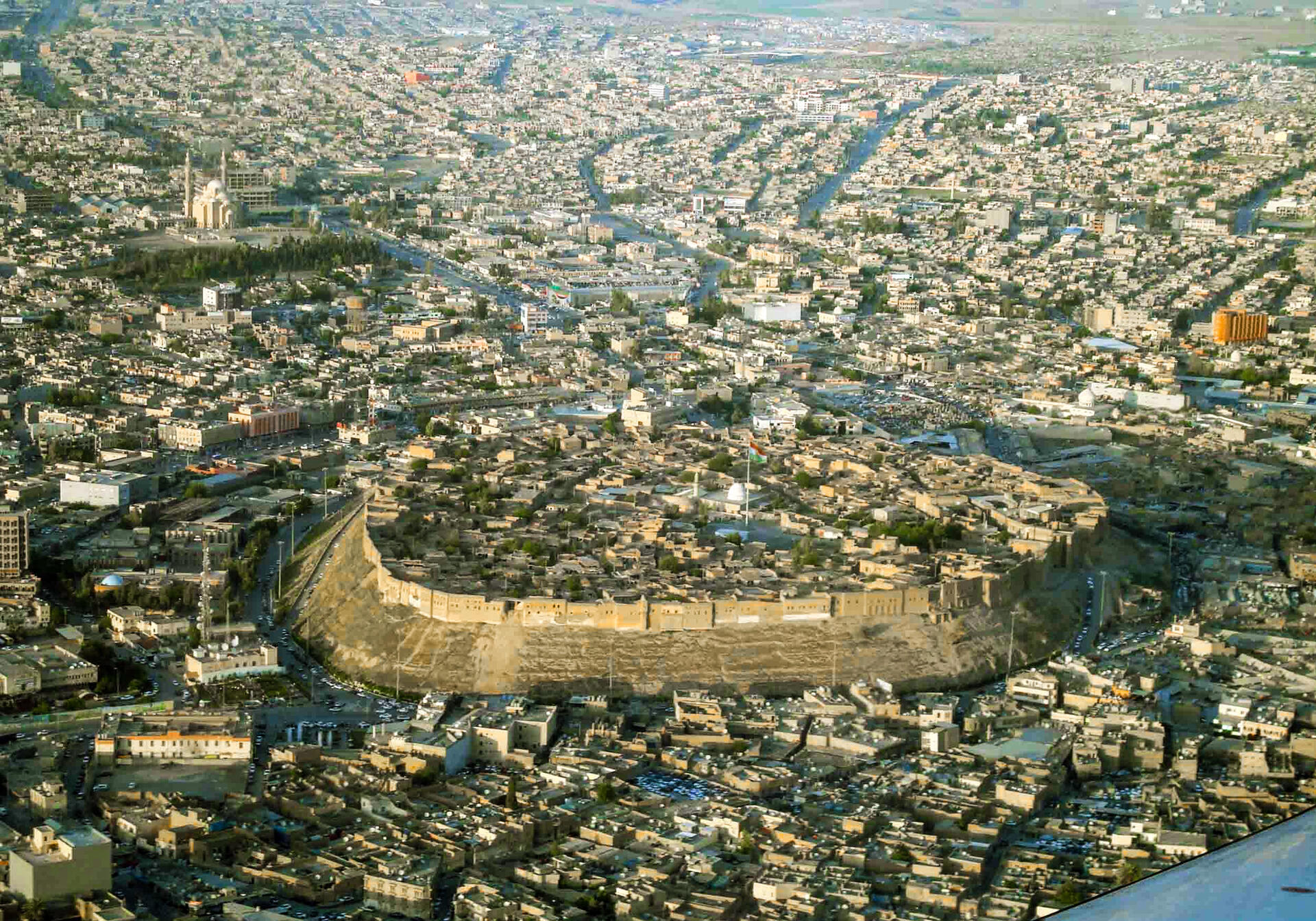
© jan kurdistani, CC BY-SA 2.0 Resized from original. (This derivative is under the same CC BY-SA license.)
World Heritage Research
Discover scientific research and academic studies that deepen our understanding of Erbil Citadel from its history and significance to its conservation, management, and contemporary challenges.
-
Investigating the impact of the Iraqi film industry on attracting foreign tourists
Films significantly boost tourism to Erbil Citadel, one of Iraq's oldest heritage sites dating back 6000 B.C., by enhancing the country's positive image and travel motivation. A study found that 'Film Influence' directly impacts tourist behavior (β = 0.72), with films effectively promoting cultural attractions and strengthening Iraq's tourism brand. The research, combining quantitative surveys of 100 international tourists and qualitative interviews with industry experts, used SPSS and PLS-SEM for data analysis. Experts highlighted films as a key driver in stimulating visitation and marketing heritage sites. Policymakers are advised to leverage film production, develop infrastructure, and create targeted campaigns to harness this strategic tool for tourism growth.
Nejmeddin, A. I. (2026). توێژینەوە ی کاریگەری پیشەسازی فیلمی عێراقی لەسەر ڕاکێشانی گەشتیارانی بیانی. Koya University Journal of Humanities and Social Sciences, 9(1), 484–490. https://doi.org/10.14500/kujhss.v9n1y2026.pp484-490
View Publication Record | Read Publication -
Mutation or Reusing: A Decision Based on Functional Analysis of Historical Houses’ Configurations
Quantitative spatial analysis emerges as a powerful tool for assessing the adaptive reuse potential of historic residential architecture while preserving cultural value. A study focusing on courtyard houses within Erbil Citadel, a UNESCO World Heritage Site in Iraq, demonstrates that this approach can effectively evaluate spatial performance and circulation logic to inform conservation strategies. By integrating functional analysis with statistical validation—using Euclidean distance and Pearson correlation—the research identifies key characteristics compatible with adaptive reuse across different contexts. This method offers a rigorous model for sustainable planning in similar heritage settings, bridging theory and practice to guide informed decision-making.
Goriel, W. A. S., Molnár, T., & Zoltán, E. S. (2026). Mutation or Reusing: A Decision Based on Functional Analysis of Historical Houses’ Configurations. Buildings, 16(10), 1871. https://doi.org/10.3390/buildings16101871
View Publication Record | Read Publication -
The strategy of urban development of the citatel cities comparative study between design strategy of the development of the citadel of aleppo and the citadel of erbil
Historical citadels significantly influence urban development and shape city centers, serving as both tourist attractions and strategic landmarks. A comparative study between the Citadel of Aleppo and Erbil's Citadel reveals that Erbil's isolation from its role as an urban node has led to a loss of integration with surrounding areas, despite its historical significance and current status as a capital in Iraq's Kurdistan region. The research identifies a lack of clear strategic development perception for Erbil's citadel, which impacts the integrity of the citadel and its historical characteristics. By analyzing Aleppo's model, known for its effective urban development strategy, the study proposes that integrating citadels into their surrounding urban fabric can enhance their role as constructive landmarks and tourist attractions.
Al-Hinkawi, W. S., & alkubaisi, S. F. (2026). The strategy of urban development of the citatel cities comparative study between design strategy of the development of the citadel of aleppo and the citadel of erbil. Iraqi Journal of Architecture and Planning, 9(19). https://doi.org/10.36041/2617-9555.1235
View Publication Record | Read Publication -
Preserving the Past to Shape the Future: The Evolution of Office Spaces Through Historic Building Adaptation
Adaptive reuse of historic buildings into modern office spaces can successfully balance cultural heritage preservation with contemporary workplace needs, enhancing employee satisfaction and creativity. A study focusing on Erbil Citadel houses found that integrating historical features—such as aesthetics, natural light, and airflow—into office environments fosters a sustainable and functional work setting. Survey data from 60 respondents revealed strong preferences for spaces that blend tradition with modern functionality, emphasizing the importance of sustainable practices and technological integration in shared areas. The research highlights the need for decision-makers to adopt culturally attuned strategies that align heritage conservation with community requirements, offering a framework for reconciling historical narratives with modern office demands.
Abu-Lail, D. M. A., Goriel, W. A. S., Molnár, T., Bachmann, B., Medvegy, G., Borsos, Á., & Zoltán, E. S. (2025). Preserving the Past to Shape the Future: The Evolution of Office Spaces Through Historic Building Adaptation. Buildings, 15(4), 574. https://doi.org/10.3390/buildings15040574
View Publication Record | Read Publication -
Examining the Hashim Chalbi House’s Spatial Aspects in Erbil Citadel: Understanding the Museum’s Configuration Potential via Depthmap Analysis
Space syntax analysis reveals the Hashim Chalbi House, a historic residence turned museum within Erbil Citadel (a UNESCO World Heritage Site), holds significant potential for conservation and restoration while preserving its architectural and cultural integrity. This study addresses a recognized gap in spatial analyses of heritage buildings by using depthmap analysis to map and interpret the house's spatial configuration, offering insights into social and cultural interactions. The findings provide actionable guidance for maintaining the museum's historical authenticity and functionality, ensuring that future conservation efforts balance structural preservation with adaptive reuse.
Goriel, W. A. S., Molnár, T., & Zoltán, E. S. (2025). Examining the Hashim Chalbi House’s Spatial Aspects in Erbil Citadel: Understanding the Museum’s Configuration Potential via Depthmap Analysis. Buildings, 15(12), 2134. https://doi.org/10.3390/buildings15122134
View Publication Record | Read Publication -
Analysis of vernacular dwellings in Iraq: A comparative study of Erbil citadel and old Akre
Vernacular architecture in Erbil Citadel and Old Akre, two historic Iraqi settlements, demonstrates context-sensitive design principles that address climatic, topographical, and social factors while maintaining cultural continuity. A comparative analysis reveals how both sites efficiently use locally available resources—such as mud brick and timber in Erbil or stone and lime in Old Akre—to achieve thermal comfort, privacy, and community integration. Erbil’s compact, inward-oriented courtyard houses contrast with Old Akre’s terraced layout, adapted to mountainous terrain, yet both showcase sustainable design strategies that remain relevant for contemporary urban development. This study highlights the potential of traditional practices as a framework for climate-responsive and culturally integrated architecture.
DHUOKI, R. M. S. B., & Çağnan, Ç. (2025). Analysis of vernacular dwellings in Iraq: A comparative study of Erbil citadel and old Akre. Yakın Mimarlık Dergisi, 9(2), 131–155. https://doi.org/10.32955/neujna2025921089
View Publication Record | Read Publication -
The Inherent Sustainability of Traditional Architecture in the Citadel of Erbil: With Reference to Residential Buildings in Erbil City
Traditional architecture in the Citadel of Erbil demonstrates inherent sustainability that can inform modern residential design. The study developed tailored Sustainability Assessment Methods (SEAM and SSAM) to evaluate environmental and social performance, comparing three traditional and three contemporary houses in Erbil. Findings suggest that traditional designs—rooted in local climate adaptation and cultural values—offer sustainable alternatives for contemporary urban planning. The research highlights the potential of integrating traditional architectural principles into modern residential buildings to enhance sustainability, providing actionable guidelines for policymakers and designers.
Roza Saber Maarof. (2025). THE INHERENT SUSTAINABILITY OF TRADITIONAL ARCHITECTURE IN THE CITADEL OF ERBIL: WITH REFERENCE TO RESIDENTIAL BUILDINGS IN ERBIL CITY. International Journal of Applied Mathematics, 38(10s), 220–265. https://doi.org/10.12732/ijam.v38i10s.933
View Publication Record | Read Publication