World Heritage Identification Number: 744
World Heritage since: 1995
Category: Cultural Heritage
WHE Type: Archaeological Sites
Transboundary Heritage: No
Endangered Heritage: No
Country: 🇨🇴 Colombia
Continent: Americas
UNESCO World Region: Latin America and the Caribbean
Map
Unveiling the Mysteries of the San Agustín Archaeological Park: A Journey Through Time and Culture
The San Agustín Archaeological Park, nestled in the verdant landscapes of the Huila Department in Colombia, serves as a captivating testament to the rich cultural heritage and artistic prowess of ancient civilizations. This expansive archaeological site, designated as a UNESCO World Heritage Site in 1995, boasts the most extensive collection of religious monuments and megalithic sculptures in all of South America.
More to come…UNESCO Description of the World Heritage Site
The largest group of religious monuments and megalithic sculptures in South America stands in a wild, spectacular landscape. Gods and mythical animals are skilfully represented in styles ranging from abstract to realist. These works of art display the creativity and imagination of a northern Andean culture that flourished from the 1st to the 8th century.
UNESCO Justification of the World Heritage Site
Criterion (iii): The wealth and concentration of elaborate monumental burials and associated megalithic statuary from the sites in San Agustín Archaeological Park bears vivid witness to the artistic creativity and imagination of a prehispanic culture that flowered in the hostile tropical environment of the Northern Andes. It symbolizes the ability of pre-Hispanic societies of northern South America to create and express in stone and earth his unique form of social organization and worldview.
Encyclopedia Record: San Agustín Archaeological Park
The San Agustín Archaeological Park is a large archaeological area located near the town of San Agustín in Huila Department in Colombia. The park contains the largest collection of religious monuments and megalithic sculptures in Latin America and is considered the world's largest necropolis. Belonging to San Agustin culture, it was declared a UNESCO World Heritage Site in 1995. The dates of the statues are uncertain, but they are believed to have been carved between 5–400 AD. The origin of the carvers remains a mystery, as the site is largely unexcavated.Additional Site Details
Area: Not available
Number of Components: 3
Coordinates: 1.916666667 , -76.23333333
Image
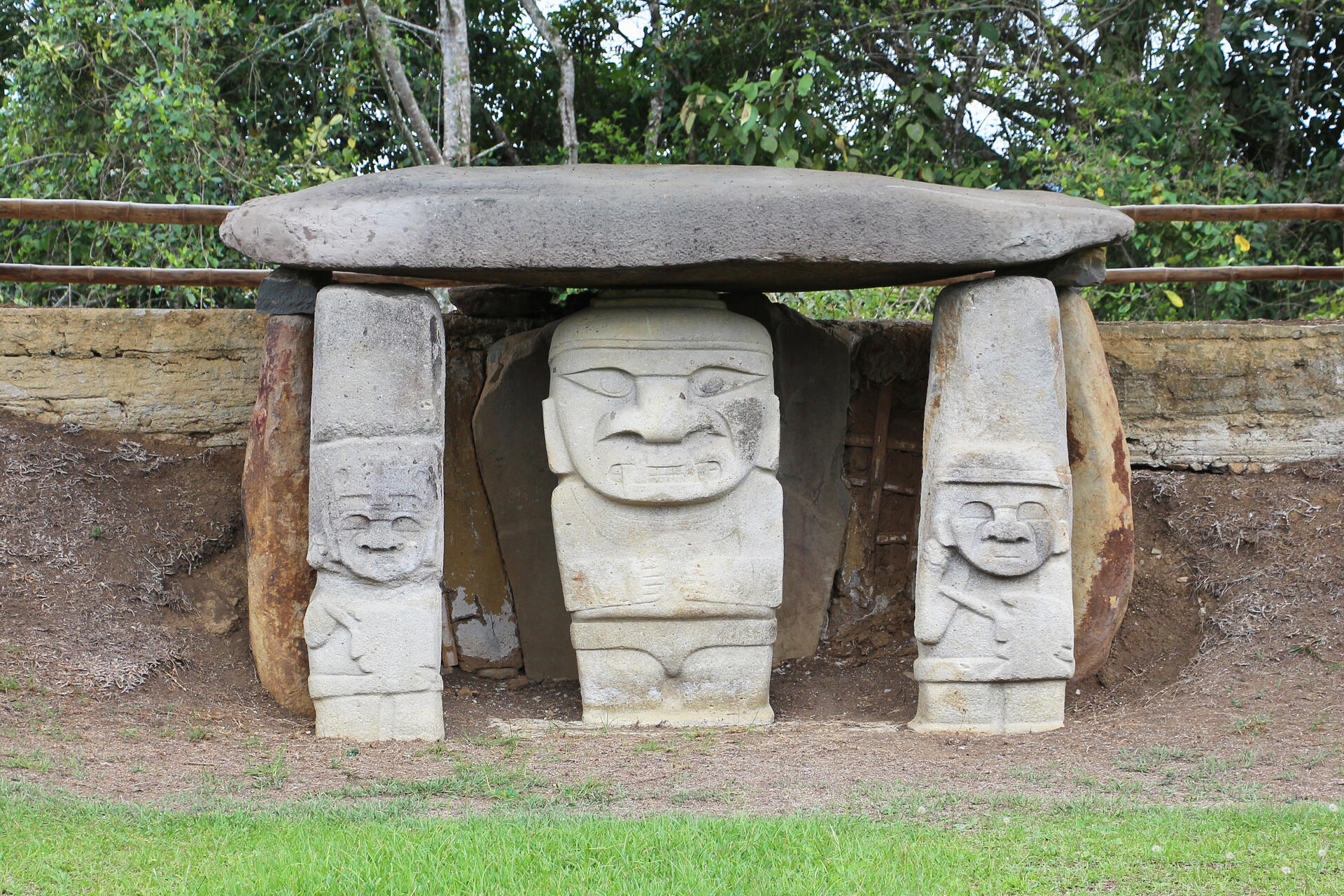
© Bernard Gagnon, CC BY-SA 4.0 Resized from original. (This derivative is under the same CC BY-SA license.)
World Heritage Research
Discover scientific research and academic studies that deepen our understanding of San Agustín Archaeological Park from its history and significance to its conservation, management, and contemporary challenges.
-
Estudio del origen de algunas piezas arqueológicas elaboradas con obsidianas prehispánicas de Colombia usando fluorescencia de rayos X
A groundbreaking X-ray fluorescence (XRF) study reveals that obsidian artifacts from the San Agustín Archaeological Park, Colombia, did not originate from nearby geological sources. Instead, these pre-Hispanic tools and weapons likely traveled long distances through ancient trade networks. Researchers analyzed 21 archaeological pieces dating from the Early Formative to Recent periods alongside geological samples from five Colombian regions and one in Ecuador. The findings demonstrate that local populations relied on obsidians sourced from distant volcanic outcrops, challenging assumptions about regional material use. This study validates XRF as a robust method for tracing provenance in archaeology, offering new insights into pre-Hispanic trade and cultural exchange across South America.
Giovanny Sierra-Vargas, Montes, L., & Almanza, O. (2023). Estudio del origen de algunas piezas arqueológicas elaboradas con obsidianas prehispánicas de Colombia usando fluorescencia de rayos X. https://doi.org/10.5281/ZENODO.7761975
View Publication Record | Read Publication -
Análisis de la competitividad de asociaciones de productores que prestan servicios ecoturísticos en los municipios de San Agustín y Pitalito, departamento del Huila (Colombia)
Rural ecotourism in the UNESCO-listed San Agustín Archaeological Park, Colombia, currently lacks competitiveness despite its significant cultural and environmental potential. A 2015 study analyzing 11 producer associations in San Agustín and Pitalito found that while these communities offer unique heritage resources—including pre-Columbian archaeological sites and the Colombian Massif’s natural beauty—they remain underdeveloped due to limited investment, weak innovation, and gaps in market access. The research, employing a mixed-methods approach with surveys based on competitive tourism management models, evaluated four key areas: innovation capacity, business opportunities, cooperation, and financing. Findings indicate that substantial improvements in infrastructure, training, and partnerships are needed to transform ecotourism into a viable economic driver for rural communities.
Méndez-Pedroza, N. M., Vinasco-Guzmán, M. C.,. (2015). Análisis de la competitividad de asociaciones de productores que prestan servicios ecoturísticos en los municipios de San Agustín y Pitalito, departamento del Huila (Colombia). Libre Empresa, 12(1), 29–44. https://doi.org/10.18041/libemp.v23n1.23102
View Publication Record | Read Publication -
Cien años de la cultura agustiniana: reflexiones acerca de un propósito convertido en despropósito
A critical reflection on the current management of San Agustín Archaeological Park reveals a shift from its original purpose to one marked by discontent, particularly concerning community engagement and political dynamics. The study examines the 2013 declaration of the Year of Augustinian Culture and the controversy surrounding the exhibition 'The Return of the Idols,' highlighting how the Colombian Institute of Anthropology and History (ICANH) has approached conservation and community relations. It frames this analysis through Jacques Rancière's concept of politics as a space for dissent, contrasting it with state/police power structures. The research underscores tensions between heritage preservation efforts and the needs or perspectives of local communities in San Agustín and Isnos.
Isaza Urrego, A. (2015). Cien años de la cultura agustiniana: reflexiones acerca de un propósito convertido en despropósito. CALLE14: Revista de Investigación En El Campo Del Arte, 10(16), 81. https://doi.org/10.14483/10.14483/udistrital.jour.c14.2015.2.a07
View Publication Record | Read Publication -
A New Approach for Documentation, Conservation and Preservation of the Monolithic Statues in San Agustín as Pilot for Outdoor Cultural Heritage Documentation in Colombia
A new approach integrating advanced technologies, particularly 3D modeling, has been successfully applied to document, conserve, and preserve the monolithic statues at San Agustín Archaeological Park in Colombia. The study, conducted by the Instituto Colombiano de Antropología e Historia (ICANH), utilized infrared structured-light (SL) and phase shift (PS) laser scanning technologies to create detailed 3D models of 66 sculptures. While the initial phase identified areas for improvement, such as increasing mesh detail for more precise conservation efforts, it established a robust methodology that can serve as a pilot model for other heritage sites in Colombia. The findings highlight the potential and challenges of using these technologies for outdoor cultural heritage documentation, offering valuable insights for future preservation projects.
Estela, A., & Hamacher, J. (2014). A New Approach for Documentation, Conservation and Preservation of the Monolithic Statues in San Agustín as Pilot for Outdoor Cultural Heritage Documentation in Colombia. The International Archives of the Photogrammetry, Remote Sensing and Spatial Information Sciences, XL-5, 225–229. https://doi.org/10.5194/isprsarchives-xl-5-225-2014
View Publication Record | Read Publication