
World Heritage Identification Number: 1675
World Heritage since: 2023
Category: Cultural Heritage
WHE Type: Infrastructure & Industry
Transboundary Heritage: Yes
Endangered Heritage: No
Country: Tajikistan, Turkmenistan, Uzbekistan
Continent: Asia
UNESCO World Region: Asia and the Pacific
Map
Exploring the Silk Roads: Zarafshan-Karakum Corridor - A Melting Pot of Cultures and Civilizations
The Silk Roads: Zarafshan-Karakum Corridor, inscribed as a UNESCO World Heritage Site in 2023, offers a fascinating glimpse into the rich history and cultural exchanges that took place along one of the most significant trade routes in human history. Stretching over 886 kilometers across Tajikistan, Turkmenistan, and Uzbekistan, this corridor forms a crucial part of the vast Silk Road network that connected East Asia with the Mediterranean world from the 2nd century BCE to the 16th century CE.
More to come…UNESCO Description of the World Heritage Site
The Zarafshan-Karakum Corridor is a key section of the Silk Roads in Central Asia that connects other corridors from all directions. Located in rugged mountains, fertile river valleys, and uninhabitable desert, the 866-kilometre corridor runs from east to west along the Zarafshan River and further southwest following the ancient caravan roads crossing the Karakum Desert to the Merv Oasis. Channelling much of the east-west exchange along the Silk Roads from the 2nd century BCE to the 16th century CE, a large quantity of goods was traded along the corridor. People travelled, settled, conquered, or were defeated here, making it a melting pot of ethnicities, cultures, religions, sciences, and technologies.UNESCO Justification of the World Heritage Site
Criterion (ii): The Zarafshan-Karakum Corridor exhibits an important interchange of human values over a span of eighteen centuries in the heart of Central Asia as demonstrated by the architecture, monuments, town planning, landscapes, arts, and technology of its component parts which reflect diversified cultures, ethnic traditions, beliefs, and technologies in both distinct and fused ways. Being one of the key sections at the centre of the Silk Roads network linking multiple ethnic regions, which has been alternatively controlled by nearby great empires, the Zarafshan-Karakum Corridor clearly demonstrates the diversity of populations, and the cultures and traditions, ideas and beliefs, as well as knowledge and technologies associated with them.
Criterion (iii): The territory of the Zarafshan-Karakum Corridor is overlaid by rich layers of cultural depositions which accumulated throughout history, which is an exceptional testimony to the cultural traditions of the societies that were shaped by the trade and exchanged along the Corridor. These are evidenced by the wealth of the Sogdian merchants as displayed by their luxurious residences, the Sogdian temples with fire altar and murals, the Achaemenid citadels, the early Islamic hypostyle mosques with a large minaret, the rich Sufism buildings after the Great Arab Conquest, the advanced irrigation systems, as well as the wide spectrum of the caravan service facilities that had been provided and maintained by the successive empires controlling the Corridor.
Criterion (v): The Zarafshan-Karakum Corridor is an outstanding example of traditional human settlements and land use that is representative of human interaction with nature. The territory of the Corridor covers diverse geographic areas such as highlands, piedmonts, dry steppes, oases and fertile valleys, and arid-desert zones, which dictated the town planning, architectural designs, agricultural and other production activities. It was also the people’s determination, initiatives, and ingenious designs that transformed the harsh land into one on which populations thrived.
Encyclopedia Record: Silk Roads: Zarafshan-Karakum Corridor
Silk Roads: Zarafshan-Karakum Corridor is a UNESCO World Heritage Site which covers the Zarafshan-Karakum portion of the ancient Silk Road and historical sites along the route. On September 17, 2023, UNESCO designated a 886 km stretch of the Silk Road network in Central Asia as a World Heritage site. The corridor spans Tajikistan, Turkmenistan and Uzbekistan, and includes 31 sites.Additional Site Details
Area: 669.679 hectares
Number of Components: 34
(iii) — Unique or exceptional testimony to a cultural tradition
(v) — Outstanding example of traditional human settlement
Coordinates: 39.4414888889 , 69.6855583333
Image
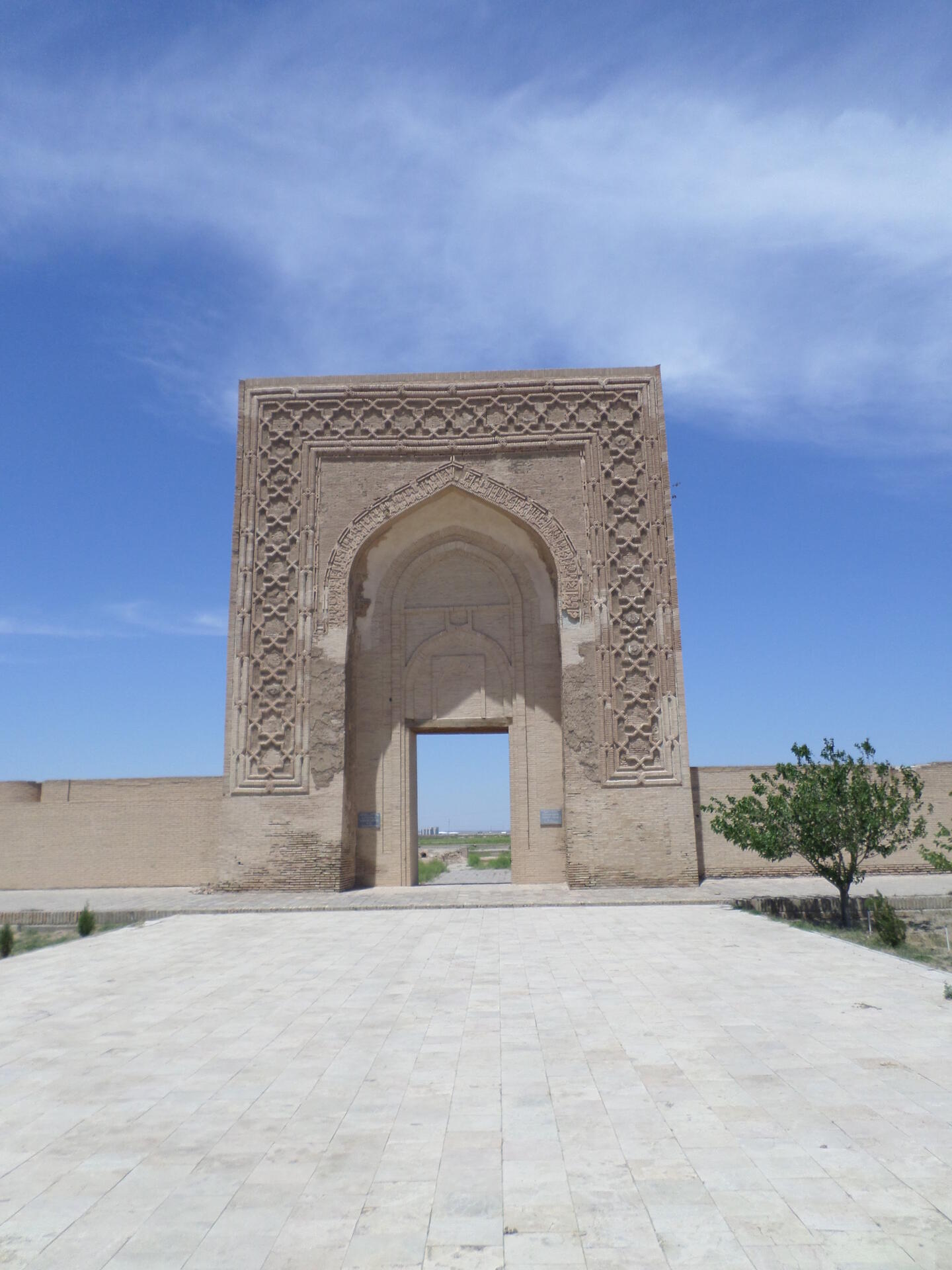
© Bobyrr, CC BY-SA 4.0 Resized from original. (This derivative is under the same CC BY-SA license.)