World Heritage Identification Number: 1141
World Heritage since: 2010
Category: Cultural Heritage
WHE Type: Archaeological Sites
Transboundary Heritage: No
Endangered Heritage: No
Country: 🇹🇯 Tajikistan
Continent: Asia
UNESCO World Region: Asia and the Pacific
Map
Sarazm: A Window into Early Urbanization in Central Asia
The Proto-urban Site of Sarazm, located in north-western Tajikistan, offers a unique glimpse into the early stages of urbanization in Central Asia during the 4th millennium BCE. Inscribed as a UNESCO World Heritage Site in 2010, Sarazm serves as a testament to the development of human settlements in this region, providing valuable insights into the social, economic, and cultural life of its inhabitants.
More to come…UNESCO Description of the World Heritage Site
Sarazm, which means “where the land begins”, is an archaeological site bearing testimony to the development of human settlements in Central Asia, from the 4th millennium BCE to the end of the 3rd millennium BCE. The ruins demonstrate the early development of proto-urbanization in this region. This centre of settlement, one of the oldest in Central Asia, is situated between a mountainous region suitable for cattle rearing by nomadic pastoralists, and a large valley conducive to the development of agriculture and irrigation by the first settled populations in the region. Sarazm also demonstrates the existence of commercial and cultural exchanges and trade relations with peoples over an extensive geographical area, extending from the steppes of Central Asia and Turkmenistan, to the Iranian plateau, the Indus valley and as far as the Indian Ocean.
UNESCO Justification of the World Heritage Site
Criterion (ii): The Proto-urban Site of Sarazm bears testimony, from the 4th millennium BCE, to trade and cultural interchanges between the pastoral nomads of the mountains of Central Asia and the agrarian peoples of Transoxiane. Later, particularly in the Bronze Age, the Proto-urban Site of Sarazm complemented and extended its activities with metallurgy and handicrafts, demonstrating the existence of a network of a diversity of interchanges on a very large scale. The Proto-urban Site of Sarazm had connections with the steppes of Central Asia, and in addition with the Turkmenian, proto-Elamite, Mesopotamian, and Indus worlds.
Criterion (iii): The Proto-urban Site of Sarazm constitutes a remarkable human settlement, exceptional in its geographical situation, in Central Asia, in the 4th and 3rd millennia BCE, to which its proto-urban and architectural remains and its archaeological findings bear witness. The town played a regional role over a long period and on a very large scale in the working of metals, particularly tin and copper, and the associated development of handicrafts to produce tools, ceramics, and jewellery. The Proto-urban Site of Sarazm is one of the places that gave birth to and saw the development of the major trans-Eurasian trade routes.
Encyclopedia Record: Sarazm
Sarazm is an ancient town and also a jamoat in north-western Tajikistan. It dates back to the 4th millennium BC, with C14 dates ranging from 3900-2100 BC, and is today a UNESCO World Heritage Site. The jamoat is part of the city of Panjakent in Sughd Region, and has a total population of 27,877 (2015). It consists of 21 villages, including Chimqal'a, Abdusamad, Bostondeh, Kamar, Kamar-Tash and Sohibnazar.Additional Site Details
Area: 15.93 hectares
Number of Components: 1
(iii) — Unique or exceptional testimony to a cultural tradition
Coordinates: 39.5078888889 , 67.4587222222
Image
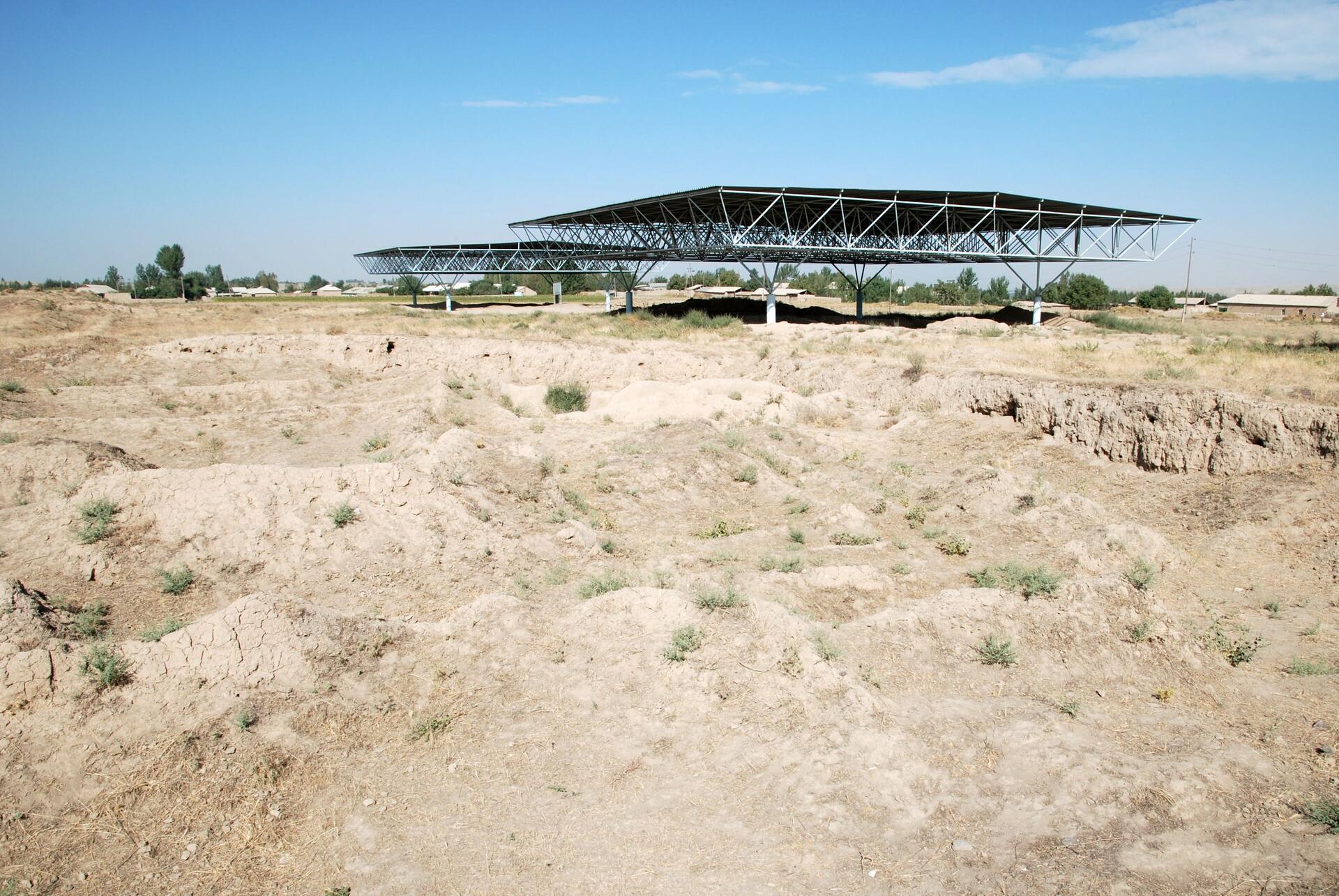
© Bertramz, CC BY-SA 3.0 Resized from original. (This derivative is under the same CC BY-SA license.)
World Heritage Research
Discover scientific research and academic studies that deepen our understanding of Proto-urban Site of Sarazm from its history and significance to its conservation, management, and contemporary challenges.
-
Sug'diyona Hududidagi Ilk Shaharlar va Ularning Mudofaa Devorlari (M.A. IV–I Ming Yilliklar)
Archaeological analysis of early urban settlements in the Sug'diyona region (modern-day Uzbekistan and northern Tajikistan) reveals sophisticated defensive wall systems dating from 4,000 to 1,000 years ago. These structures, examined at sites like Sarazm, Koktepa, and Afrasiab (Samarqand), demonstrate advanced urban planning during the Bronze and Iron Ages, with walls serving as key defenses against nomadic migrations and reflecting Achaemenid imperial influence. The study integrates findings on irrigation, metallurgy, and trade to highlight the region's role in early urbanization, offering new insights into the social and political dynamics of proto-urban development.
Shakirova, M. M. Q. (2025). SUG'DIYONA HUDUDIDAGI ILK SHAHARLAR VA ULARNING MUDOFAA DEVORLARI (M.A. IV–I MING YILLIKLAR). Zenodo. https://doi.org/10.5281/ZENODO.17545249
View Publication Record | Read Publication -
Traditions et renouvellements dans l’approche des anciens systèmes d’irrigation de l’Asie centrale
A groundbreaking geoarchaeological study of the Proto-urban Site of Sarazm in Tajikistan reveals the operational dynamics and maintenance practices of an early Bronze Age high-terrace irrigation canal, providing rare insights into water management strategies in a seismically active region. By analyzing sediment fill through micromorphology, researchers documented how this ancient hydraulic system adapted to environmental constraints, challenging traditional evolutionary narratives that prioritize material production over functional adaptability. The study employs a multidisciplinary approach combining landscape archaeology, photo-interpretation, and excavation techniques, offering a nuanced understanding of pre-urban water governance in Central Asia's arid landscapes.
Cez, L. (2024). Traditions et renouvellements dans l’approche des anciens systèmes d’irrigation de l’Asie centrale. Le Passé Au Fil de L’eau. https://doi.org/10.4000/books.psorbonne.116051
View Publication Record | Read Publication -
Shimoliy Baqtriya va Zarafshon Mintaqalarida Dehqonchilik va Chorvachilik Madaniyati Sohiblari Etnomadaniy Aloqalarining O‘zbek Xalqi Etnogenezi Shakllanishidagi O'rni
A new study reveals the significant role of ethnocultural interactions between agricultural and pastoral communities in shaping the ethno-genesis of the Uzbek people. Focusing on the Proto-urban Site of Sarazm, the research highlights how the migration and settlement patterns of nomadic herders from northeastern regions and their integration with sedentary populations influenced cultural dynamics in Northern Bactria and the Zarafshan Valley. The study provides insights into the historical processes of agricultural expansion and pastoralist movements, emphasizing their lasting impact on the formation of Uzbek ethnic identity. By analyzing archaeological evidence from sites like Sarazm and Sopollitepa, the research offers a nuanced understanding of how these interactions contributed to the cultural and societal development in Central Asia.
Sattorov, N. (2024). РОЛЬ ЭТНОКУЛЬТУРНЫХ СВЯЗЕЙ НОСИТЕЛЕЙ ЗЕМЛЕДЕЛЬЧЕСКОЙ И СКОТОВОДЧЕСКОЙ КУЛЬТУРЫ В СЕВЕРНОЙ БАКТРИИ И ЗАРАФШАНЕ В ФОРМИРОВАНИИ ЭТНОГЕНЕЗА УЗБЕКСКОГО НАРОДА. Ижтимоий-Гуманитар Фанларнинг Долзарб Муаммолари / Актуальные Проблемы Социально-Гуманитарных Наук / Actual Problems of Humanities and Social Sciences., 3(12/1). https://doi.org/10.47390/sp1342v3i12.1y2023n22
View Publication Record | Read Publication -
Étude géoarchéologique du système d'irrigation de Sarazm (IVe-IIIe millénaires av. n. è) : de la gestion de l'eau à la fabrique du paysage fluvial de la moyenne vallée semi-aride et tectoniquement active du Zeravshan (Tadjikistan, Asie Centrale)
A groundbreaking geoarchaeological study of the Proto-urban Site of Sarazm in Tajikistan reveals sophisticated water management practices dating back to 3015 BCE, predating previously assumed timelines. The research demonstrates that an advanced irrigation canal system, fed by the Zeravshan River, was already operational during the late 4th millennium BCE, with evidence of controlled water flow and maintenance practices adapted to seismic disturbances. Using luminescence dating (OSL) and morphotectonic analysis, the study maps a dense network of faults influencing the region's drainage dynamics and landscape evolution. It highlights how Sarazm's development on a Pleistocene terrace was facilitated by strategic irrigation, with subsequent systems active during historical periods, indicating sustained agricultural adaptation in a tectonically active, semi-arid environment.
Cez, L. Étude géoarchéologique du système d’irrigation de Sarazm (IVe-IIIe millénaires av. n. è) : de la gestion de l’eau à la fabrique du paysage fluvial de la moyenne vallée semi-aride et tectoniquement active du Zeravshan (Tadjikistan, Asie Centrale). https://doi.org/10.70675/bfd2e66ez07aez4bf3z83e4z87019026f146
View Publication Record | Read Publication -
Some Aspects of Central Asian Studies in France
French Central Asian studies, rooted in the 18th century, have significantly advanced the understanding of the region's history and culture through archaeological excavations at key sites like Sarazm, Afrasiab, and Ulug Depe. This long-standing tradition involves multidisciplinary research conducted by institutions such as the College de France, INALCO, CNRS, and IFEAC, focusing on archaeology, anthropology, linguistics, and more. Since 1990, there has been a steady development of regional studies in France, covering historical, cultural, and socio-political dynamics across Central Asia.
Ostonov, J. (2024). SOME ASPECTS OF CENTRAL ASIAN STUDIES IN FRANCE. Zenodo. https://doi.org/10.5281/ZENODO.21682905
View Publication Record | Read Publication -
Domestic Crafts from the Eneolithic Sarazm Materials
Archaeological evidence from the Proto-urban Site of Sarazm reveals that domestic crafts played a pivotal role in the Eneolithic economy, complementing agriculture and livestock breeding. The study identifies a diverse range of craft activities—including leatherworking, wickerwork, weaving, woodworking, pottery, and metallurgy—each reflected through specific tools and artifacts found within dwelling complexes. Stone tools linked to farming (e.g., tillage, reaping) and metal items associated with ore processing highlight the sophistication of subsistence strategies during this period. The research underscores Sarazm's advanced economic productivity, blending agricultural dominance with specialized craft production.
G., K., & M., K. (2023). DOMESTIC CRAFTS FROM THE ENEOLITHIC SARAZM MATERIALS. Modern Solutions to Current Problems of Eurasian Archeology, 227–232. https://doi.org/10.14258/msapea.2023.3.47
View Publication Record | Read Publication -
Réparer le canal. Contribution des archives sédimentaires de comblement du canal de Sarazm à l’approche sociotechnique de la gestion de l’eau à l’âge du Bronze en Asie centrale (Tadjikistan, 3e millénaire avant notre ère)
A groundbreaking study reveals that the ancient canal system at Sarazm, dating back to 2500 BCE, was not merely a static structure but a dynamic sociotechnical endeavor. Through the analysis of sedimentary infill archives, researchers uncovered sophisticated practices for water management during the Bronze Age in Central Asia (Tajikistan). These findings challenge traditional views by highlighting the adaptability and technical prowess of early societies in overcoming topographical, hydro-climatic, and seismic constraints. The study employs a geoarchaeological approach, integrating micromorphological analysis to reconstruct the canal's functionality and maintenance, offering new insights into the interplay between human ingenuity and environmental challenges.
Cez, L. (2023). Réparer le canal. Contribution des archives sédimentaires de comblement du canal de Sarazm à l’approche sociotechnique de la gestion de l’eau à l’âge du Bronze en Asie centrale (Tadjikistan, 3e millénaire avant notre ère). Palethnologie, 11. https://doi.org/10.4000/palethnologie.10241
View Publication Record | Read Publication