World Heritage Identification Number: 885
World Heritage since: 2000
Category: Cultural Heritage
WHE Type: Historic Cities & Urban Areas
Transboundary Heritage: No
Endangered Heritage: Yes
Country: 🇺🇿 Uzbekistan
Continent: Asia
UNESCO World Region: Asia and the Pacific
Map
The Historic Centre of Shakhrisyabz: A Glimpse into Timurid Architecture and Culture
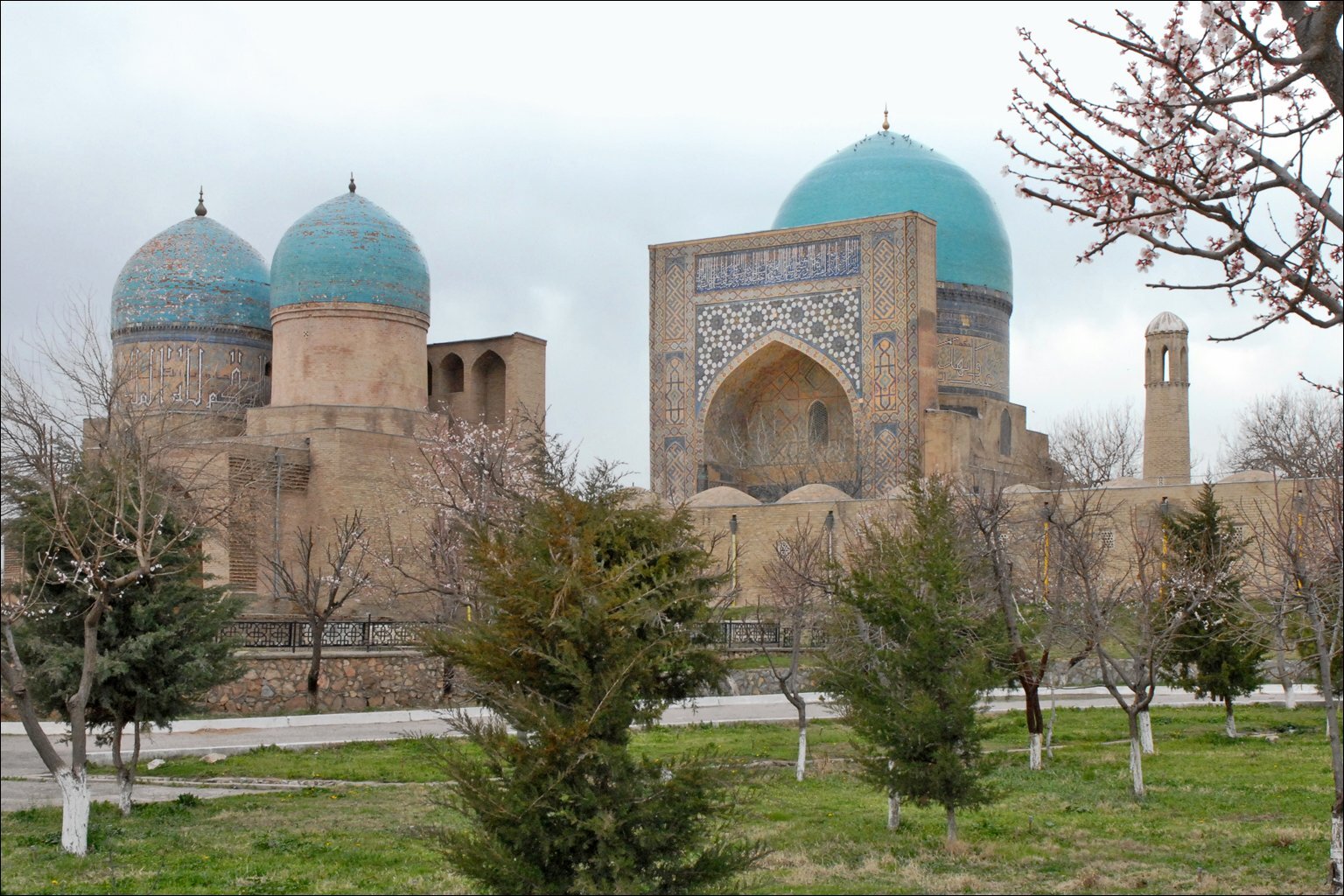
The Historic Centre of Shakhrisyabz, located in the Qashqadaryo Region of southern Uzbekistan, is a captivating testament to the rich history and architectural prowess of the Timurid Empire. Inscribed as a UNESCO World Heritage Site in 2000, this ancient city offers a unique insight into the civilization that flourished under the rule of Amir Timur (Tamerlane) and his successors during the 15th and 16th centuries.
More to come…UNESCO Description of the World Heritage Site
The historic centre of Shakhrisyabz contains a collection of exceptional monuments and ancient quarters which bear witness to the city's secular development, and particularly to the period of its apogee, under the rule of Amir Temur and the Temurids, in the 15th-16th century.
UNESCO Justification of the World Heritage Site
Criterion (iii): Shakhrisyabz contains many fine monuments, and in particular those from the Temurid period, which was of great cultural and political significance in medieval Central Asia.
Criterion (iv): The buildings of Shakhrisyabz, notably the Ak-Sarai Palace and the Tomb of Temur, are outstanding examples of a style which had a profound influence on the architecture of this region.
Encyclopedia Record: Shahrisabz
Shahrisabz, lit. "Green City" in Persian, is a district-level city in Qashqadaryo Region in southern Uzbekistan. The Economic Cooperation Organization (ECO) has selected Shakhrisabz as its tourism capital for 2024.Additional Site Details
Area: 240 hectares
Number of Components: 1
(iv) — Outstanding example of a type of building or landscape
Coordinates: 39.05 , 66.83333
World Heritage Research
Discover scientific research and academic studies that deepen our understanding of Historic Centre of Shakhrisyabz from its history and significance to its conservation, management, and contemporary challenges.
-
Shahrisabz va Qarshi Shaharlardagi Me'moriy Obidalar Muzeylar va Zamonaviy Turizm Masalalari
A critical analysis of the historic architectural landmarks, museums, and contemporary tourism challenges in Shakhrisyabz and Qarshi reveals the transformative potential of infrastructure development, digital marketing, and innovative events to enhance their global appeal. The study underscores how leveraging these elements can preserve cultural heritage while boosting sustainable tourism, offering a model for other UNESCO World Heritage Sites facing similar transitions.
Eshonqulov, D. M. o'g'li, & Normurodov, D. R. (2026). SHAHRISABZ VA QARSHI SHAHARLARIDAGI ME'MORIY OBIDALAR MUZEYLAR VA ZAMONAVIY TURIZM MASALALARI. Zenodo. https://doi.org/10.5281/ZENODO.18303738
View Publication Record | Read Publication -
Analysis of the Constructive Solution of the Dome of the "Kok Gumbaz" Mosque Memorial Monument Located in Shahrisabz
A groundbreaking analysis of the Kok Gumbaz Mosque's dome in Shakhrisyabz reveals sophisticated architectural innovations that integrate structural stability with climatic adaptation. The study identifies key relationships between the dome’s geometry, load-bearing systems, and transitional elements—particularly the squinch-like transitions—that enhance durability while minimizing material use. Findings underscore the mosque’s advanced engineering, offering critical insights for both historic preservation and modern design. By examining wall thickness and material integration, researchers demonstrate how 15th-century techniques remain relevant today.
Razzaqova, S. (2026). ANALYSIS OF THE CONSTRUCTIVE SOLUTION OF THE DOME OF THE "KOK GUMBAZ" MOSQUE MEMORIAL MONUMENT LOCATED IN SHAKHRISABZ. Zenodo. https://doi.org/10.5281/ZENODO.18844319
View Publication Record | Read Publication -
Shahrisabz Davlat Muzey Qoʻriqxonasi Oʻzbekiston Iqtisodi va Turizmga Qoʻshgan Xissasi oid Ayrim Manbalar
Shahrisabz State Museum Reserve significantly enhances Uzbekistan's economic growth and tourism sector by preserving and showcasing its rich historical heritage. Located in one of Central Asia’s ancient historical centers, the reserve—including its archaeological findings and cultural landmarks—plays a pivotal role in boosting the country’s tourism potential. The study highlights how the reserve’s development of tourism infrastructure not only supports local economies but also contributes to the preservation of Uzbekistan’s intangible and material cultural heritage, reinforcing its global significance as a UNESCO World Heritage Site.
Dusmetova, R., & Achilov, O. (2026). SHAHRISABZ DAVLAT MUZEY QOʻRIQXONASI OʻZBEKISTON IQTISODI VA TURIZMGA QOʻSHGAN XISSASI OID AYRIM MANBALAR. Zenodo. https://doi.org/10.5281/ZENODO.18994136
View Publication Record | Read Publication -
Shahrisabz Davlat Muzey Qo'riqxonasi Restavratsiya Faoliyatiga oid Ayrim Manbalar
A groundbreaking initiative at the Shahrisabz State Museum Reserve has successfully integrated conservation, restoration practices, and educational outreach. The study highlights significant advancements achieved between 2024-2026 in preserving cultural artifacts through meticulous laboratory techniques. Key findings emphasize the effectiveness of these methods in maintaining historical integrity while also contributing to pedagogical activities. This research underscores the importance of combining scientific conservation with public engagement, setting a new benchmark for heritage preservation efforts at UNESCO World Heritage Sites.
Olimov Ulug'bek Nabi og'li, (2026). SHAHRISABZ DAVLAT MUZEY QO'RIQXONASI RESTAVRATSIYA FAOLIYATIGA OID AYRIM MANBALAR. Zenodo. https://doi.org/10.5281/ZENODO.19603934
View Publication Record | Read Publication -
Shahrisabz Muzey-qo'riqxonasida Saqlanayotgan Eksponatlarning O'zbek Amaliy San'atidagi O'rni
A collection of 520 applied art items, primarily from the 19th and 20th centuries, housed at the Shahrisabz State Museum-Reserve showcases unique examples of Uzbek national craftsmanship. These artifacts, including Iroqi embroidery, bigizkashta (a type of decorative stitching), metalwork, leaf ornaments, and wood carvings, exemplify the distinctive styles of the Shahrisabz school. They serve as a continuation of Timurid traditions, highlighting the region's rich cultural heritage. The study underscores the significance of these artifacts in preserving and understanding Uzbek applied arts.
Temirov Asadbek, & Xurramov Murodjon, (2026). SHAHRISABZ MUZEY-QO'RIQXONASIDA SAQLANAYOTGAN EKSPONATLARNING O'ZBEK AMALIY SAN'ATIDAGI O'RNI. Zenodo. https://doi.org/10.5281/ZENODO.19606056
View Publication Record | Read Publication -
The Role of Historical Cities of Uzbekistan in Forming the Spatial-planning Structure
Historical cities of Uzbekistan, including Bukhara, Samarkand, Khiva, Shahrisabz, Tashkent, and Kokand, have played a pivotal role in shaping the spatial-planning structure of the region. These cities were strategically established in areas with favorable landscape conditions, abundant natural resources, and developed transport and communication networks. Such factors served as key determinants in defining their spatial structure, functional zoning, and architectural appearance. The study highlights how these historical cities' development was influenced by their geographical advantages, contributing significantly to the region's urban planning heritage.
Fayoza Odilova, Tugalov Abror. (2026). THE ROLE OF HISTORICAL CITIES OF UZBEKISTAN IN FORMING THE SPATIAL-PLANNING STRUCTURE. Zenodo. https://doi.org/10.5281/ZENODO.20273976
View Publication Record | Read Publication -
Shahrisabz Hududidagi Joy Nomlarning Shakllanish Omillari va Rivojlanish Bosqichlari
Toponyms in the Shakhrisyabz region serve as critical markers of historical memory, reflecting the interplay of natural-geographical, historical, ethnic, socio-economic, and cultural factors. This study reveals that toponymic evolution—tracked across distinct developmental stages—preserves national heritage while illuminating semantic and linguistic nuances. By analyzing toponyms in cross-sectional periods, researchers identify their role in shaping territorial identity and cultural continuity. The findings underscore the significance of toponymy as a tool for safeguarding intangible heritage, offering insights into how place names encode layers of history, from ancient origins to modern socio-economic influences.
Almardonova, M. (2026). ФАКТОРЫ ФОРМИРОВАНИЯ И ЭТАПЫ РАЗВИТИЯ ТОПОНИМОВ ШАХРИСАБЗСКОГО РЕГИОНА. Ijtimoiy-Gumanitar Sohada Ilmiy-Innovatsion Tadqiqotlar, 3(5), 493–495. https://doi.org/10.67227/wrv4m858
View Publication Record | Read Publication