
World Heritage Identification Number: 1187
World Heritage since: 2005
Category: Cultural Heritage
WHE Type: Infrastructure & Industry
Transboundary Heritage: Yes
Endangered Heritage: No
Country: Belarus, Estonia, Finland, Latvia, Lithuania, Norway, Republic of Moldova, Russian Federation, Sweden, Ukraine
Continent: Europe
UNESCO World Region: Europe and North America
Map
The Struve Geodetic Arc: A Pioneering Feat in Earth Sciences
The Struve Geodetic Arc, inscribed as a UNESCO World Heritage Site in 2005, stands as a testament to human ingenuity and international cooperation in the field of earth sciences. This remarkable chain of survey triangulations spans an impressive distance of approximately 2,820 kilometers, traversing ten countries from Hammerfest in Norway to the Black Sea.
The Arc's origins trace back to the early 19th century when the astronomer Friedrich Georg Wilhelm Struve embarked upon a groundbreaking project. His objective was to measure a significant portion of a meridian accurately, thereby contributing to the understanding of the Earth's size and shape. While meridian measurements had been attempted earlier on shorter scales, the Struve Geodetic Arc represented the first accurate triangulated measurement of such an extensive meridian arc, marking a major advance in geodesy and cartography.
The Arc consists of 258 main triangles, each containing one or more station points. Initially, there were 265 main station points; however, the current listed site encompasses only 34 of these points, each marked uniquely depending on the terrain—ranging from drilled holes in rocks, iron crosses, cairns, to built obelisks.
The construction of the Struve Arc was no small undertaking, requiring meticulous planning and execution. Over four decades, from 1816 to 1855, surveyors worked tirelessly to ensure the accuracy of their measurements. Their efforts resulted in a precise determination of the Earth's ellipsoidal shape and the length of its meridians.
One of the most striking aspects of the Struve Arc is the level of international collaboration it fostered. Scientists from various nations collaborated on this project, sharing knowledge and resources to achieve a common goal. Furthermore, the project was supported by multiple monarchs, further underscoring the spirit of global cooperation that characterized this endeavor.
Beyond its historical importance, the Struve Geodetic Arc retains substantial scientific and educational value. Although modern geodesy now relies on satellite-based technologies, the Arc remains a foundational achievement in the history of Earth measurement and a benchmark in the development of geodetic science. Moreover, the Arc serves as a powerful symbol of human curiosity, perseverance, and the ability to transcend borders for the pursuit of knowledge.
Today, the Struve Geodetic Arc stands as a UNESCO World Heritage Site, preserving a vital piece of our shared history while continuing to inspire future generations of scientists and explorers. As we look towards the future, the Arc serves as a reminder of what can be achieved when individuals and nations come together in pursuit of a common goal—the expansion of human knowledge.
UNESCO Description of the World Heritage Site
The Struve Arc is a chain of survey triangulations stretching from Hammerfest in Norway to the Black Sea, through 10 countries and over 2,820 km. These are points of a survey, carried out between 1816 and 1855 by the astronomer Friedrich Georg Wilhelm Struve, which represented the first accurate measuring of a long segment of a meridian. This helped to establish the exact size and shape of the planet and marked an important step in the development of earth sciences and topographic mapping. It is an extraordinary example of scientific collaboration among scientists from different countries, and of collaboration between monarchs for a scientific cause. The original arc consisted of 258 main triangles with 265 main station points. The listed site includes 34 of the original station points, with different markings, i.e. a drilled hole in rock, iron cross, cairns, or built obelisks.
UNESCO Justification of the World Heritage Site
Criterion (ii): The first accurate measuring of a long segment of a meridian, helping in the establishment of the exact size and shape of the world exhibits an important step in the development of earth sciences. It is also an extraordinary example for interchange of human values in the form of scientific collaboration among scientists from different countries. It is at the same time an example for collaboration between monarchs of different powers, for a scientific cause.
Criterion (iv): The Struve Geodetic Arc is undoubtedly an outstanding example of a technological ensemble - presenting the triangulation points of the measuring of the meridian, being the non-movable and non-tangible part of the measuring technology.
Criterion (vi): The measuring of the arc and its results are directly associated with humans wondering about their world, its shape and size. It is linked with Sir Isaac Newton’s theory that the world is not an exact sphere.
Encyclopedia Record: Struve Geodetic Arc
The Struve Geodetic Arc is a chain of survey triangulations stretching from Hammerfest in Norway to the Black Sea, through ten countries and over 2,820 kilometres (1,750 mi), which yielded the first accurate measurement of a meridian arc.Additional Site Details
Area: Not available
Number of Components: 34
(iv) — Outstanding example of a type of building or landscape
(vi) — Directly associated with events or living traditions
Coordinates: 59.0577777778 , 26.3377777777
Image
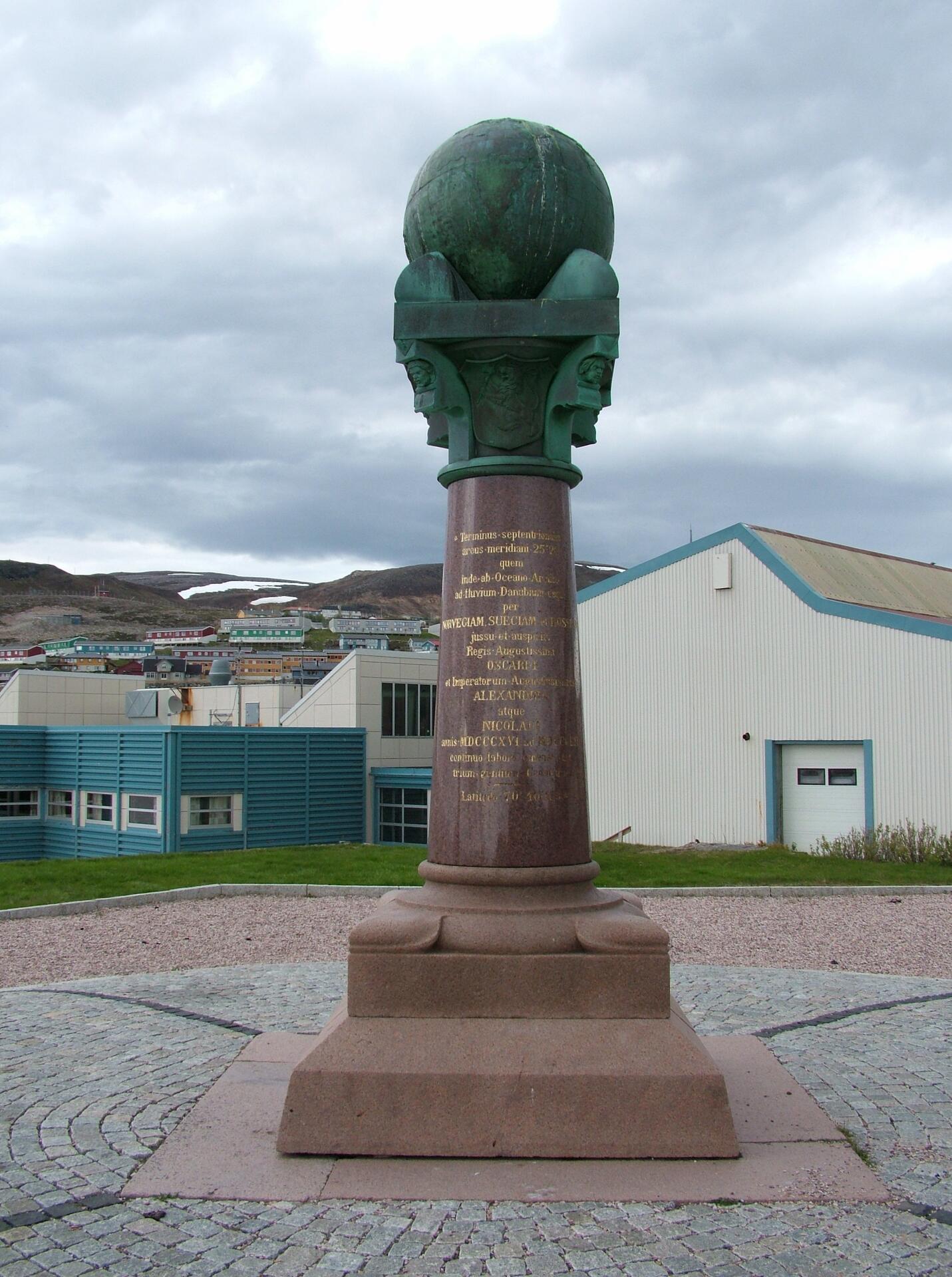
© Clemensfranz, CC BY-SA 3.0 Resized from original. (This derivative is under the same CC BY-SA license.)
World Heritage Research
Discover scientific research and academic studies that deepen our understanding of Struve Geodetic Arc from its history and significance to its conservation, management, and contemporary challenges.
-
On the programs of monitoring studies of space weather based on radio astronomical and magnetometric observations
A comprehensive monitoring program has revealed significant variability in the fluxes of extragalactic radio sources, such as supernova remnants and radio galaxies, linked to space weather effects. Conducted since 1987 using advanced radio telescopes (URAN-4, RT-32, RT-16, LOFAR) and magnetometers across Ukraine, Latvia, Finland, and other regions, this study highlights the impact of solar activity on terrestrial ionospheric conditions. Observations during the 2025 solar eclipses further elucidated local space weather manifestations along the UNESCO-listed Struve Geodetic Arc. The research, supported by the Latvian Council of Science, underscores the importance of multi-national collaboration in characterizing extreme space weather events and their ionospheric effects.
Ryabov, M., Sukharev, A., Usoskin, I., Orlyuk, M., Bezrukovs, V., Steinbergs, J., Romenets, A., & Zabora, D. (2026). On the programs of monitoring studies of space weather based on radio astronomical and magnetometric observations. Proceedings of Baltic Applied Astroinformatics and Space Data Processing — PoS(BAASP2025), 9. https://doi.org/10.22323/1.520.0009
View Publication Record | Read Publication -
Cultural and creative tourism: Moldova's UNESCO heritage as a catalyst for growth
Moldova's UNESCO-recognized heritage, including the Struve Geodetic Arc and intangible cultural traditions, holds significant untapped potential to drive tourism growth and foster cultural preservation. This study is the first to comprehensively assess how Moldova's material and intangible heritage can attract global visitors while supporting local identity and conservation efforts through tourism revenue. By focusing on cultural and creative tourism, the research demonstrates its role as a catalyst for economic development and the sustainable promotion of heritage sites.
Lazar, D., Mischevca, M., & Pnake, E. (2025). Cultural and creative tourism: Moldova’s UNESCO heritage as a catalyst for growth. Modern Paradigms in the Development of the National and World Economy, 407–410. https://doi.org/10.59295/mpdnwe2024.53
View Publication Record | Read Publication -
Spatio-temporal disturbances of the Earth’s magnetic field along the Struve Geodetic Arc
A strong correlation exists between the amplitude of external geomagnetic field variations and the Earth's main magnetic field (BIGRF), with R² values exceeding 0.96, indicating that ionospheric currents are significantly influenced by both the core field and regional magnetic anomalies. The study analyzed a 2024 magnetic storm along the Struve Geodetic Arc, using data from seven observatories to map induction modules at 5 km and 100 km altitudes. Findings revealed that storm intensity increases with latitude, peaking at Pello due to localized anomalous fields (over 90 nT at 100 km), while Mikkelvik experienced minimal disturbances. The research also noted a southern shift in the 2024 storm's maximum compared to a 2003 event, attributed to BIGRF variations of 830–930 nT.
Orlyuk, M. I., Romenets, A. O., Marchenko, A. V., & Orlyuk, I. M. (2025). Spatio-temporal disturbances of the Earth’s magnetic field along the Struve Geodetic Arc. Geofizicheskiy Zhurnal, 47(3). https://doi.org/10.24028/gj.v47i3.323184
View Publication Record | Read Publication -
Balancing Playability and Historical Accuracy in Game Design - Developing the Struve Geodetic Arc Mobile Game
A key insight from developing the Struve Geodetic Arc mobile game is that the interplay between historical accuracy and playability is shaped by resource constraints, timing of research, and developers' roles—often leading to varying degrees of historical fidelity. The study identifies critical challenges in balancing educational value with engaging gameplay, particularly in small development teams where individual decisions influence both design and historical representation. Through thematic analysis of interviews and game documents, researchers reveal that historical knowledge and technological integration must be carefully timed to avoid compromising either accuracy or user experience.
Mustonen, S., Paananen, S., Eckhoff, E., & Colley, A. (2024). Balancing Playability and Historical Accuracy in Game Design - Developing the Struve Geodetic Arc Mobile Game. Proceedings of the ACM on Human-Computer Interaction, 8(CHI PLAY), 1–16. https://doi.org/10.1145/3677060
View Publication Record | Read Publication -
The Reichenbach & Ertel Meridian Circle at the Tartu Old Observatory: Great Moments from the History of a 200 Years Old Instrument
A 200-year-old meridian circle at Tartu's Old Observatory played pivotal roles in groundbreaking astronomical and geodetic projects. The instrument, ordered in 1817/1822, enabled Friedrich Wilhelm Struve to measure the positions of 3220 stars for his seminal binary star catalogue (1827) and contributed to the UNESCO-listed Struve Geodetic Arc. Later, under Ludwig Schwarz's leadership, it facilitated zone observations despite deterioration. Beyond these contributions, the meridian circle served as a tool for timekeeping and astronomer training from 1822 to 1964. This study reconstructs its history using archival sources and primary literature, highlighting its enduring scientific significance.
Leppik, L. (2023). The Reichenbach & Ertel Meridian Circle at the Tartu Old Observatory: Great Moments from the History of a 200 Years Old Instrument. Cahiers François Viète, III-14, 171–189. https://doi.org/10.4000/cahierscfv.4040
View Publication Record | Read Publication -
Methodical framework for developing interactive web maps based on the example of Struve Geodetic Arc UNESCO World Heritage Site
A new methodical framework for developing interactive web maps has been established, addressing gaps in both theoretical and practical aspects of web cartography. This framework integrates user-centered design principles and practical experience to guide the creation of interactive web maps, covering key aspects such as interactivity, accessibility across devices, data structuring, multilinguality, and software selection. The proposed framework was demonstrated through the development of an interactive web map for the Struve Geodetic Arc UNESCO World Heritage Site, showcasing its applicability and effectiveness. Additionally, a new definition for interactive web maps is introduced, contributing to the systematization of principles in this field.
Manerov, M., Syuzyumov, A., & Tyurin, S. (2020). Methodical framework for developing interactive web maps based on the example of Struve Geodetic Arc UNESCO World Heritage Site. InterCarto. InterGIS, 26(4), 228–241. https://doi.org/10.35595/2414-9179-2020-4-26-228-241
View Publication Record | Read Publication -
The Struve Geodetic Arc: the development of the triangulation, technical possibilities, and the initiation of the project
A groundbreaking geodetic project, the Struve Geodetic Arc, successfully measured Earth's ellipsoid parameters using triangulation from the Black Sea to the Arctic Ocean. This study reveals how advancements in triangulation techniques, geodetic instruments, and 18th–19th century Russian Empire policies created ideal conditions for its execution. By analyzing historical scientific progress, technological developments, and political factors, researchers identified key elements that ensured the project's success, contributing to its UNESCO World Heritage Site recognition.
Puziene, R. (2019). The Struve Geodetic Arc: the development of the triangulation, technical possibilities, and the initiation of the project. History of Geo- and Space Sciences, 10(2), 269–277. https://doi.org/10.5194/hgss-10-269-2019
View Publication Record | Read Publication